Best Baking Tools
The essential baking tools are fewer than most starter sets suggest. With a digital scale, measuring cups and spoons, mixing bowls, a silicone spatula, a whisk, two half sheet pans, parchment paper and a cooling rack, you can bake most cookies, bars, quick breads and sheet cakes. Add a few pans and two thermometers, and you're ready for almost any recipe.
Below is the full list, in the order we'd buy it, with what to look for in each.
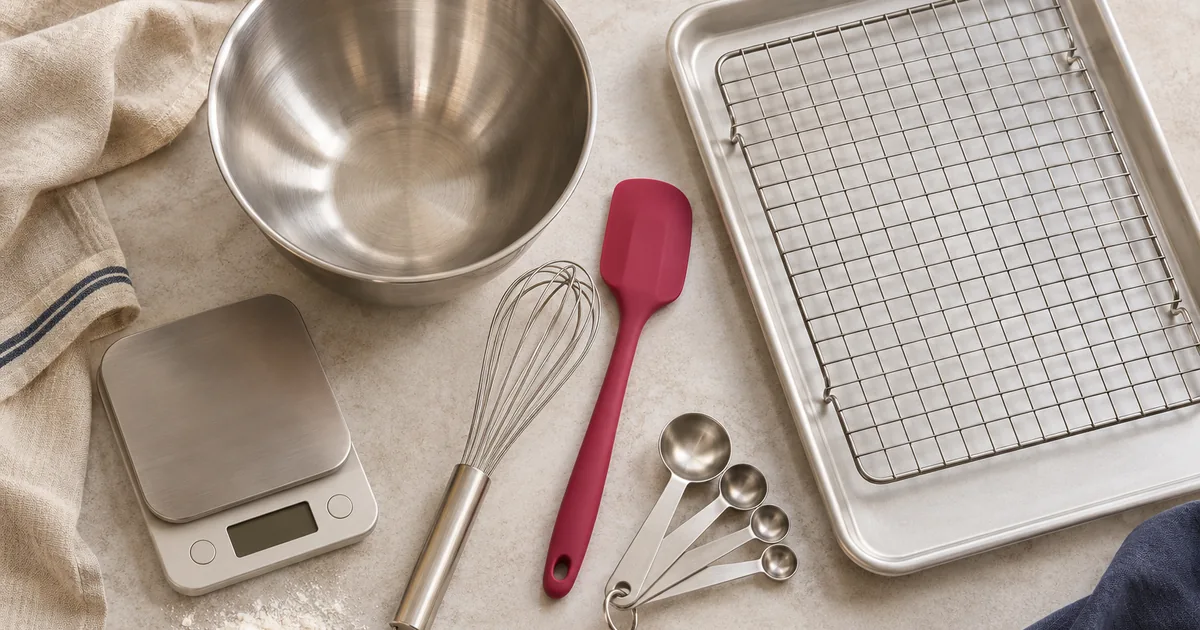
The core kit: buy these first
| Tool | Why you need it | What to look for |
|---|---|---|
| Digital kitchen scale | Weighing is the most accurate way to measure flour and sugar | Grams and ounces, a tare button, at least 11 lb (5 kg) capacity |
| Measuring cups (dry) | For recipes in cups | Stainless steel, engraved markings, flat rims for leveling |
| Liquid measuring cup | Liquids measured at eye level | Glass, 2-cup and 4-cup sizes |
| Measuring spoons | Leaveners, salt, spices | Stainless, narrow enough for spice jars |
| Mixing bowls | Mixing, whisking, proofing | A nesting set of three to five, stainless or glass |
| Silicone spatula | Folding, scraping bowls clean | One-piece, heat resistant to 500°F or more |
| Balloon whisk | Eggs, batter, dry ingredients | Stainless, comfortable handle, about 10 to 12 inches |
| Half sheet pans (×2) | Cookies, sheet cakes, roasting | Heavy-gauge aluminum, rimmed |
| Parchment paper | Nonstick lining for any pan | Unbleached, precut sheets save time |
| Cooling rack | Air under baked goods so bottoms don't steam | Stainless, grid pattern, fits inside a half sheet |
Our baking tools and measuring tools sections compare these.
Pans to add next
As recipes call for them, add:
- A 9 x 13 inch pan for brownies, bars, sheet cakes and casseroles. Metal for cakes and bars, glass or ceramic for casseroles.
- Two 9-inch round cake pans, light-colored aluminum with straight sides. See cake pan materials.
- An 8 or 9-inch square pan for brownies and cornbread.
- A loaf pan, 8½ x 4½ for yeast bread or 9 x 5 for quick breads. See loaf pan materials.
- A 12-cup muffin pan for muffins and cupcakes.
- A 9-inch pie dish, glass or ceramic.
For how materials compare across all of these, see our guide to baking pan materials.
Tools that fix common failures
These don't look essential, but they solve the problems behind most baking disappointments:
- An oven thermometer. Ovens are often 15 to 25 degrees off. If cookies burn or cakes sink, check the oven first.
- An instant-read thermometer. Tells you when bread (about 200 to 210°F inside), custards and cheesecakes are done, and checks water temperature for yeast.
- A bench scraper. Cuts and lifts dough, scoops ingredients and cleans the counter in one pass.
- A fine-mesh sieve or flour sifter. For dusting powdered sugar and sifting cocoa, which clumps.
- A cookie scoop. Even cookies bake evenly. See cookie scoop size.
Nice to have
- A hand mixer for creaming butter, whipping cream and meringue. A stand mixer when you bake often. See the best size KitchenAid mixer.
- A rolling pin, ideally a French tapered pin. See the types of rolling pins.
- A pastry brush for egg wash and butter.
- A microplane for citrus zest.
- An offset spatula for frosting and spreading batter.
- A kitchen timer, since phone timers get dismissed.
- Oven mitts that reach your forearms.
What to skip
- Big boxed tool sets. They usually mix a few useful tools with many you won't use, often in thin metal or plastic.
- Single-use gadgets (egg separators, special brownie cutters) that a spoon or knife does as well.
- Thin, dark nonstick pan sets. They warp and brown unevenly. Buy a few heavy pans instead.
Buying tips
- Weight is a good sign. Heavier pans, bowls and tools usually last longer and work better.
- One-piece is easier to clean. One-piece spatulas and whisks with sealed handles don't trap food.
- Stainless and glass outlast plastic. They don't stain, warp or hold odors.
- Match sizes to your oven. Check that half sheets and pans fit with an inch of space on each side for air to circulate.
Frequently Asked Questions
A digital scale, measuring cups and spoons, a set of mixing bowls, a silicone spatula, a whisk, two half sheet pans, parchment, a cooling rack and a 9 x 13 inch pan.
No. Most recipes work with a hand mixer or even a whisk and a strong arm. A stand mixer helps with bread dough, big batches and long whipping.
A scale gives more consistent results, because a cup of flour can vary in weight by a few tablespoons depending on how you fill it. Measuring cups work fine when a recipe is written in cups and you spoon and level the flour.
For consistency, a digital scale. For avoiding failures, an oven thermometer.