Best Cake Pan Materials
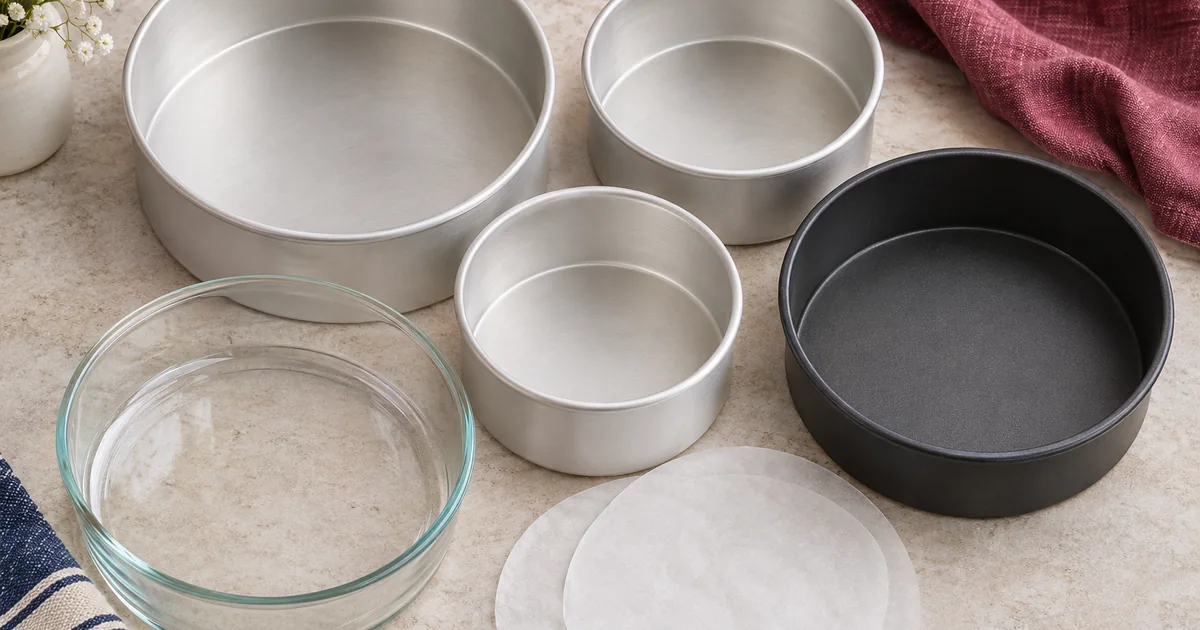
The best cake pan material is light-colored aluminum, ideally anodized aluminum. It heats quickly and evenly, so the batter at the edge and the batter in the middle set at nearly the same time. That gives level layers with thin, golden sides instead of domed tops and dark, dry edges. Fat Daddio's anodized aluminum pans are a common example; Nordic Ware and USA Pan also make light-colored metal pans that bake well.
Here's why the material makes such a difference, and when another material makes more sense.
How a cake pan shapes the cake
Cake batter sets from the outside in. The edges touching the pan get hot first, firm up, and stop rising, while the center keeps climbing. If the edges heat much faster than the center, the cake domes, cracks across the top and dries out at the sides.
A good cake pan narrows that gap. It needs to:
- Conduct heat evenly, so the whole pan is about the same temperature.
- Not absorb too much heat, so the edges don't race ahead.
- Have straight sides, so the layers stack neatly.
Light aluminum does all three. That's also why professional bakers wrap pans in wet cake strips: they slow the edges further for perfectly flat layers.
Cake pan materials compared
| Material | Heat | Browning | Typical result | Best for |
|---|---|---|---|---|
| Anodized aluminum | Fast, even | Light golden | Level layers, tender sides | Layer cakes, cheesecake, sponge |
| Bare aluminum | Fast, even | Light golden | Level layers | Layer cakes; hand wash |
| Aluminized steel | Even | Golden | Very good | Layer and sheet cakes |
| Dark nonstick steel | Fast absorption | Dark | Domed tops, darker sides | Bundt cakes (with care) |
| Glass | Slow, holds heat | Medium to dark edges | Drier edges, slower center | Sheet cakes, snack cakes |
| Ceramic or stoneware | Slow, holds heat | Soft | Moist but slower | Pudding cakes, upside-down cakes |
| Silicone | Insulating | Pale | Soft sides, little crust | Molds, novelty shapes |
Each material, in plain terms
Anodized aluminum
Aluminum treated to form a hard, sealed surface. It's light-colored, doesn't react with acidic batters (lemon, buttermilk, fruit), doesn't discolor, and is easy to clean. For layer cakes, it's the benchmark.
Bare aluminum and aluminized steel
Both bake nearly as well. Bare aluminum can darken in the dishwasher, so wash it by hand. Aluminized steel is stiffer and often has a release coating.
Dark nonstick
Dark coatings absorb more radiant heat, so the outside of the cake sets and browns sooner. Lower the oven by 25°F, start checking 5 to 10 minutes early, and expect slightly darker sides. Nonstick is most useful for Bundt pans, where intricate shapes make release hard; Nordic Ware's cast aluminum Bundt pans are the classic.
Glass
Glass heats slowly, then stays hot. In a 9 x 13 sheet cake that's fine. In a round layer pan, the edges often overbake while the center lags. If a recipe works in metal and you're using glass, reduce the temperature 25°F and bake a little longer.
Ceramic
Ceramic behaves like glass, with a softer, moister edge. It suits upside-down cakes, pudding cakes and cakes served from the dish.
Silicone
Silicone releases well and comes in fun shapes, but it insulates. Cakes brown little and the floppy sides can bulge, so always set silicone pans on a baking sheet. It works best for small cakes and molded desserts.
Shape and size matter as much as metal
- Straight sides, at least 2 inches tall. Sloped or short sides give layers that taper and overflow.
- The recipe's size. An 8-inch round holds about a fifth less batter than a 9-inch round, so swapping sizes changes depth and baking time.
- Square corners on square and rectangular pans give clean edges for sheet cakes and brownies.
- Removable bottoms or springform for cheesecakes and delicate cakes you can't flip.
Before you buy, see our cake pans section. For other pans, our guide to baking pan materials covers the full range.
How to get a clean release in any pan
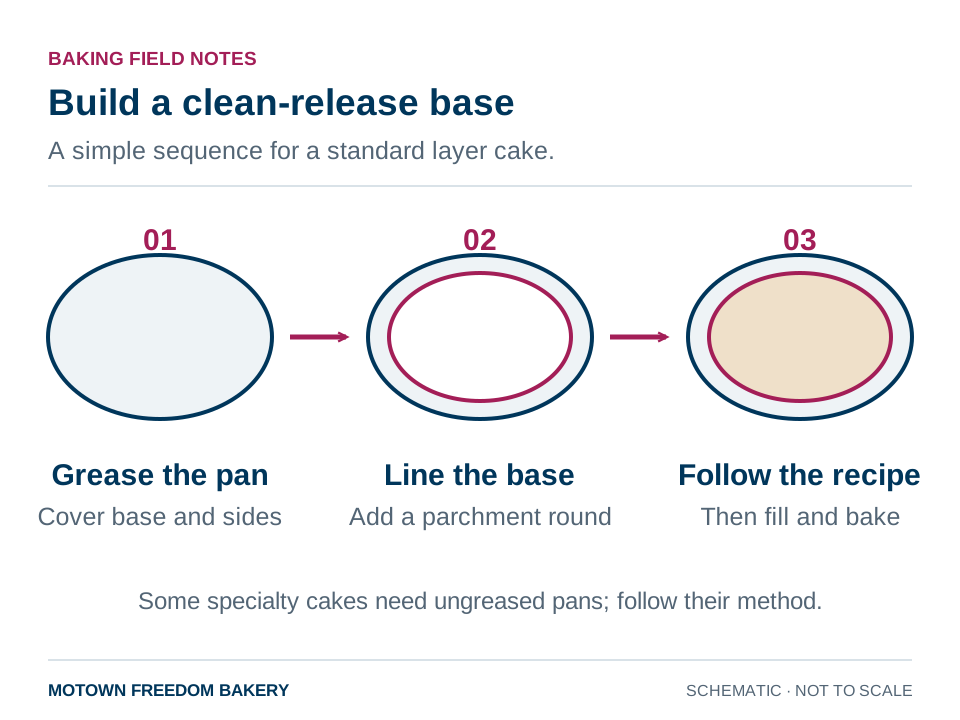
- Grease the pan, including the corners.
- Line the bottom with a parchment circle.
- Grease the parchment and dust with flour, or use a baking spray with flour.
- Cool the cake in the pan for 10 to 15 minutes before turning it out.
Frequently Asked Questions
Light pans. Dark pans brown the edges faster and tend to dome the cake. If you only have dark pans, lower the oven by 25°F.
Yes, especially sheet cakes. Lower the oven by 25°F, and check doneness with a toothpick in the center, since glass keeps the edges hotter than the middle.
Yes. Anodizing creates a hard, sealed oxide layer that doesn't react with food, so it's a good choice if you want uncoated bakeware.
The edges are setting much faster than the center. Use a light aluminum pan, bake at the recipe's temperature or a little lower, and try cake strips around the pan.