Best Bread Baking Tools
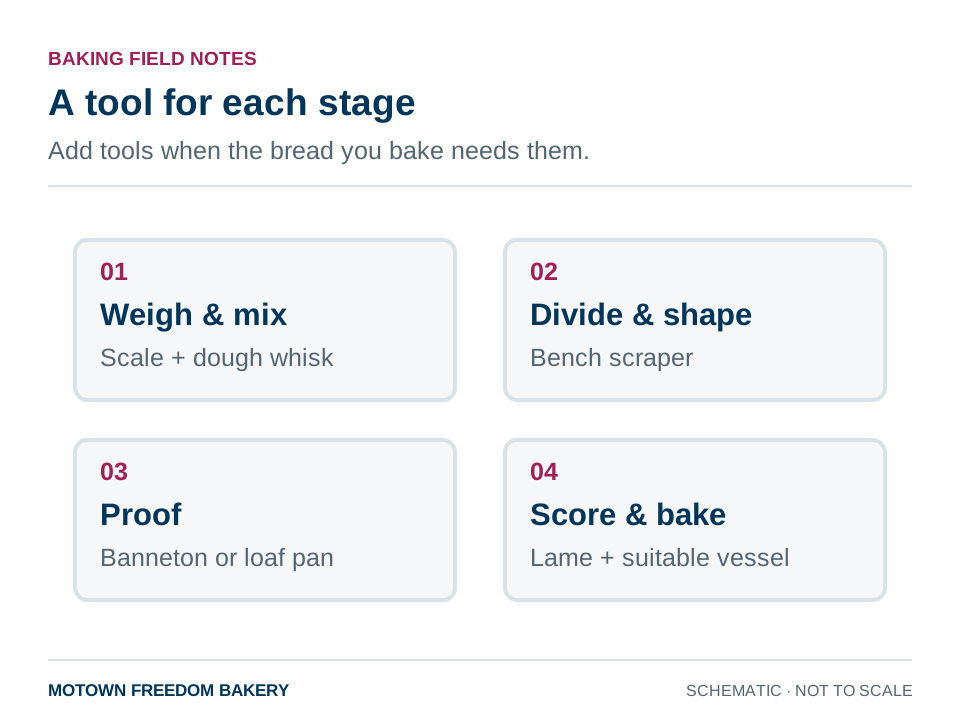
The essential bread baking tools are a digital scale, a large bowl or dough tub, a bench scraper, an instant-read thermometer, a cooling rack and a serrated bread knife. With those and a loaf pan you can bake sandwich bread. For crusty artisan loaves, add a banneton, a lame and a Dutch oven (or a bread pan such as the Challenger).
Here's what each tool does and when you need it.
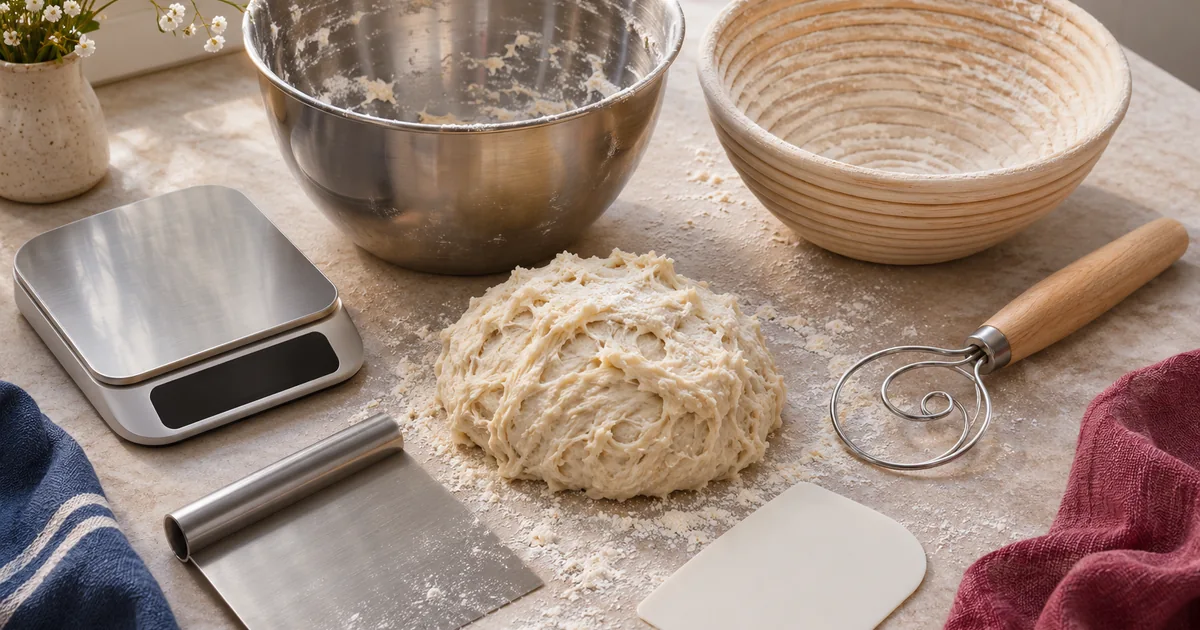
Tools for every kind of bread
| Tool | Why it matters |
|---|---|
| Digital scale | Bread recipes depend on ratios of flour to water. Grams are far more accurate than cups. |
| Large bowl or dough tub | A clear tub with volume markings shows when the dough has doubled. |
| Bench scraper | Divides, lifts and shapes dough, and scrapes the counter clean. |
| Danish dough whisk | Mixes stiff dough without clumping and is easy to clean. |
| Instant-read thermometer | Checks water temperature for yeast and tells you when the loaf is done: about 190°F for enriched breads and 200 to 210°F for lean loaves. |
| Cooling rack | Lets steam escape so the bottom crust doesn't go soggy. |
| Serrated bread knife | A 10-inch or longer blade slices crusty bread without crushing it. |
For sandwich and pan breads
- Loaf pans. Light-colored aluminized steel or aluminum. Use 8½ x 4½ inch pans for yeast bread recipes with about 3 cups of flour; 9 x 5 inch pans give a lower loaf. See loaf pan materials.
- A Pullman pan. A lidded pan that makes perfectly square slices for sandwiches. The 13 x 4 inch size is the most common.
- A pastry brush for egg wash or melted butter.
- A bread slicing guide if you want even slices from a homemade loaf.
For crusty artisan and sourdough loaves
- A Dutch oven or bread pan. A 5 to 6 quart pot traps steam for a high rise and crisp crust. Combo cookers and the Challenger Bread Pan are easier to load. See the best size Dutch oven for bread.
- Bannetons. Rattan or wood-pulp baskets that support the shaped loaf as it proofs and give it a floured spiral pattern. A 9-inch round and a 10-inch oval cover most recipes.
- A lame. A razor blade on a handle for scoring the loaf, which controls where it opens in the oven.
- Parchment paper. For lowering the loaf into a hot pot without burning your hands.
- A baking stone or steel. For baguettes and loaves too large for a pot. See pizza stone materials.
- A linen couche. Supports baguettes while they proof.
For managing rise and fermentation
- A proofer. The Brød & Taylor Folding Proofer holds dough at a set temperature, which makes rise times predictable year-round.
- A starter jar (for sourdough), straight-sided glass with a loose lid.
- An oven with a light. Turning on just the oven light creates a warm spot that works as a basic proofer.
For mixing
Most bread can be mixed by hand with a dough whisk and a few minutes of kneading or a series of folds. A machine helps with stiff and enriched doughs:
- A stand mixer with a dough hook handles brioche, bagels and big batches. Bowl-lift models are steadier with heavy dough; see our stand mixers section.
- A bread machine mixes, kneads, proofs and bakes with almost no effort, or can just make the dough. Compare models in our bread machines section.
- A food processor kneads small batches in about a minute.
For storing bread
- A bread box keeps loaves fresher than plastic bags and keeps the crust from going soft.
- Linen bread bags for crusty loaves you'll eat within a day or two.
- Freezer bags for slicing and freezing, which preserves bread better than the refrigerator.
Where to start
- Total beginner: scale, bowl, bench scraper, loaf pan, cooling rack and bread knife.
- Moving to artisan loaves: add a Dutch oven, a banneton and a lame.
- Regular baker: add a proofer, a second banneton shape and a dough tub.
- Enthusiast: a grain mill for fresh flour, a baking steel, a couche and a stand mixer for enriched doughs.
You'll find bannetons, lames and Dutch ovens in our bread and sourdough tools section.
Frequently Asked Questions
At minimum: a bowl, a scale or measuring cups, a loaf pan or a baking sheet, and an oven. A bench scraper, a thermometer and a cooling rack make the results more reliable.
Only for crusty free-form loaves. Sandwich bread bakes in a loaf pan. Without a Dutch oven, a baking stone with a pan of hot water on the rack below also creates steam.
No. Hand mixing and folding works for most lean doughs. A stand mixer helps with enriched doughs such as brioche, stiff doughs such as bagels, and large batches.
Check the internal temperature with an instant-read thermometer: about 190°F for soft, enriched loaves and 200 to 210°F for lean, crusty loaves.