Best Size Dutch Oven for Bread
The short answer: a 5 to 6 quart round Dutch oven is the best size for most home bread. It holds the classic loaf made with about 500 grams of flour (roughly 4 cups), leaves enough room for the dough to spring up and out, and still fits on the middle rack of a standard oven with the lid on.
That covers most recipes, including the basic no-knead loaf and most sourdough recipes written for home bakers. If you bake smaller or larger loaves, or prefer an oval batard to a round boule, the right size shifts. The rest of this guide shows how to match the pot to the loaf you actually bake.
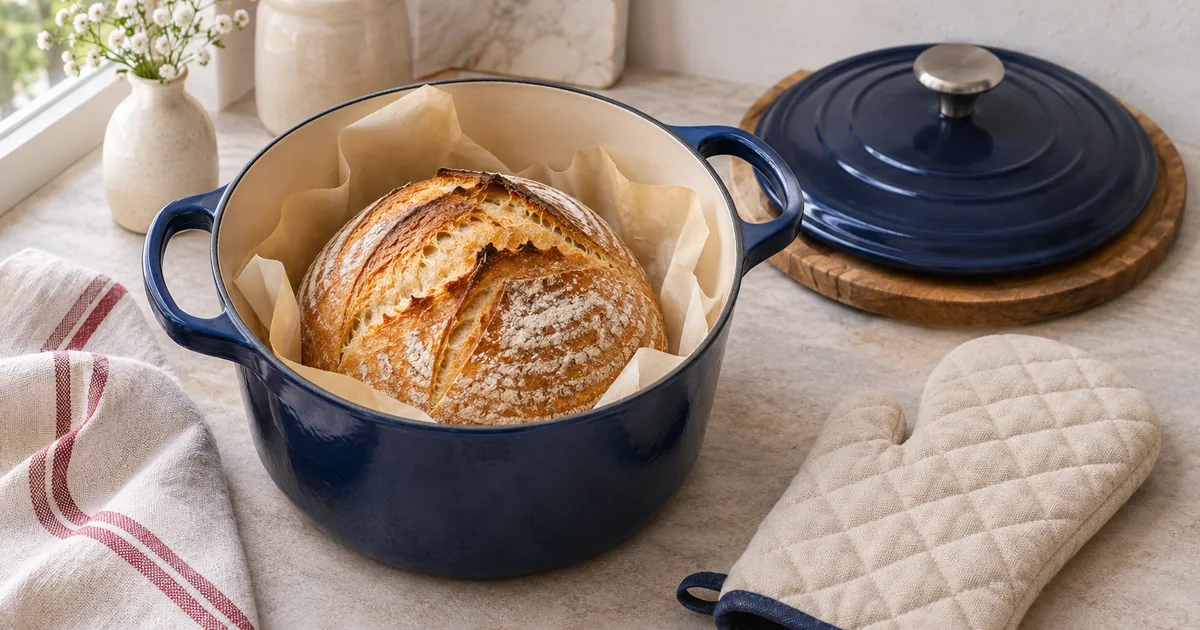
Why a Dutch oven bakes better bread
A loaf needs steam in its first 15 to 20 minutes in the oven. Moist air keeps the crust soft long enough for the dough to expand, which is what bakers call oven spring. It also lets the scored cut open into a clean "ear" and gives the crust its shine.
Professional deck ovens inject steam. A home oven vents it away. A Dutch oven solves this by trapping the steam that comes off the dough itself inside a small, closed space. The heavy walls also store heat and pass it into the loaf from all sides, much like the floor of a bread oven.
So the pot has two jobs: hold enough steam close to the dough, and leave enough room for the loaf to grow. A pot that is too big lets the steam spread out and the dough slump sideways. A pot that is too small squeezes the loaf, so it hits the lid or the walls and bakes into an odd shape.
Dutch oven size chart for bread
Bread recipes are usually written by flour weight, so that is the easiest way to pick a size. The dough weighs a bit less than twice the flour once water, starter and salt go in.
| Flour in the recipe | Approx. dough weight | Round pot | Oval pot |
|---|---|---|---|
| 300 to 400 g (2½ to 3¼ cups) | 550 to 750 g | 3.5 to 4.5 qt | 4 to 5 qt |
| 450 to 550 g (3½ to 4½ cups) | 800 to 1,000 g | 5 to 6 qt | 6 to 7 qt |
| 600 to 700 g (5 to 5½ cups) | 1,100 to 1,300 g | 6 to 7 qt | 7 qt |
| 750 g or more (6 cups +) | 1,350 g + | 7 qt + | 7 to 8 qt |
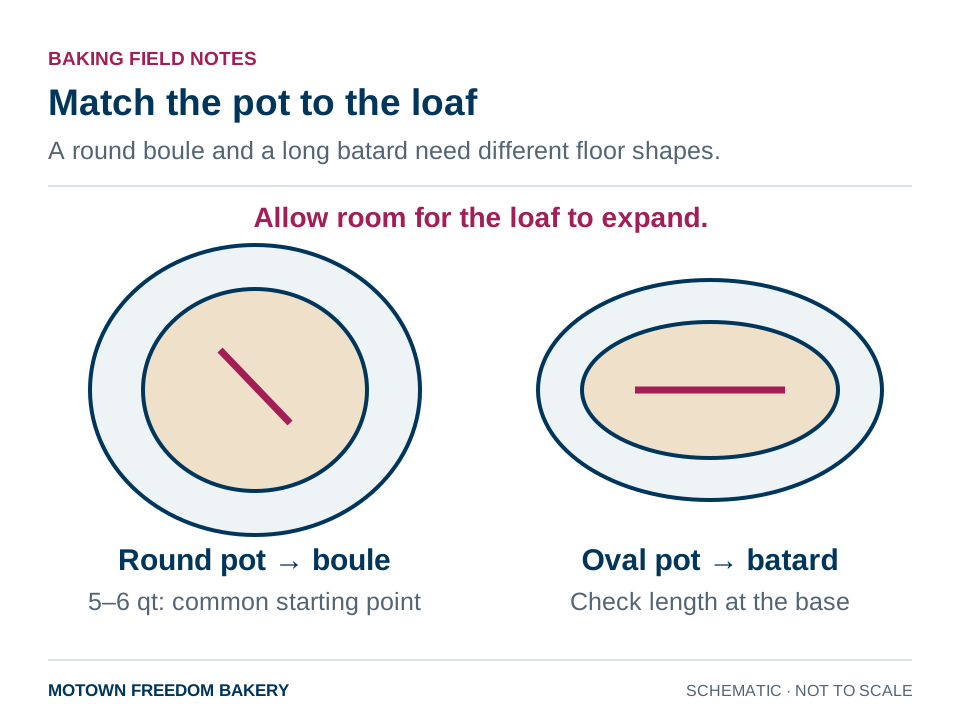
Two rules sit behind the chart. First, leave about 1 to 2 inches of space between the shaped dough and the wall all the way around. Second, the inside height should be at least 4 inches, or a tall loaf will touch the lid.
Diameter matters more than quarts
Quart sizes are measured to the brim, but bread only uses the bottom of the pot. Two pots sold as 5.5 quarts can have different floors: a wide, shallow one gives the dough more room to spread than a narrow, deep one.
So check the inside floor diameter. For a 500-gram loaf, look for about 9 to 10 inches across the bottom. A banneton for that loaf is usually 8 to 9 inches, so the proofed dough drops in with room to spare.
Round or oval
Match the pot to the shape you bake most.
- Round pots fit boules, the round loaf most beginner recipes make. They also fit a round banneton and work for soups and braises, so a round pot is the easier one to justify in a small kitchen.
- Oval pots fit batards, the longer loaf that slices into more even sandwich pieces. An oval pot needs to be 6 to 7 quarts to give a 500-gram batard room at both ends.
If you only want one pot, choose round. An oval loaf can bake in a large round pot, but a round loaf rarely fits an oval pot well.
Pot shapes made for bread
A standard Dutch oven has one problem for bread. You lower a wobbly, proofed loaf into a 450°F pot with tall walls, and it is easy to burn a wrist or knock the dough out of shape. Several designs fix that by flipping the pot.
- Combo cookers. A shallow skillet base plus a deep pot that works as the lid. The Lodge Cast Iron Combo Cooker is 3.2 quarts and fits loaves up to about 500 grams of flour if they are shaped tight. You slide the dough onto the low base, then cover it.
- Double Dutch ovens. The Lodge 5 Quart Double Dutch Oven has a lid that doubles as a shallow skillet, so you can bake on the lid and use the pot as the cover.
- Bread pans and cloches. The Challenger Bread Pan is a cast iron base and tall lid sized for both boules and batards. Ceramic cloches from makers such as Emile Henry work the same way and are lighter.
These shapes are why many bakers who already own a regular Dutch oven still buy a bread-specific one. The loaf comes out the same; loading it is simply easier and safer. You'll find these alongside bannetons and lames in our bread and sourdough tools section.
Material: cast iron or enameled
Both work. The size advice above holds for either.
- Bare cast iron (Lodge is the common example) is affordable and can go into a hot oven empty for preheating without risk. It needs to stay seasoned, and it is heavy: a 5-quart pot weighs around 13 pounds.
- Enameled cast iron (Le Creuset, Staub, and many lower-cost brands) needs no seasoning and is easier to clean. Check two things before you buy. Some lid knobs are only rated to 375°F or 400°F, below normal bread temperatures, so look for a metal knob. And preheating any enameled pot empty for long periods can craze the enamel over time, so some bakers keep a sheet of parchment or a light layer of cornmeal in the base.
A Le Creuset size 26 round (5.5 quarts) is one of the most common enameled pots used for bread, and it matches the 5 to 6 quart sweet spot.
Signs your pot is the wrong size
- The loaf is flat and wide. The pot is too big, or the dough was underproofed. With a big pot, the dough spreads before the crust sets.
- The top crust is pale or pressed flat. The loaf touched the lid. Use less dough or a taller pot.
- One side is lopsided. The loaf hit a wall as it rose. Center it on parchment, or size up.
- The bottom burns. This is usually heat, not size. Put a baking sheet on the rack below the pot or slide a second sheet of parchment under the loaf.
Frequently Asked Questions
Yes, if you scale the loaf down to about 350 to 400 grams of flour. A full 500-gram loaf usually touches the walls or the lid of a 4-quart pot.
Not for big loaves of 650 grams of flour or more, or for long batards in an oval 7-quart pot. For a standard 500-gram boule, the loaf tends to spread more in a 7-quart round pot, though it still bakes well if the dough is shaped tightly.
Most recipes preheat the pot with the oven for 30 to 45 minutes so the loaf meets a hot surface. Some bakers start in a cold pot to avoid handling hot cast iron; the crust is a little softer, but the loaf still bakes well.
Usually 20 minutes with the lid on to hold the steam, then 15 to 25 minutes with it off to brown the crust. The bread is done when the inside reaches about 205 to 210°F.