The 8 Best Pizza Peels of 2026

The first time you try to slide a raw pizza off a peel, you find out fast whether you bought the right one. The dough either glides off or it bunches, sticks, and drags a half-folded mess across a screaming-hot stone. A peel is really two tools in one — the surface that launches the pie and the paddle that turns and retrieves it — and the wrong blade size or material turns pizza night into a rescue operation.

I've made pizza at home for years and landed on a simple rule: wood launches, metal turns. We put that rule to 14 peels — aluminum, stainless, perforated and wood, fixed handles and folding — on real Friday nights.

Two things surprised me. A rough blade grabbed dough that a smooth one let slide, and a peel an inch too wide for the oven was worse than one that was slightly small. Start with blade size and material, then think about where it lives between pizzas, which is where a folding handle earns its keep.

Our Top Picks

The Best Pizza Peels

1

Chef Pomodoro Aluminum Pizza Peel Best Overall
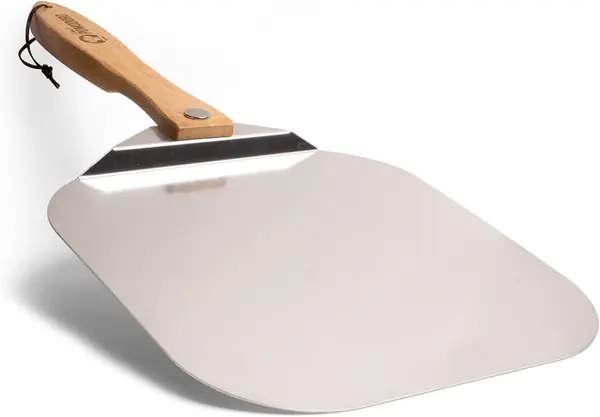
Chef Pomodoro aluminum pizza peel with folding pine handle and thin tapered blade

Everyday home pizzas

Bake Score 96/100
Material
Aluminum
Blade Size
12 x 14 in
Overall Length
24 in
Handle
Foldable wood
View on Amazon

The front edge is where a peel earns its keep, and this one tapers thin enough to slide under a pie that has already settled on a hot stone. The 24-inch overall length keeps our hands clear of a 500°F oven, and the 12-by-14-inch head is sized for a normal home pie without turning into a barn door inside a narrow oven. We handed it to people on their first pizza night and it behaved: dust it, shake once to check the dough is loose, and the pie goes in without drama.

The folding handle is why it lives in a drawer instead of on a hook. It is a knob you loosen and swing rather than a latch that clicks, so it takes a couple of seconds and a little wrist work — the trade for a peel that stows in the same drawer as your stone.

Two details showed up in use. The raised backstop that stops a pie sliding off the far end can catch on the stone's front lip as you pull back, so lift slightly on the way out. And the nonstick surface is doing less work than the flour: a wet dough still grabs if you skimp on semolina.

The 12-inch blade width is the real boundary. It is shaped for the 10- to 12-inch pies most people actually stretch, and if yours routinely run to 14 inches, the 16-inch wooden board here is the better shape for the job.

Worth Noting

  • Hand wash only, unlike the stainless pick
Our Verdict

Our first recommendation for home pizza makers: a genuinely thin aluminum edge, real reach, and a handle that folds into the same drawer as your stone.

Check Latest Price
2

Checkered Chef Stainless Steel Pizza Peel Best Dishwasher-Safe

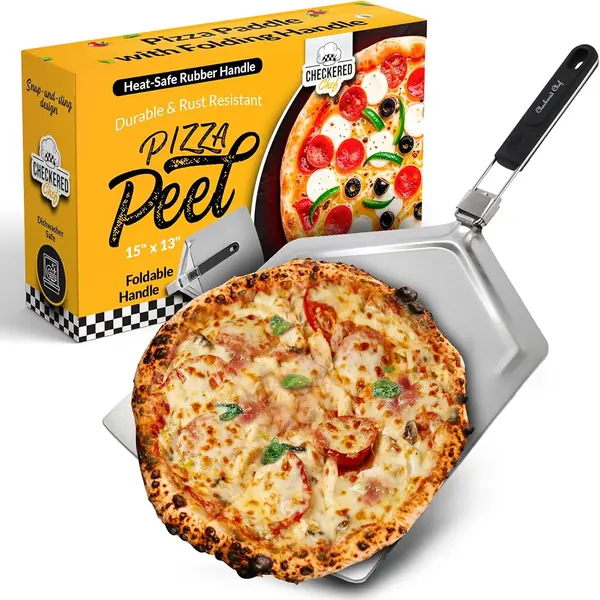
Checkered Chef stainless steel pizza peel with folding handle and teardrop blade

Small kitchens

Bake Score 95/100
Material
Stainless steel
Blade Size
13 x 15 in
Handle
Foldable
Care
Dishwasher safe
View on Amazon

Stainless steel plus a dishwasher-safe rating is the whole pitch here, and it is a real advantage: this is the only peel in the group you can rinse and load into the machine instead of drying it by hand at the sink. The head folds down against the handle, so it goes into a cabinet rather than hanging over the counter.

The 13-by-15-inch head is the widest of the folding peels here, and that extra inch shows up when a 13-inch pie sits fully on the blade instead of overhanging the front edge as you walk it to the oven. Stainless is also stiffer than the aluminum peels in this group, so a loaded pie does not flex on the way in, and the folding joint locks up solid when it is open.

At 1.5 pounds it is light enough to work one-handed, and the rounded corners of the teardrop head give you a place to start when a crust has welded itself to the stone. It is the peel we leave out on the counter rather than folded away.

Worth Noting

  • Needs a flour dusting to release wet dough
Our Verdict

We reach for this one when the sink is already full: it is the only peel here that goes in the dishwasher, and the wide 13-inch head holds a bigger pie.

Check Latest Price
3

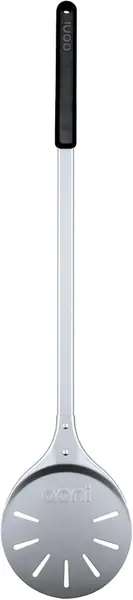
ooni 12-Inch Perforated Pizza Peel Best Splurge

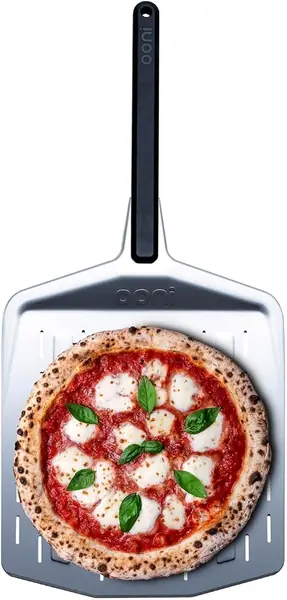
ooni 12-inch perforated aluminum pizza peel with long handle and slotted blade

High-heat ovens

Bake Score 94/100
Material
Perforated aluminum
Blade Size
12 in
Overall Length
25 in
Weight
1.1 lb
View on Amazon

The holes are the point. Slits and ridges across the 12-inch blade let excess flour and semolina fall away instead of riding into the oven with the pie, and they give steam somewhere to go in the first minute — the two things that leave a stone gritty and a base soggy.

Ooni builds its ovens to run up to 950°F, and the long handle is made for that: you stand back and reach in rather than leaning into the mouth. At just over a pound it is light enough that a loaded 12-inch pie does not drag your wrist down as you turn it.

For a high-heat oven, this is the best launching peel in this group. The perforations do what the marketing claims — less loose flour on the stone means fewer burnt patches under the next pie — and the blade is thin enough to slide under a crust that has already set. It is the one we reach for when the oven is above 700°F.

What you pay for is the specialization. This is the most expensive launching peel here, and its advantages show up mainly above 700°F; in a home range that tops out around 550°F, the perforations buy much less.

Worth Noting

  • Snug fit in a 12-inch oven opening
  • Holes take a brush to clean
Our Verdict

Buy it if your oven runs above 700°F: the perforations keep loose flour off the stone, and the thin 12-inch blade launches a set crust cleanly.

Check Latest Price
4

ooni 7-Inch Turning Peel Best for Turning

ooni 7-inch turning peel with perforated aluminum disc and long nylon handle

Turning hot pies

Bake Score 93/100
Material
Anodized aluminum
Blade Size
7 in
Overall Length
31.5 in
Handle
Glass-reinforced nylon
View on Amazon

A 7-inch disc looks like a novelty next to a full-size peel until you watch someone try to rotate a pie with a 12-inch blade and drag half the toppings off. This one slips under the edge of a cooking pizza, lifts it a few inches, and spins it, so the pie stays on the stone where it belongs in an oven that hot. It is the tool that keeps one side of the crust from charring before the other side sets.

Thirty-one inches of handle and a glass-reinforced nylon grip keep your arm outside the mouth of a 900°F oven, and at a pound it is light enough to hold in one hand while you check the underside. The perforations do the same flour-shedding job as the full-size version.

It will not launch or retrieve a whole pie, so this is a second purchase rather than a first peel — you still need a full-size blade beside it. For anyone cooking at 800°F and up, it is the second purchase that decides whether the crust comes out even.

Worth Noting

  • Handle has more flex than the peel head
Our Verdict

A second peel worth owning for anyone cooking at 800°F and up — it turns a pie in place, which is the difference between an even crust and a burnt shoulder.

Check Latest Price
5

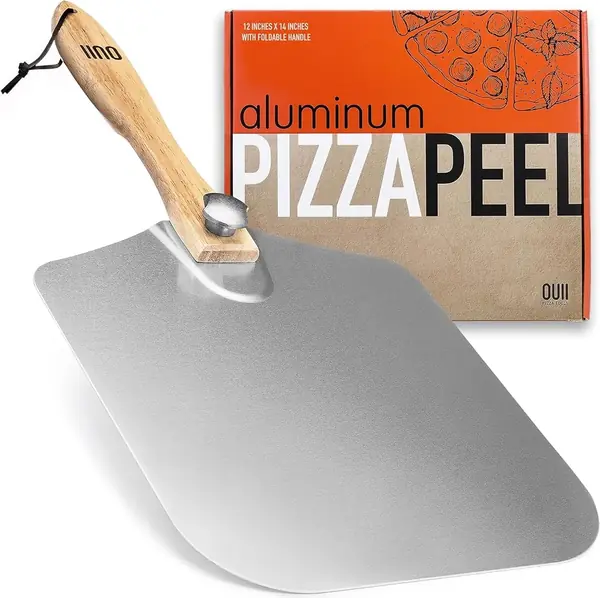
OUII Aluminum Pizza Peel Best Budget

OUII aluminum pizza peel with folding wooden handle and 12-by-14-inch blade

Tight budgets

Bake Score 92/100
Material
Aluminum
Blade Size
12 x 14 in
Overall Length
25 in
Weight
1.3 lb
View on Amazon

This is the least expensive of our picks, and nothing about it reads as a compromise: 12 by 14 inches of aluminum, a wooden handle that folds, and a front edge that tapers thin enough to get under a set crust.

At 1.3 pounds it is the lightest peel in this group, which matters more than it sounds. You hold a loaded peel at arm's length, and a few ounces turn into a tired wrist by the fourth pie of the night. The handle extends to 25 inches and locks with a metal knob that stays snug in use.

The blade has stayed flat through a run of pies, and the fold lets it stand in a drawer instead of hanging. What it does not have is the perforations of the ooni peel or the dishwasher rating of the stainless one; it is the plain, light, inexpensive peel that does the job.

Worth Noting

  • Knob at the handle joint sits proud and can catch
Our Verdict

We point budget-minded shoppers here: the lightest peel in the group, thin enough to launch with, and the least expensive of our picks.

Check Latest Price
6

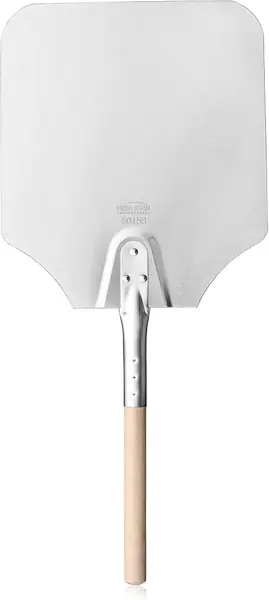
New Star Aluminum Pizza Peel Best Solid Handle

New Star aluminum pizza peel with riveted blade and solid wood handle

Frequent pizza nights

Bake Score 91/100
Material
Anodized aluminum
Blade Size
12 x 14 in
Handle
Solid wood
Weight
1.2 lb
View on Amazon

No hinge, no knob, no folding joint: this is the restaurant version of the tool, with an anodized aluminum blade riveted in three places to a solid wood handle. If a folding peel has ever loosened up on you mid-launch, that construction is the answer.

The blade is slim enough to work under a crust and stiff enough that a loaded pie does not bow in the middle — we have carried rounds on it that made the folding peels flex. The handle is long, long enough that shortening it is a real option for a tight kitchen, and it keeps your hand back from the heat.

What you give up is a little money next to the folding aluminum peels, and what you get is a joint that never needs tightening and a blade that stays flat. This has become the peel we reach for when the pie is heavy and the oven is hot.

Worth Noting

  • Long fixed handle needs wall or corner storage
Our Verdict

Our choice when a folding joint has burned you before: a riveted blade that stays flat and a handle that never needs tightening.

Check Latest Price
7

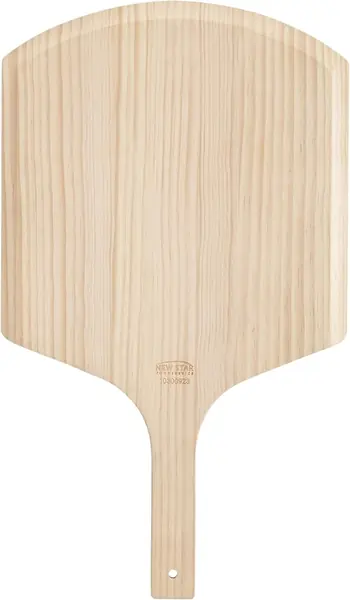
New Star Wooden Pizza Peel Best for Large 16-Inch Pies

New Star wooden pizza peel with wide pine board and short wooden handle

Large 16-inch pies

Bake Score 90/100
Material
Pinewood
Blade Size
16 x 14 in
Care
Hand wash
Handle Length
8 in
View on Amazon

Ours arrived rougher than a peel should be: the grain stood up across the face and a dough ball dragged instead of sliding. A few minutes with fine sandpaper and a wipe-down fixed it, and after that the board did what wood is supposed to do — hold a dusting of flour and release a wet dough that metal would grab.

Sixteen inches of width is the reason to buy it. A big round sits entirely on the board with room to spare, so you are not chasing the edge of the crust as you slide it in, and the tapered front edge works under a pie that is already dressed.

Wood charges upkeep. This one is hand wash only and needs to dry flat and promptly, because a pine board that soaks will warp or split, and pine is soft enough that a carelessly applied wheel leaves a mark.

Buy it for the footprint and the way flour clings to wood, then treat it like a board rather than a tool: sand it once, dry it flat, keep it out of the sink. For anyone stretching pies past 12 inches, it solves something the 12-inch metal peels cannot.

Worth Noting

  • Short 8-inch handle puts hands nearer the heat
  • No hanging hole in the handle
Our Verdict

Buy it for wide pies: 16 inches of wood holds a big round, and flour clings to the surface in a way metal does not.

Check Latest Price
8

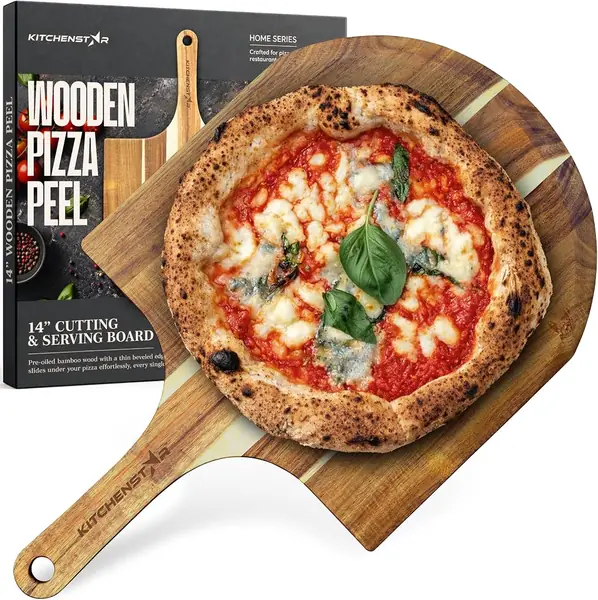
KitchenStar Acacia Wood Pizza Peel Best for Serving and Slicing

KitchenStar acacia wood pizza peel with beveled edge and hanging hole

Serving and slicing

Bake Score 89/100
Material
Acacia wood
Blade Size
14 in
Overall Length
22 in
Weight
2.3 lb
View on Amazon

Acacia with a wax-and-oil finish is the reason to look at this one. The grain is the best-looking surface in this group, and it is the only board here that looks right carrying a pie to a table where people are already sitting.

It is 14 inches across with a beveled front edge and a handle that ends in a hanging hole. As a cutting and serving board it is excellent: broad enough for a large pie, with a surface that does not skate while you cut.

As a launch tool it is more limited. Half an inch of wood is a lot to slide under a pie that is already on a hot stone; the bevel helps, but the board is doing more pushing than slipping.

So treat it as the board that finishes the job: launch with a thin metal peel, then slide the pie onto this one to cut and carry. In a home oven it can pull double duty; in a 900°F pizza oven it cannot, and a 12-inch metal blade belongs in the drawer beside it.

Worth Noting

  • Heavier than the metal peels at 2.3 pounds
Our Verdict

Ours is the board that finishes pizza night: pretty enough for the table, solid enough to cut on, and it can launch a pie in a home oven.

Check Latest Price

How We Tested the Best Pizza Peels

We started by reading through customer reviews and pulling every peel that came up repeatedly for quality and ease of use, then narrowed the field by blade size, material, handle type, and price so the group covered the shapes and budgets people actually buy. That left 14 peels, and we spent four months using them the way they're meant to be used: Friday-night pies in a home oven with a steel, a portable outdoor pizza oven in the backyard, and a gas grill for the bigger ones.

Each peel launched a 12-inch pie and a 16-inch pie. We logged how much bench flour it took to get the dough moving, whether the pie slid free on the first shake, and whether it needed a second dusting. The same wet-mozzarella pie went across every blade so we could see which surfaces turned sticky under a heavy load.

For surface quality, we ran a hand over each blade and noted snags, seams, and spots where coarse grain or a raised rivet could catch dough. For durability, we launched and turned roughly 30 pies per peel and watched for wobbling handles, cracked wood, and warped blades; the dishwasher-safe ones went through repeated cycles. Folding handles were opened and closed every session, and we measured how much drawer space each peel took folded versus fixed. Size got settled by fit, meaning which blade cleared a small oven opening and which was too clumsy to turn a small pie. Several ended up on the table as serving boards, and that counted too.

How to Choose a Pizza Peel

Start with the leading edge

A beveled edge a fraction of an inch thick slips between dough and stone. A thick, blunt board pushes the whole pie across the oven instead, which is why some of the handsomest wooden peels are really serving boards. Metal blades are the thinnest option and need only a dusting of semolina to release; wood is a little thicker but holds flour better, and several wooden peels arrive rough enough to need a few minutes with fine sandpaper before the first launch.

When a peel shows up, run a fingernail along the front edge. If it catches, sand it before you use it. That is the single upgrade that turns a stubborn board into a working peel.

Match the blade to the pie and the oven opening

Twelve by fourteen inches covers pies up to about 12 inches across, which is what most home ovens and most home dough recipes produce. Step up to a 16-inch board only if you stretch bigger rounds, because the board also gets heavier and harder to steer.

Then measure the opening rather than the interior. A 12-inch peel in a 12-inch oven mouth is a tight fit, and you want an inch of clearance on each side or you will scrape the frame on every launch.

Handle length, weight, and where it will live

Twenty-four to twenty-six inches of overall length keeps a forearm away from a 500°F oven. Serving boards with a four- or eight-inch handle put your knuckles near the element, so we treat those as boards first and peels second.

Folding handles buy drawer space at the cost of a knob to loosen and tighten; a fixed handle is simpler and stiffer but wants a wall hook or a corner. A loaded 12-inch pie is heavier than it looks at arm's length, so if you bake several in a row, weight is a spec worth reading.

When a second peel earns its place

Perforated peels exist for high heat. The holes let loose flour fall away instead of burning onto the stone and give steam a way out in the first minute — worth it above 700°F, much less so in a home oven that tops out near 550°F.

A turning peel is a different tool again: a 7-inch disc that slips under the edge of a cooking pie so you can spin it without dragging it off the stone. At 800°F and up, it is the piece that keeps one shoulder of the crust from charring before the rest sets.

Frequently Asked Questions

Final Verdict

If you are buying one peel and you make pizza in a normal oven, the Chef Pomodoro is the one: the edge is thin enough to get under a set crust, the length keeps your arm out of the heat, and it stores in a drawer. Nothing else here does all three as well.

Two situations change the answer. If you would rather not hand-wash anything, the Checkered Chef is the only dishwasher-safe peel in the group and its wider head holds a 13-inch pie. If your oven runs above 700°F — an Ooni, a Gozney, a wood-fired build — the perforated ooni peel is worth the step up, and the 7-inch turning peel is the partner that keeps the crust even.