The 8 Best Nonstick Pizza Peels of 2026

Pizza night rarely fails because of the dough. It fails in the last ten seconds, when you slide a fully loaded pie off the peel and half the toppings stay behind. A peel that sticks turns a carefully built pizza into a folded mess, and one that's too wide for the oven door or too long for the drawer is a problem you don't discover until the box arrives.

I've made a lot of pizza at home, and the peel does more work than any other tool in the setup. We worked through 14 of them — aluminum, stainless steel, bamboo, and acacia, with handles that fold, detach, or don't budge at all.

Here's what nobody tells a first-time buyer: wood and metal aren't interchangeable. Bamboo and acacia grip raw dough just enough to launch it, while aluminum is what you want for turning and pulling a pie out, which is why so many home cooks end up owning two. We picked for both jobs, plus the storage question that comes with anything this long.

Our Top Picks

The Best Nonstick Pizza Peels

1

Chef Pomodoro Aluminum Pizza Peel Best Overall
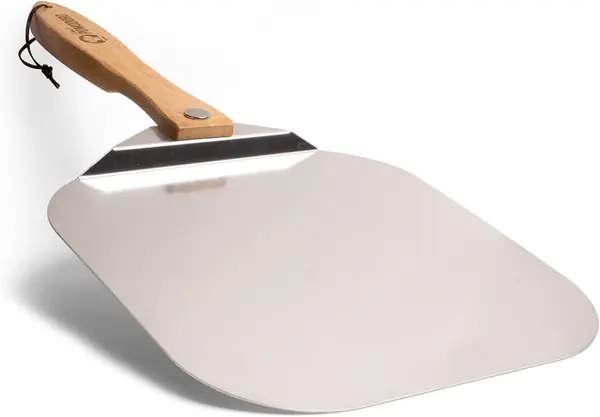
Chef Pomodoro aluminum pizza peel with 12-by-14-inch plate and folded wooden handle

Everyday home pizza

Bake Score 96/100
Head Size
12 x 14 in
Overall Length
24 in
Handle
Foldable wood
Max Temperature
572 °F
View on Amazon

Of the peels here, this is the one we hand to almost anyone: a 12-by-14-inch aluminum plate on a 24-inch handle that folds flat. It isn't the best in the group at any single thing — the perforated Ooni releases dough more cleanly, the Chicago peel reaches deeper — but it balances size, reach, storage, and price better than anything else in the set.

Aluminum does most of the work. The plate is thin, the leading edge tapers to almost nothing, and a light dusting of flour is enough to get a loaded pie moving. We noticed the difference most on the second and third pies of a session, when a wooden board has picked up a little moisture and starts to grab at the dough.

The fold is the practical part. The handle swings down and locks, so the peel goes in the drawer with the stone instead of living on the counter, and at 1.6 pounds it's light enough to move one-handed with a pie aboard. The pine handle stayed comfortable to grab bare-handed between bakes.

The boundary is worth naming: this is a launching and retrieving peel, not a turning tool. The wide head is awkward to spin with inside a small oven chamber, which is exactly the gap the 9-inch Ooni turning peel fills.

Worth Noting

  • Hand wash only, no dishwasher
  • Backstop can snag on a stone edge
Our Verdict

For most home pizza makers, this is the peel we recommend: a full-size aluminum head, a fold-flat handle, and a midrange price that undercuts the specialty peels here.

Check Latest Price
2

Ooni 12-Inch Perforated Pizza Peel Best Nonstick Release

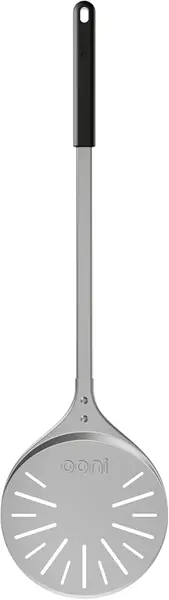
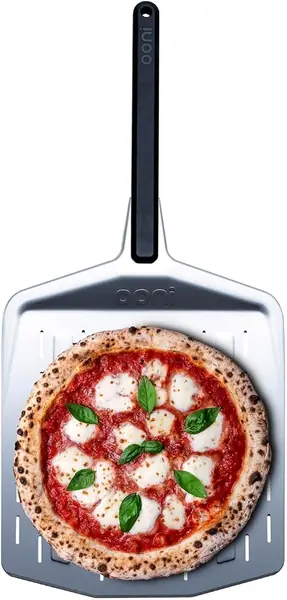
Ooni 12-inch perforated aluminum pizza peel with slotted head and long handle

Hot, sticky ovens

Bake Score 95/100
Weight
1.1 lb
Head Size
12 in perforated
Overall Length
25 in
Max Temperature
500 °C
View on Amazon

Slits and ridges run the length of the 12-inch aluminum head, and that pattern is the whole difference between this peel and the solid plates here. Flour falls through instead of riding into the oven on the underside of the dough, and steam escapes from beneath the crust rather than condensing on the metal.

The payoff is that we stopped leaning on semolina. A short shake is enough to free a dressed pie, which means less flour on the bench, less burnt flour on the stone, and fewer launches that end with a folded crust. The plate is thin, and at 1.1 pounds the peel is light enough to work one-handed while you steer with the other.

What it costs you is money and margin. The head is exactly 12 inches across, the same as the floor of a small pizza oven, so a launch has to be straight every time, and it's the priciest launching peel in this group. If your pies have been sticking at high heat, that's the upgrade that fixes it; in a home oven on a stone, the extra outlay buys you less.

Worth Noting

  • Holes need brushing to clear flour and cheese
  • A 12-inch head leaves no margin in a 12-inch oven
Our Verdict

For a hot oven and a sticky dough, this is the peel we point to: the perforated head lets go of a pie with almost no flour, at a specialty-tool price.

Check Latest Price
3

Checkered Chef Stainless Steel Pizza Peel Best for Easy Cleanup

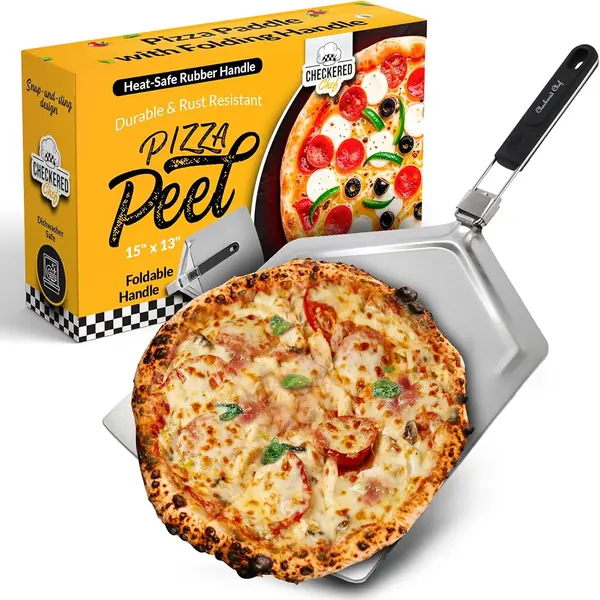
Checkered Chef stainless steel pizza peel with 13-by-15-inch head and folding handle

Fast cleanup

Bake Score 94/100
Head Size
13 x 15 in
Material
Stainless steel
Handle
Fold-flat
Cleaning
Dishwasher safe
View on Amazon

Stainless steel is the odd material in this group, where nearly everything else is aluminum or bamboo. The reward is the dishwasher: the 13-by-15 head and its handle go in the rack, which is not true of a single aluminum peel here.

It's also the largest metal plate in the set, and the fold is genuinely flat. The latch at the hinge held solid when we carried a loaded 13-inch pie across the kitchen, and folded it slides into a cabinet beside a sheet pan. Steel doesn't flex the way aluminum does, so it feels planted under a heavy pie, and the trade is a little more weight in the hand at 1.5 pounds.

What settles it for us is the ninety seconds after the pizza. A peel gets floury and there's never a good moment to deal with it; this one goes in the machine with the dinner plates. The rest is competence rather than brilliance — a smooth taper at the front, a handle that locks without wobble, nothing that calls attention to itself.

Worth Noting

  • Steel grabs dough more than aluminum
Our Verdict

The peel we recommend when cleanup is what stops you: a 13-by-15 stainless head, a solid folding latch, and a trip through the dishwasher after every pie.

Check Latest Price
4

Chicago Brick Oven Aluminum Pizza Peel Best Long Reach

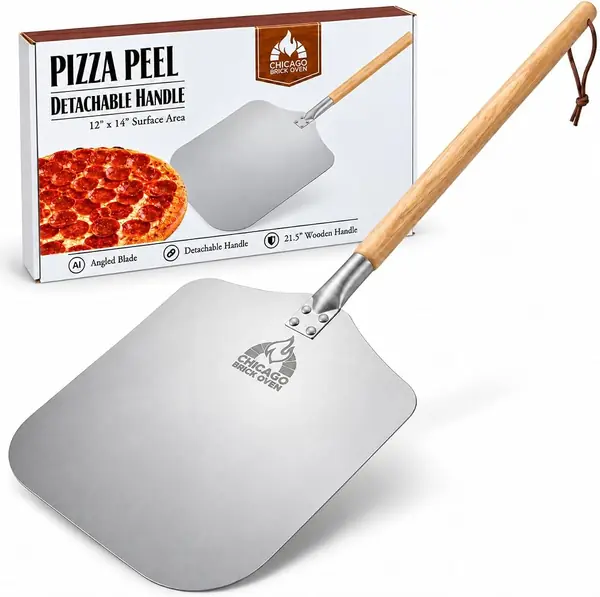
Chicago Brick Oven aluminum pizza peel with long detachable wooden handle and leather loop

Deep ovens

Bake Score 93/100
Weight
1.4 lb
Head Size
12 x 14 in
Overall Length
35.5 in
Handle
21 in detachable
View on Amazon

Thirty-five and a half inches is the number that matters here. That's the overall length with the 21-inch wooden handle screwed on, roughly ten inches more peel than most of this group, and it changes where you can stand while a pie bakes.

We reached for it on a deep oven and over a kettle grill, and the extra length stopped being a specification and started being the reason to own it. The head is the familiar 12-by-14 metal plate with a tapered front edge, so it launches like the others, and the handle unscrews, which is how it fits in a car alongside a portable oven.

Storage is the other half of the trade. It doesn't fold, so it hangs from the leather loop at the end of the handle or stands in a closet, and it will not live in a drawer. At 1.4 pounds it's still a one-hand tool once a pie is on it.

Worth Noting

  • Threading the handle on and off is slow
Our Verdict

We reach for this one when reach is the problem: nothing else here puts your hand that far from the fire, and the handle comes off for the car.

Check Latest Price
5

OUII Aluminum Pizza Peel Best Budget

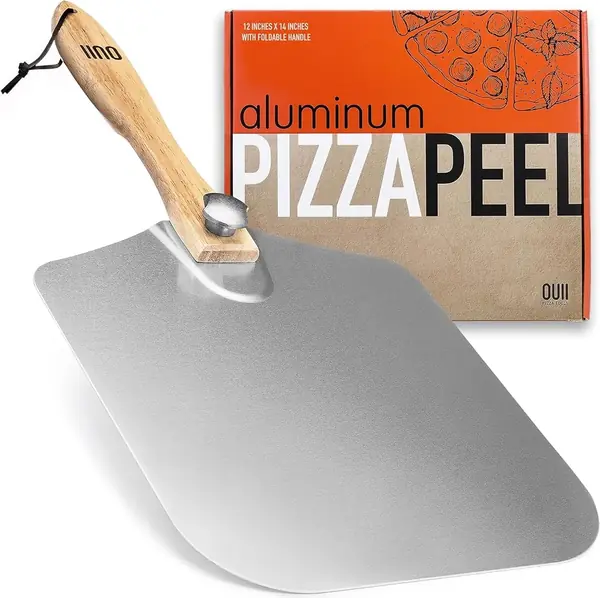
OUII aluminum pizza peel with wooden handle and thin rectangular metal plate

First pizza setup

Bake Score 92/100
Weight
1.3 lb
Head Size
12 x 14 in
Overall Length
25 in
Plate Thickness
0.08 in
View on Amazon

This is the least expensive peel here that still gives you a full 12-by-14 plate, and that's the case for it: the working size of our top pick, a wooden handle that folds, and a plate thin enough to get under a crust without a fight.

At 0.08 inch, the plate is the thinnest in this group, and that shows up where it matters, sliding under a pie that has already set at the rim. It weighs 1.3 pounds and locks open with a knob on the handle end. That knob is the one design quirk: it sits proud of the wood, so load the pie on the smooth face and you'll forget it's there.

Where it gives ground to the Chef Pomodoro is in the finishing, not the function: lighter hardware, a bit more flex when a heavy pie sits at the end of a full reach, and a fold that takes two hands to tighten. For a first peel, none of that has cost us a pizza.

Worth Noting

  • Even folded, it takes a long drawer
Our Verdict

We recommend this as the first peel to buy: a thin 12-by-14 plate, a folding handle, and enough stiffness for a loaded pie.

Check Latest Price
6

Ooni 9-Inch Turning Peel Best Turning Peel

Ooni 9-inch perforated turning peel with anodized aluminum head and long handle

Even browning

Bake Score 91/100
Weight
12.8 oz
Head Size
9 in perforated
Material
Anodized aluminum
View on Amazon

A turning peel does a different job from everything else here: a small head, a long handle, and the task of spinning a pie in place instead of hauling it out. This one is 9 inches across, perforated, with a hardened anodized finish and beveled edges around the plate.

In a hot oven the rim sets in seconds, and a 9-inch head gets under that set edge without dragging the rest of the pie off the stone. The perforations drop flour away instead of scorching it while you work, and the bevel lets you slide in at a shallow angle and lift. We turned pies a quarter at a time with it and never had to pull one out to do it.

It won't launch a pizza — you still need a 12-inch plate to build and slide one in — and it costs more than the launching peels here. What it fixes is uneven browning, and it fixes that better than a wider head or a pair of tongs: if your crust chars on one side while the top stays pale, this is the purchase, not another launching peel.

Worth Noting

  • Can't launch a pie on its own
  • Costs more than the launching peels here
Our Verdict

This is the second peel we recommend owning: a 9-inch perforated head that spins a pie in place and evens out browning in a hot oven.

Check Latest Price
7

JIAFUEO Bamboo Pizza Peel Best for Serving and Launching

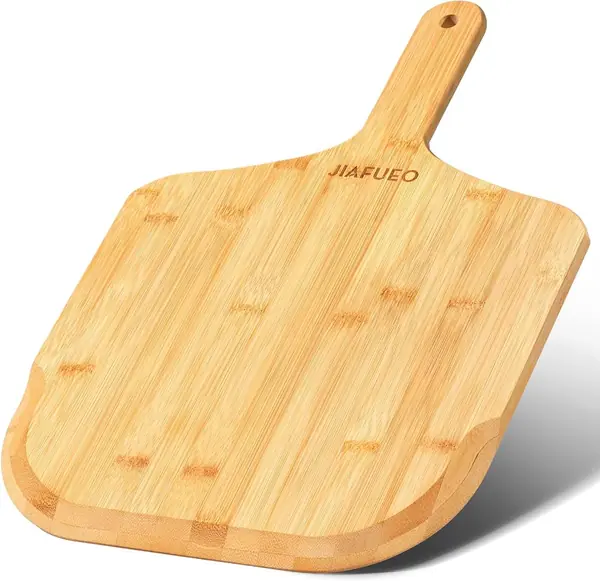
JIAFUEO bamboo pizza peel board with short handle and smooth polished surface

Serving and launching

Bake Score 90/100
Weight
1.5 lb
Material
Bamboo
Thickness
0.47 in
Board Size
17.5 x 12 in
View on Amazon

Twelve inches wide, seventeen and a half long, and about half an inch thick: this is a board with a stub of handle, sized for 10- and 11-inch pies. That's most of what a home oven turns out, and it's the size this peel is built for.

Bamboo is the friendlier surface for a slack dough. Metal wants a confident shake and a dusting of semolina; polished bamboo grips a wet dough just enough to hold it while you dress the pie, then releases it with a little flour and cornmeal. A little cornmeal and it slides off with less flour than any metal peel here needs.

Water is what bamboo doesn't tolerate. A board that stays damp raises its grain and can split, so this is hand wash, dry it straight away, and keep it out of the sink and the dishwasher. Skip that and the board that was going to last years becomes the one that cracks in a month.

What we like most is the second job it takes on: it goes to the table, the pie gets sliced on it, and it serves bread and cheese the rest of the week. As the only peel in a kitchen with a deep oven it's the wrong shape; as the board that starts and finishes pizza night, we kept reaching for it.

Worth Noting

  • Short four-and-a-half-inch handle keeps your hand near the heat
Our Verdict

We like this bamboo board for a home oven and a slack dough — it grips and releases better than metal, as long as you dry it right after washing.

Check Latest Price
8

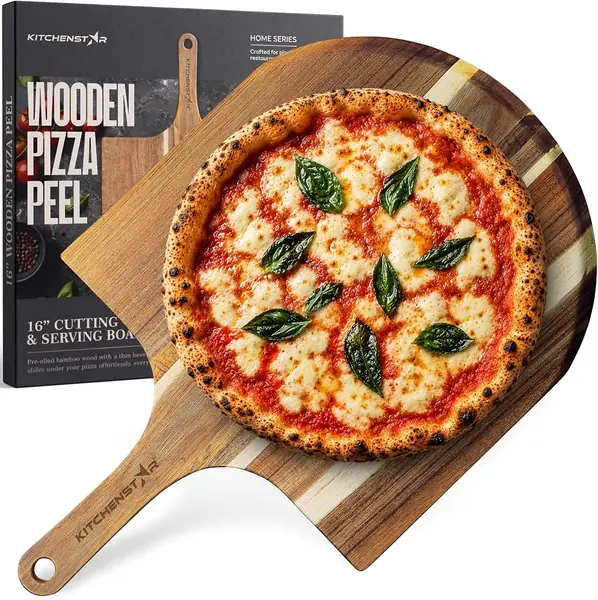
KitchenStar Acacia Wood Pizza Peel Best for Large Pies

KitchenStar acacia wood pizza peel and serving board with beveled edge

Large pies

Bake Score 89/100
Weight
2.76 lb
Material
Acacia wood
Thickness
0.5 in
Board Size
24 x 16 in
View on Amazon

The acacia grain and the waxed finish are the first thing you notice, and they tell you where this piece belongs: on the table. At 16 inches across and 2.76 pounds, it's built to be carried, not flicked.

For building and carrying, the size is the appeal. A 14- or 15-inch pie fits with room to spare, the beveled front edge lets you get under a loaded dough on the counter, and there's enough handle to hold it steady with two hands. Call it what it is — a pizza paddle that doubles as a serving platter.

Acacia arrives waxed and oiled here rather than bare, which is why the grain looks the way it does and also why it needs a little attention: hand wash, dry it fully, and rub in food-safe oil a few times a year. None of that is hard; all of it is the difference between a board that lasts and one that dries out and splits.

Our take: it's the nicest thing here to put a pizza on and the least useful to put a pizza in with. If you already own a metal peel and want the table side of pizza night to feel like an occasion, this is where the money goes; as a first peel, it isn't.

Worth Noting

  • Half-inch thickness won't slip under a set crust
  • Needs hand washing and occasional re-oiling
Our Verdict

This is the board we bring out for a 16-inch pie: waxed acacia with a beveled edge, and no substitute for a metal peel at the oven.

Check Latest Price

How We Tested: Launch, Turn, and Store

To build the shortlist, I started with the specs that decide whether a peel works in your kitchen at all: blade size against the mouth of a standard home oven, overall length, material, and whether the handle folds, detaches, or stays put. Anything that couldn't clear a 12-inch pie or fit in a drawer was set aside. That left 14 peels, which we used over five months in a home oven cranked as high as it goes and in a backyard propane oven, plus a few weeknight sessions with store-bought dough for the messier cases.

Every peel got the same launch test: one dough recipe, one hydration level, a light dust of flour and semolina, and a loaded pie. We timed how long it took to get from the bench to the stone and noted whether the dough stuck, stretched out of shape, or slid off clean. Solid blades were compared against perforated ones on the same dough to see how much bench flour came along for the ride and whether the crust bottom set differently.

Turning was its own test. About a minute into the bake, we slid each peel under a half-set pie to see how cleanly it lifted and whether the rim or the toppings shifted. Handles got measured and grabbed with a towel after a stretch in front of a hot oven, and we loaded each one with a heavy, wet pie to see whether the fold or detach mechanism flexed or held firm.

Durability came from ordinary wear rather than a lab: edges dragged against a hot stone, repeated washing where the maker allowed it, and a close look at the rivets, welds, and coating after a few weeks. We also folded or collapsed each peel, measured it, and checked it against a standard kitchen drawer, since storage is where most of these end up abandoned.

How to Choose a Nonstick Pizza Peel

Start With the Surface, Because That's the Nonstick Part

Aluminum is the default for good reasons: it's thin, light, and lets go of a floured dough with a short shake. Perforated aluminum pushes that further, since flour and steam escape through the plate instead of scorching on the stone, and it's the surface we reach for when dough has been fighting back. Stainless is the heaviest and the least slippery of the metals, and what it buys you is the dishwasher. Wood and bamboo sit at the other end: they grip a slack dough while you dress it and release it with flour and cornmeal, but they have to stay dry.

For a first peel, buy plain aluminum and learn the flour-and-shake habit. If sticking is your problem in a hot oven, pay for perforations. If you want to stop hand-washing a floury plate at the end of the night, stainless is the trade to make.

Size the Head to Your Oven, Not Just Your Pie

A 12-by-14-inch head carries a 12-inch pie with room to work, and 13 by 15 handles a 13-inch pie without the toppings crowding the edge. Boards bigger than that are usually serving pieces first, which is fine as long as you know which job you're buying.

The trap is the oven mouth. A 12-inch head in a 12-inch oven leaves no margin, so a launch has to be dead straight every time, and a peel wider than the opening is worse than useless. Measure the door and the floor before you buy, and remember the head has to turn inside the chamber, not just fit through it.

Handle Length Is Really a Safety Measurement

Most launching peels here run 24 to 25 inches overall, which keeps a hand comfortably back from a home oven. A deep brick oven or a kettle grill wants more: the Chicago peel's 35.5 inches is the longest in this group, and it's the difference between reaching in and leaning in.

Watch how the numbers get quoted. Sellers list head size, handle length, and overall length in the same breath, so a 21-inch handle can describe a 35-inch tool. Compare overall length — that's the figure that tells you where your knuckles end up.

Storage and Weight Decide Whether You Reach For It

Folding and detachable handles exist because a 24-inch peel does not live in a drawer. A fold-flat handle stows fastest; a screw-off handle packs smaller but takes longer to put back together, which matters when you're holding a raw pie. Either way the head sets the footprint, so measure the drawer against the plate, not the handle.

Weight matters more than it sounds. Anything from about 1.3 to 1.6 pounds is a one-hand tool with a loaded pie aboard, while a 2.7-pound board wants both hands. Check the care instructions too: a dishwasher-safe stainless peel is a different ownership experience from a wooden one you wash and dry by hand.

Frequently Asked Questions

Final Verdict

Our pick for most kitchens is the Chef Pomodoro. A 12-by-14 aluminum head releases a floured dough with a short shake, the handle folds flat so the peel lives in a drawer, and the 24-inch reach keeps a hand out of a hot home oven. It wins on balance rather than on any single number.

Spend more only for a specific problem: the perforated Ooni if dough sticks in a high-heat oven, the Checkered Chef if you refuse to hand-wash, the Chicago peel if reach into a deep chamber is what's missing. For the ordinary case — one peel, a home oven, pizza on a Friday — the Chef Pomodoro is the one to buy.