The 5 Best Mini Food Scales of 2026

A mini food scale makes one promise, and it's a big one: that the tenth of a gram it shows you is actually there. That matters when you're dosing coffee, weighing yeast for a single loaf, or portioning out a supplement — a scale that quietly drifts by a gram ruins the batch. The other half of the bargain is size. These things live in drawers, knife rolls, and backpack pockets, so they have to survive being shoved around and still read true the moment you pull them out.

I've kept a small scale within arm's reach of my coffee grinder for years, and the gap between a good one and a cheap one shows up within a week. We weighed our way through 16 of them, from bare 500-gram pocket models to stainless-steel versions with backlit displays. The lesson that kept repeating: 0.1-gram resolution only holds near the bottom of a scale's capacity, and a tare button that resets cleanly will matter to you more day to day than an extra digit on the screen.

Our Top Picks

The Best Mini Food Scales

1

MAXUS Digital Gram Scale Best Overall
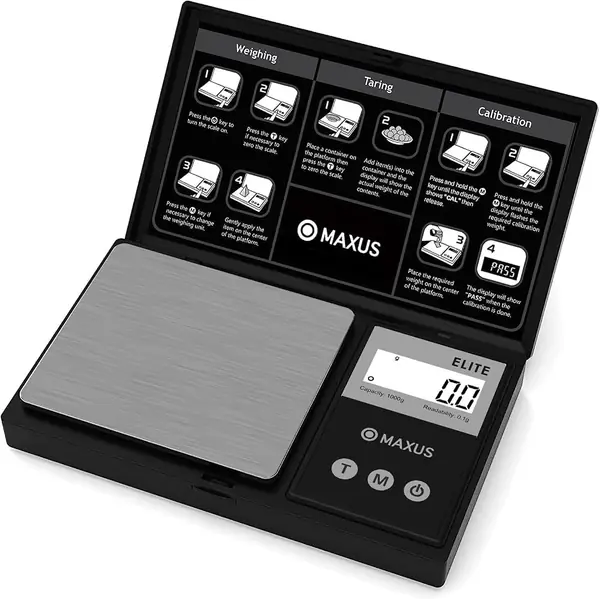
MAXUS mini digital gram scale in matte black with backlit LCD display

Everyday small-batch baking

Bake Score 94/100
Readout
0 oz
Capacity
1,000 g
Item Weight
4.48 oz
Weighing Units
g / oz / ozt / dwt / ct / gn
View on Amazon

A tenth of a gram of resolution on a full kilogram of capacity is the pairing that earns this one its spot. That's a wider useful range than most of the mini scales here: fine enough for 3 grams of instant yeast or 4 grams of fine salt, big enough to weigh the flour for a single loaf without stopping halfway. At 4.48 ounces in a matte black body, it disappears into a drawer between bakes, and the backlit display is easy to read in a dim kitchen.

The conveniences are what we kept noticing. Tare zeroes out a bowl so you can add flour without doing arithmetic, and six units — grams, ounces, troy ounces, pennyweights, carats, grains — let it migrate from the kitchen to a workshop without complaint. It's sold for powders, which matches what we weighed: cocoa, espresso powder, spice, yeast. The platform is small the way every mini scale is small, so a cereal bowl fits and a sheet pan doesn't.

Accuracy is the part to manage rather than assume. This is a 0.1 g scale, not a lab balance, and the bottom of the range is where anything in this class gets twitchy; a calibration against a known weight is the fix, and none is included, so add one to the order. It handles kitchen fractions, not analytical ones — the GDEALER goes finer if you need hundredths. Otherwise this is the one we hand to a friend who wants to start weighing their baking.

Worth Noting

  • No calibration weight in the box
  • 0.1 g steps rule out hundredth-gram work
Our Verdict

We recommend it as the one small scale most bakers need: fine enough for yeast, wide enough for a loaf, and honest about needing a calibration weight.

Check Latest Price
2

Fuzion Pocket Gram Scale Best Value

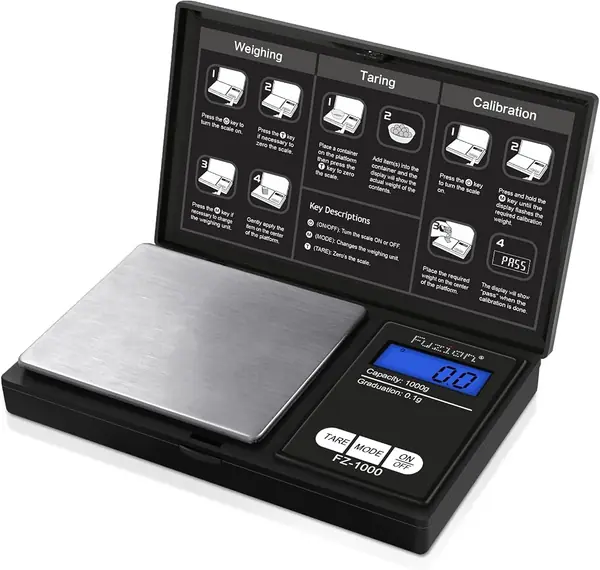
Fuzion pocket gram scale in black with stainless steel platform and flip cover

Travel and shared kitchens

Bake Score 93/100
Readout
0 oz
Capacity
1,000 g
Minimum Load
0.02 oz
Permissible Error
±0.3 g
View on Amazon

The flap across the front is the detail we keep coming back to. It's a hard ABS cover that closes over the stainless platform, so the scale can ride in a tote beside a jar of starter or a bag of coffee beans without the weighing surface getting scratched. With two AAA batteries in the box and a factory calibration, it's ready the moment it comes out of the packaging — no extra shopping trip first.

The headline numbers match our top pick's, 1,000 g at 0.1 g, with two qualifications the manufacturer prints plainly: a 0.5 g minimum load and a permissible error of plus or minus 0.3 g. Read those as a description of a kitchen tool rather than an instrument. It will weigh 250 g of flour, 8 g of cocoa, or 18 g of coffee beans all day long; a single gram of anything sits below its floor.

Portability is where it earns its place. It's the one we take to a rental kitchen, a holiday bake at someone else's house, or a market stall, and the cover means we stop thinking about it once it's packed. Backlight, tare, six units, auto shut-off — the standard kit, executed without fuss. If it's going to live in a bag rather than a drawer, this is the one we reach for.

Worth Noting

  • 0.5 g minimum load before it registers
  • ±0.3 g permissible error is kitchen-grade
Our Verdict

We take this one when the scale has to leave the kitchen: pre-calibrated, batteries in the box, and a hard cover over the platform.

Check Latest Price
3

AMIR Digital Kitchen Scale Best for Tiny Amounts

AMIR mini digital kitchen scale in silver with stainless steel platform and two trays

Yeast, salt, and spice

Bake Score 92/100
Readout
0 oz
Capacity
1.1 lb
Included
Two weighing trays
Platform
4 x 4 in
View on Amazon

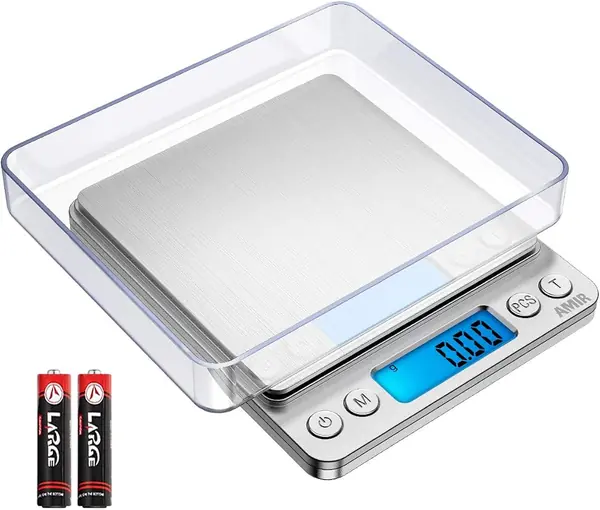
Five hundred grams is the entire allowance here, and that's the first thing to check against your bowl. A stand mixer bowl holding 500 g of flour goes over the limit before the dough is mixed, so this isn't the scale for a big batch — it's the scale for four grams of yeast, three grams of salt, and the teaspoon of espresso powder you'd rather not guess at.

What you get for that ceiling is the second-finest resolution in this group at 0.05 g, and trays that make it useful. Two come in the box; the practical move is to set one on the platform, tare, weigh the yeast into it, and tip it straight into the bowl with one fewer dish to wash. The stainless platform underneath wipes clean, the blue backlight is easy on the eyes, and the whole thing weighs 159 g and stands three-quarters of an inch tall, so it drops into a utensil drawer beside the measuring spoons.

Our expectations for the last digit are modest. At 0.05 g a scale is quoting resolution, not accuracy, and the readings nearest zero are the fussiest part of any mini scale — check a 5 g load against something known before you trust a half-gram one. The other compromise is the platform: 4 by 4 inches takes a ramekin or a small bowl and not much more.

Worth Noting

  • 500 g ceiling caps batch size
  • 4 x 4 in platform limits bowl size
Our Verdict

Our pick when the amounts get tiny — yeast, salt, spice, cocoa — provided the whole batch fits inside half a kilo.

Check Latest Price
4

GDEALER Digital Kitchen Scale

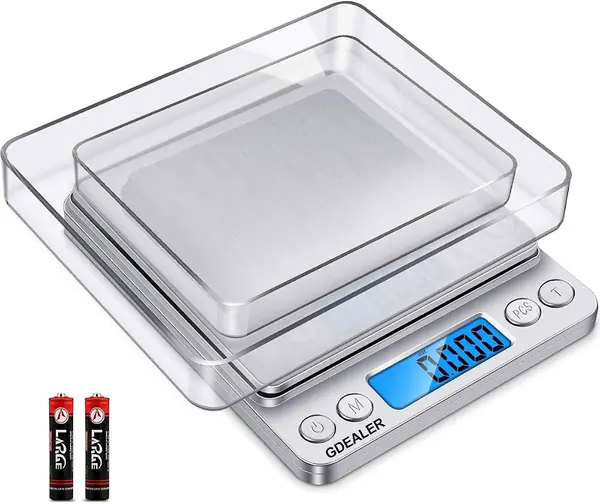
GDEALER digital kitchen scale in silver with stainless steel platform and two clear cases

Hundredth-gram precision

Bake Score 91/100
Readout
0 oz
Capacity
1.1 lb
Units
g / ct / dwt / ozt / oz / gn
Platform Material
Stainless steel
View on Amazon

The AMIR and the GDEALER answer the same question, and the difference sits at the decimal point: this one reads to 0.01 g where the AMIR stops at 0.05 g. That extra digit is the whole reason to choose it, and it's a real one if your recipes run to hundredths. Otherwise the two are close — 500 g capacity, six units, a stainless plate, and two clear plastic cases that work as trays and covers.

A hundredth of a gram is a strange thing to want in a kitchen, and we appreciate that the scale doesn't pretend otherwise. With a 500 g ceiling and a plate that size, it's built for curing salt, food color, yeast by the fraction, and small-batch chocolate work. If your recipes read 2.5 g, this is your scale; if they read 250 g, you're paying for a digit you'll never use.

Longevity is the caveat. Durability is the uneven part of this model's story — there are units still weighing after two years and units that stopped within a couple of months — so buy from a seller with an easy return and keep the packaging for a while. Accuracy can fade too: a reading that no longer returns to zero is the signal to recalibrate against a known weight.

Worth Noting

  • Durability is uneven, so keep the receipt
Our Verdict

We rate it for hundredth-gram work — curing salt, food color, small-batch chocolate — and not much else.

Check Latest Price
5

Escali Primo Digital Food Scale Best for Big Batches, Small Kitchens

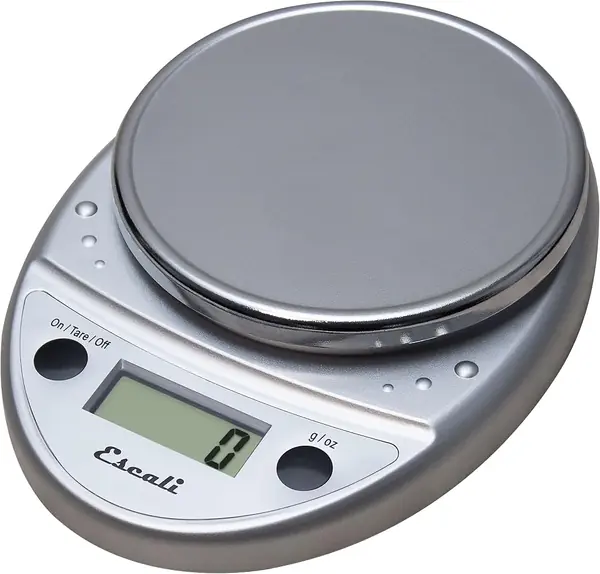
Escali Primo digital food scale in chrome with a two-button sealed control panel

Big batches, small kitchens

Bake Score 90/100
Readout
0.05 oz (1 g)
Capacity
11 lb (5,000 g)
Item Weight
15.2 oz
Dimensions
8.5 x 6 x 1.5 in
View on Amazon

If your baking runs by the kilo — a double batch of sourdough, a full sheet of focaccia, a holiday cookie marathon — 5,000 g of capacity and 1 g steps are the right tool, and the Primo is the most pleasant version of that we tested. The body is 8.5 by 6 by 1.5 inches and weighs 431 g, so it's compact in the way a small kitchen actually needs: on edge in a cabinet, or flat in a drawer.

Two buttons, sealed under a membrane, and a rounded body that wipes down when flour goes everywhere. That's the entire interface, and after a few weeks we appreciated not cycling through modes to get back to tare. It's the least fiddly scale here in daily use, which is exactly what you want from the one that stays out on the counter.

The boundary is worth stating plainly. One-gram steps won't give you 2.5 g of instant yeast, and there's no tenth hiding in a menu; at 8.5 inches wide, this is also not a scale you carry anywhere. For fine work, look at the AMIR or the MAXUS. For the kilo of dough that has to fit in the bowl, none of the pocket scales can help and this one can.

Worth Noting

  • 1 g increments too coarse for tiny amounts
  • Durability is uneven over years of use
Our Verdict

Our choice for bakers working by the kilo in a small kitchen: 5 kg of capacity, 1 g steps, and a sealed panel you can wipe clean.

Check Latest Price

How We Tested Mini Food Scales in Real Kitchens

We started with a list of about 40 compact scales and cut it down by reading spec sheets closely: capacity against resolution, metal platform or plastic, how many units the display could toggle between, and whether the model had a tare button plus a documented way to recalibrate. That left 16, all bought at retail, spanning simple 500-gram pocket models to stainless-steel scales with backlit screens.

Then we used them the way people actually use them. For three months, one lived beside the coffee grinder for the morning dose, others came out on weekends for a single loaf of bread, a batch of brine, or portioning dog food, and a couple got carried in backpacks and bounced around in transit. We weighed the same stack of nickels — 5 grams apiece — on every scale, then re-weighed it after 20 consecutive readings to see whether the number wandered.

We paid attention to the small stuff: whether a few grains of yeast registered or the display just sat at zero, whether tare snapped back to zero with a bowl still on the platform, whether the backlight was readable at an angle in a dim kitchen, and whether auto-off cut power mid-pour. Durability got a real test too — a waist-high drop onto a wood floor, then another check against the nickels.

Cleaning and storage counted as much as accuracy. We wiped each platform after flour and coffee spills, watched whether crumbs worked into the seams around the buttons, and measured whether the footprint truly fit a crowded drawer or a jacket pocket. Value came down to one boring question: does it still read true after three months of this?

How to Choose a Mini Food Scale

Capacity First, and Count Your Bowl

A scale's limit applies to everything on the platform, bowl included. Taring the bowl to zero feels like it frees up capacity, but the mechanism is still carrying bowl plus flour, so a 500 g scale under a 300 g mixing bowl leaves about 200 g of real work. Weigh the bowl you use most before you decide.

For a single loaf, a tray of brownies, or a batch of cookies, 1,000 g is comfortable. For a kilo of dough or a full bag of flour, only the Escali Primo here has the range, and no amount of tare gets a pocket scale there.

Resolution Isn't the Same as Accuracy

The increment is what the display will show; accuracy is whether that number is right. Every mini scale here is least reliable in its first few grams, so treat the finest digit as a guide rather than a guarantee. A 0.1 g scale covers yeast, salt, spice, and coffee with room to spare.

Go finer only if your recipes genuinely call for it — curing salt, food color, small-batch chocolate — and expect to trade capacity for the digit, since the 0.05 g and 0.01 g models here both stop at 500 g.

Drawer, Counter, or Bag

Where the scale lives decides more than its finish does. In a drawer, a hard cover or a tray that doubles as a lid is worth more than good looks: the Fuzion's flip cover and the two trays that come with the AMIR and the GDEALER all keep the platform protected between bakes.

Compact means it takes little counter space, not that it slips into a pocket. Match the platform to the bowl you'll set on it — a 4-inch plate holds a ramekin, not a mixing bowl — and check the height if the scale has to slide into a shallow drawer.

Batteries, Covers, and Calibration

What ships in the box shapes your first week. The Fuzion arrives calibrated with two AAA batteries; the MAXUS includes no calibration weight, so add one to the order if you want to check it against a known mass.

Auto shut-off saves batteries and can catch you mid-recipe, so add in one pass rather than a spoon at a time. Test the scale against a known weight every few months; a reading that stops returning to zero is your cue to recalibrate.

Frequently Asked Questions

Final Verdict

For most bakers, the MAXUS is the scale to buy: 0.1 g steps for yeast and salt, a full kilogram for a single loaf or a tray of brownies, and a backlight that makes an early-morning weigh-out easy on the eyes. Add a calibration weight to the order and check it against a known mass every few months.

If the scale will travel, the Fuzion's hard cover and included batteries make it the better bag companion. If your dough comes in kilos, the Primo is the one with the range.