The 7 Best Food Scales of 2026

A food scale has one job, and it's the one you can't check at a glance: telling you the truth. A scale that's off by three grams doesn't announce itself — you find out two hours later, when the loaf comes out dense. We weighed flour, water and starter on 16 of them, from slim drawer-friendly models to heavier stainless scales built for big batches.

The spec shoppers fixate on, 1-gram versus 0.1-gram precision, matters less than whether a scale gives the same answer twice. Set a bowl of flour down, lift it, set it back; a good one repeats, a bad one drifts. Tare is the other quiet hero — you press it every time you weigh into a bowl, and a sluggish button gets old fast.

The rest comes down to your kitchen, and price turned out to be a poor predictor of anything. A scale that crowds the counter gets put away for good, and one whose display disappears under a dinner plate is a daily irritation.

Our Top Picks

The Best Food Scales

1

Ozeri Pronto Best Overall
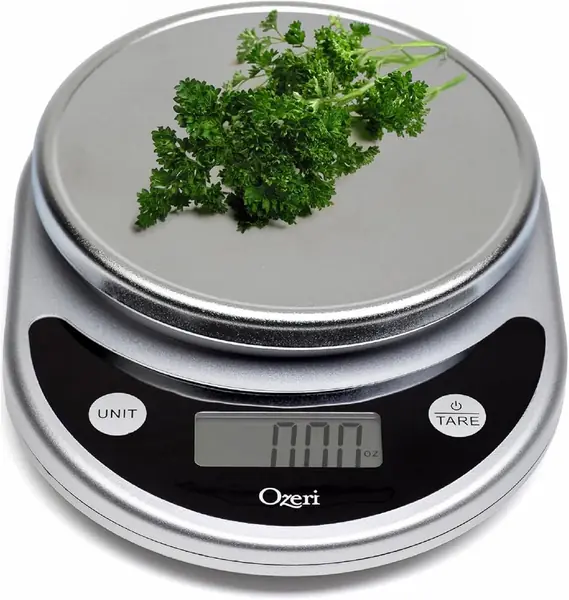
Ozeri Pronto digital kitchen scale with stainless-look platform and LCD display

Everyday baking

Bake Score 97/100
Capacity
11 lb
Units
Six, including kg and lb:oz
Increments
0.04 oz
Auto-off
2 to 5 minutes, programmable
View on Amazon

Every scale here will weigh a bowl of flour. What separates the Pronto is where the buttons live: the tare and unit controls are set clear of the weighing platform, so pressing tare doesn't also press down on the deck and spoil the reading you just set. We've lost more zeros to that problem than to any other quirk of budget scales, and it's the main reason this one is our top pick.

The rest of the numbers hold up for baking. It reads in 1-gram steps and the maker lists a 0.5-gram starting point, so 3 grams of yeast or a scant spoon of salt registers instead of flashing zero. Six units cover grams, kilograms, pounds, pounds-and-ounces, ounces, and milliliters, which is every figure a recipe is likely to throw at you, and the characters are big enough to read from standing height. The auto-off can be set anywhere from two to five minutes, and that matters more than it sounds: the fixed timer on most budget scales cuts out while you're still spooning.

Where it gives ground is cleanup. The platform doesn't lift off, so flour dust and sugar gather in the seam around it, and you're wiping around a rim instead of rinsing a plate. The trade runs the other way too: no removable tray means no tray to lose or set back crooked. For anyone weighing ingredients several times a week, the accuracy and the button layout are what you notice daily; the crumb line only bothers you when you deep-clean.

Worth Noting

  • Fixed platform traps crumbs around the rim
Our Verdict

Our pick for most bakers: the tare button stays clear of the platform, it reads down to a listed half gram, and it costs a fraction of the premium options.

Check Latest Price
2

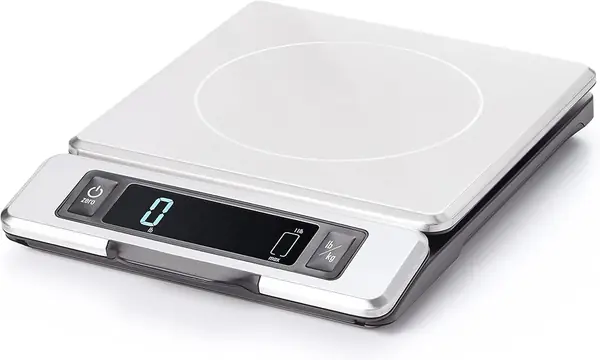
OXO Good Grips 11-lb Best for Big Bowls

OXO Good Grips stainless steel food scale with pull-out display and removable platform

Wide mixing bowls

Bake Score 96/100
Capacity
11 lb
Increments
1 g / 0.125 oz
Platform
Removable stainless steel
Display
Pull-out, tether-mounted
View on Amazon

Set a wide mixing bowl on any flat kitchen scale and the rim lands squarely over the numbers. OXO's answer is a display that slides out from the body on a short tether, so you can pull it clear of a dough bowl and read the weight without crouching or lifting anything. We used it that way through a stretch of bread baking, and it's the feature we miss most when we go back to a fixed screen.

The platform lifts off completely, which makes cleanup the easiest of this group: rinse the plate, wipe the deck underneath, done. Resolution is 1 gram or an eighth of an ounce, capacity is 11 pounds, and the brushed stainless resists fingerprints better than the polished tops on cheaper scales. Nothing about the design is decorative — the pull-out screen and the removable plate are the two things you touch every single time you bake, and both are done properly here.

It is also the heaviest scale in this set at 1.8 pounds, and by a wide margin the most expensive. Neither matters much if the scale lives on the counter, which is where a display like this belongs; both matter if you were planning to slide it into a drawer between baking days. For big-bowl work — bread, pastry, a double batch of cookies — the pull-out screen earns the difference. For a scoop of coffee in the morning, it's a lot of scale for the job.

Worth Noting

  • Pull-out screen can drift on its magnets
Our Verdict

Worth the splurge if you bake in wide bowls: the display pulls out past a dough bowl, and the platform comes off for a proper wash.

Check Latest Price
3

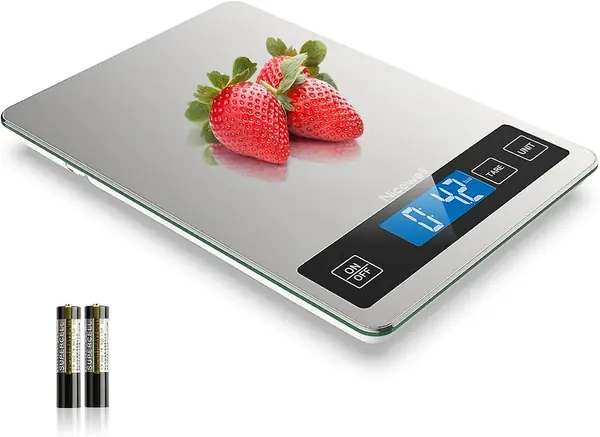
Nicewell 22-lb Best for Large Batches

Nicewell digital food scale with 9-inch tempered glass and stainless steel platform

Big dough batches

Bake Score 95/100
Capacity
22 lb
Units
g, kg, lb:oz, fl.oz, ml
Platform
9 x 6.3 inches
Top
Tempered glass with stainless steel
View on Amazon

Nine by 6.3 inches is the weighing surface, and that's the number to check if a batch for you means a six-quart dough bowl rather than a cereal bowl. A wide bowl sits fully on this platform instead of tipping over the edge, and the display runs along the front with large backlit characters, so a bowl set down on top doesn't hide the weight. Capacity is 22 pounds, twice what most of this group handles — enough for a double batch of dough or a pot of fruit headed for jam.

The top is tempered glass under a stainless surface and wipes clean in a single pass, with no removable tray to lift off and wash afterward. Units run through grams, kilograms, pounds-and-ounces, fluid ounces, and milliliters, so you can follow an American recipe and a metric one without doing arithmetic. There's a two-year manufacturer warranty behind it as well.

Weighing is a touch less settled than on the Ozeri: trickle flour in slowly and the final gram takes a beat to lock. That's irrelevant when you're adding in large pours, which is the job this one is built for — the capacity and the platform are the reasons to buy it. If you already keep a small precision scale for yeast and spices, this is the second one that earns permanent counter space.

Worth Noting

  • Top shows fingerprints and can scratch
  • Zero button can need a second press
Our Verdict

The big-batch pick: a 9-inch platform that holds a wide dough bowl, 22 pounds of capacity, and a front display you can still read.

Check Latest Price
4

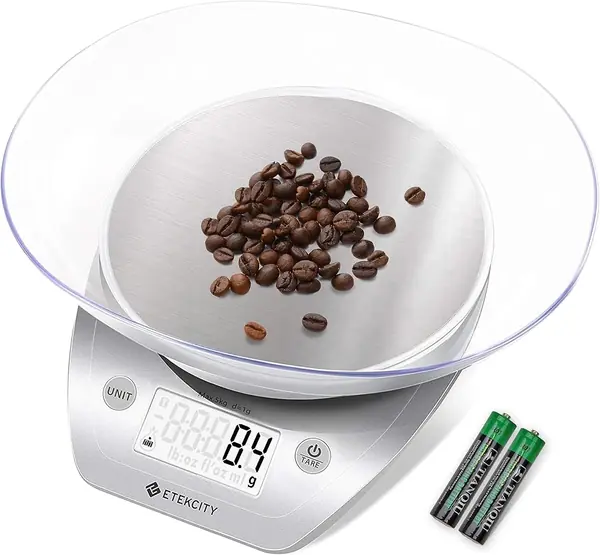
Etekcity 0.1g Bowl Scale Best for Tiny Amounts

Etekcity 0.1-gram food scale with detachable stainless steel bowl and backlit display

Yeast and spices

Bake Score 94/100
Capacity
11 pounds (5 kg)
Units
oz, lb, g, fl:oz, mL
Increments
0.1 g below 1,000 g; 1 g to 5,000 g
Bowl
Detachable, flips over as a cover
View on Amazon

A few grams of instant yeast is exactly the amount a 1-gram scale rounds away. This Etekcity reads in 0.1-gram steps below a kilogram, which brings yeast, salt, baking powder, espresso doses, and sourdough starter culture into range — and it does that with a detachable bowl that flips over to become a cover when the scale is stored.

We found the bowl does more than hold ingredients: it lifts the food above the platform and away from the display, so you can watch the number while you pour. Capacity runs to 5 kilograms (11 pounds) with 1-gram steps once you pass a kilo, so the same scale handles a full batch of dough after the yeast is in. Five units cover grams, ounces, pounds, fluid ounces, and milliliters, with separate water and milk density settings for liquids.

The bowl is smaller than the photos suggest — enough for a portion of dough or a bowl of oats, not a full batch — so treat this as a prep scale that sits alongside a bigger one rather than replacing it. Because it flips down over the platform, it stores thinner than a bowl scale has any right to, and that's why it has stayed within reach in our kitchen instead of going into the cupboard.

Worth Noting

  • Loud beep every time it powers on
Our Verdict

Buy it for the small stuff: 0.1-gram steps make yeast and salt repeatable, and the flip-over bowl keeps the display clear while you pour.

Check Latest Price
5

Greater Goods Slim Best Budget

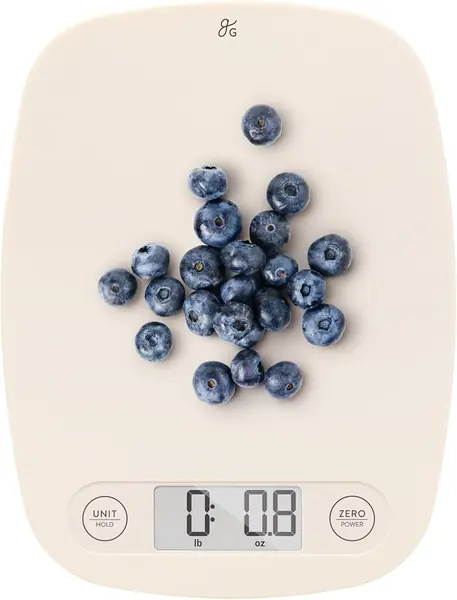
Greater Goods slim birch-white digital kitchen scale with touch controls and LCD

Small kitchens

Bake Score 93/100
Capacity
2 g to 11 pounds
Platform
6.5 x 6.1 inches
Profile
0.5 inch
Warranty
5 years
View on Amazon

This is the least expensive scale we recommend, and it's also the thinnest — half an inch tall, thin enough to slide in among the cookbooks or stand on edge in a drawer. The weighing surface is 6.5 by 6.1 inches, which takes a mixing bowl without turning the scale into another appliance competing for counter space.

The range runs from 2 grams to 11 pounds in 1-gram steps, with four sensors under the platform and touch controls for grams, pounds-and-ounces, fluid ounces, and milliliters. The birch-white finish earns its keep for a reason that has nothing to do with looks: it doesn't show flour the way black and stainless scales do after a morning of baking. Behind it sits a five-year manufacturer warranty, the longest coverage of anything in this guide.

The one habit to learn is the power button, which also zeroes the scale — press it twice in the wrong rhythm and you'll clear a reading you meant to keep. Learn it and the rest is unremarkable in the best way: it wakes fast, tares cleanly, and settles on a number without a second nudge. In a kitchen where the counter is already full, that's the whole brief.

Worth Noting

  • Coin-cell battery drains quickly
  • Wide plates can hide the display
Our Verdict

The budget pick for a small kitchen: half an inch thin, accurate to a gram, and the least expensive scale we recommend.

Check Latest Price
6

CROWNFUL 33-lb Best for Bulk and Brine

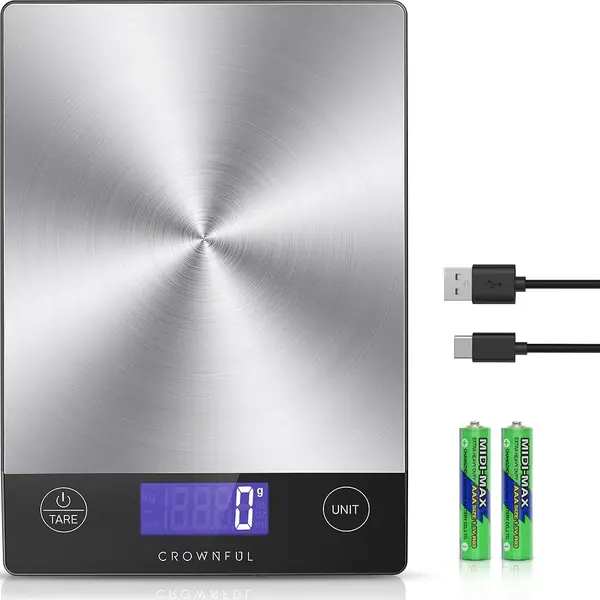
CROWNFUL 33-pound stainless steel food scale with slanted LCD and USB-C cable

Bulk and brine

Bake Score 92/100
Capacity
33 pounds (15 kg)
Units
Six, including milk ml
Increments
0.04 oz
Power
USB-C rechargeable or 2 AAA
View on Amazon

Thirty-three pounds, or 15 kilograms. That capacity is the entire argument for this scale: a full stockpot, a crate of apples headed for pie, a 15-kilo sack of flour being split into storage containers. The stainless panel is sized to match, and the display sits on a slant at the front so a wide pot doesn't shade the numbers.

It's the only rechargeable scale here — a USB-C port, with a pair of AAA batteries as backup for the day it runs flat mid-recipe. Six units, 1-gram steps, and a tare button we found responsive even with a loaded pot on the platform round out a feature set that sits below the mid-range picks on price.

The boundary is precision. If your baking runs on exact gram-by-gram additions, this isn't the scale you want, and the same goes for anything where you need two weighings of the same ingredient to agree exactly. If your kitchen runs on volume — bulk flour, big ferments, a brine for a turkey — capacity is what you're buying here, and the extra reach is worth the trade.

Worth Noting

  • Readings can drift between weighings
  • Charge doesn't last with daily use
Our Verdict

For bulk work only: 33 pounds of capacity and USB-C charging at a budget price, with accuracy that isn't as steady as the rest of this group.

Check Latest Price
7

Amazon Basics Digital Best for Simple Portioning

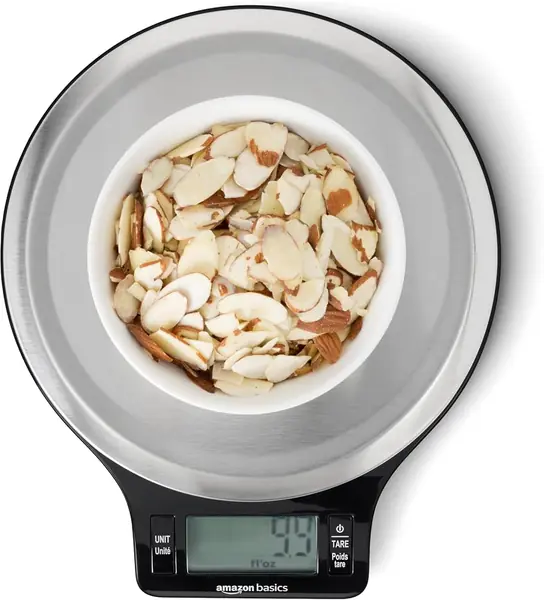
Amazon Basics digital kitchen scale with stainless steel platform and wide LCD

Simple portioning

Bake Score 91/100
Capacity
11 lb
Units
lb, oz, g, fl oz, ml
Increments
0.04 oz
Minimum Weight
0.07 oz
View on Amazon

Nothing about the Amazon Basics scale asks to be noticed. It's a flat stainless plate on a black plastic body, a wide LCD, and two buttons, with no extras bolted on, and it has sat in the same spot in our kitchen for months without needing anything from us. If you want a scale that disappears into the routine, this is the shape of it.

The specification is honest: 11 pounds of capacity, 1-gram resolution, five units including fluid ounces and milliliters, a tare button, and two AAA batteries in the box. The stainless platform is a good size for a mixing bowl or a food-storage container, and the wide display sits behind it where you can read it at a glance rather than leaning over the bowl.

What keeps it out of the top tiers is the long game. A scale built to this position in the market lives a harder life than its spec sheet suggests, and this one's track record over months rather than weeks is the least settled in this group. We haven't owned ours long enough to say how it holds up past the first year, and that uncertainty is exactly why it sits here rather than higher.

The other thing in its favor is disposability in the literal sense: it runs on AAA batteries you already have in a drawer, wipes down in seconds, and occupies so little space that moving it around the kitchen never feels like a decision. If it dies in a move or a bad spill, you won't mourn it.

Worth Noting

  • 2 g minimum misses small additions
Our Verdict

Buy it if you want gram-level weighing for very little money — the plainest scale here, and perfectly capable for portioning and everyday cooking.

Check Latest Price

How We Tested 16 Food Scales in Real Kitchens

We started by reading the specs and the review pages for every food scale we could find, then narrowed the field by capacity, resolution, platform size, and price, aiming for a spread of slim drawer models, full-size stainless scales, and high-capacity ones for big batches. That left us with 16, which we weighed with for four months.

Accuracy came first. We checked each scale against calibration weights on day one and again at the end, then ran a simpler test that mimics real cooking: the same bowl of flour set down, lifted, and set down again three times to see whether the readout repeated or wandered. We also trickled salt into a bowl a few grams at a time to watch how fast the numbers settled instead of bouncing.

Ease of use got tested at 7 a.m. and again at dinner. We tared heavy mixing bowls, switched between grams, ounces, pounds, and milliliters, and watched whether the display stayed visible once a bowl was on the platform. Each scale lived on a real counter for a week so we could see how much room it ate, and we wiped flour and spilled stock off every platform to check that nothing crept under the buttons.

Durability and battery life are slow to judge, so we let them accumulate. Scales were stacked in crowded drawers, carried to a friend's kitchen for a dumpling night, and left running to see how quickly auto shut-off kicked in, and we logged every battery change and recharge. Build quality showed up in small ways along the way — platform edges that flexed under a full bowl, buttons that needed a hard jab, feet that slid on a wet counter. We set all of it beside what each scale cost, and four months in, the ones still sitting on our counters never made us re-weigh anything.

How to Choose a Food Scale

Precision: What 1 Gram and 0.1 Gram Actually Buy

Resolution is the smallest change a scale can display, and it's the number to sort by first. One gram handles bread, cake, and portioning without complaint. Below about five grams it starts to matter: 3 grams of yeast rounded up to 4 is a third more yeast than the recipe asked for, and espresso doses live entirely in that zone, which is where a 0.1-gram mode under a kilogram earns its price.

Two traps catch people here. A scale showing 1-gram steps is not automatically accurate to 1 gram, because resolution and accuracy are different claims, and only a known weight tells you which you have. The minimum start weight matters just as much: a scale that begins reading at 2 grams can't help with a gram of salt. Bread and cake bakers can stay at 1 gram; anyone dosing yeast, salt, or coffee wants the finer mode.

Capacity and Platform Size: Start With Your Widest Bowl

Eleven pounds covers nearly everything a home baker does. Twenty-two pounds is for double batches, a stockpot of fruit for jam, or splitting a bulk bag of flour into containers. Capacity is the easy figure to compare.

Platform size is the one people forget, and it decides whether the scale is pleasant or maddening. A six-quart bowl on a saucer-sized platform overhangs the edges, loads the sensors off-center, and covers the numbers. Our large-batch pick's platform is 9 inches, the widest here. Set your own mixing bowl next to a ruler before you order — if it's wider than the platform you're considering, size beats extra units and a slimmer profile.

The Display Is the Feature You Stop Noticing Last

Backlighting matters if you bake early or late, and character size matters more than the number of units for anyone who doesn't want to lean in over a bowl. Position is the part most shoppers skip entirely: a front-mounted display sits low, so a dinner plate or a wide mixing bowl throws it into shadow, while a top-mounted or pull-out screen stays readable under the same bowl.

This is what separates a good digital kitchen scale from a frustrating one after the novelty wears off. If you weigh into mixing bowls rather than onto a plate, pay for the display before you pay for anything else — the OXO's pull-out screen and the Nicewell's forward placement both exist because of this exact problem.

Tare, Units, and Keeping It Clean

Tare subtracts the container, and where that button sits matters more than whether it exists. If it shares a panel with the weighing deck, pressing it nudges the platform and you re-zero by accident. Units are a smaller decision: grams for baking, pounds-and-ounces for older American recipes, milliliters if you weigh liquids — though the ml setting on nearly every scale assumes water, so milk reads a few percent light unless there's a milk mode.

For cleanup, a removable platform rinses in the sink, a sealed glass or stainless top wipes in one pass, and a fixed stainless plate leaves a seam where flour collects. Power runs the same way: AAA batteries are cheap and universal, coin cells are thin but short-lived, and USB-C charging ends the battery hunt at the cost of a cable you have to keep track of.

Frequently Asked Questions

Final Verdict

Most bakers should buy the Ozeri Pronto. The tare and unit buttons sit clear of the weighing platform, it reads in 1-gram steps from a listed half gram, and it handles every unit a recipe is likely to name, all at a mid-range price.

Spend more on the OXO Good Grips if you routinely set a wide dough bowl on the platform and want the display out from under it. Go smaller with the Etekcity bowl scale if your real problem is 2-gram additions rather than capacity, or with the Greater Goods if the scale has to vanish into a drawer between uses.