The 8 Best Baking Thermometers of 2026

There's a particular silence that falls over a kitchen when someone cuts into a chicken breast and finds the middle still pink. A thermometer is the cheapest insurance against that moment, yet the one rattling around most drawers is slow, a few degrees off, or awkward enough that it only comes out at Thanksgiving.

It also helps to know the category isn't one thing. Instant-reads are for spot checks, leave-in probes are for a brisket you plan to sit with, dial thermometers hang from an oven rack, and long-stem clip-on versions are built for sugar and hot oil. Pick the wrong format and accuracy barely matters.

We put 12 of them to work searing, deep-frying, tempering chocolate and holding a pork shoulder at a stubbornly low temperature, to see which were fast, which stayed honest after a few weeks of real use, and which earned their price.

Our Top Picks

The Best Baking Thermometers

1

ThermoMonster HT09 Best Overall
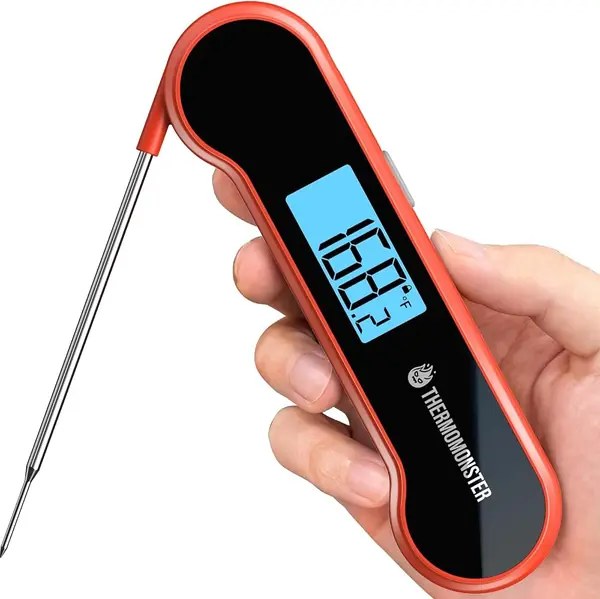
ThermoMonster HT09 red instant-read thermometer with four-inch probe and backlit LCD

Everyday baking

Bake Score 97/100
Response Time
0.5 seconds
Stated Accuracy
±0.5°F, NIST certificate
Temperature Range
Up to 572°F
Probe Length
4 inches
View on Amazon

Half a second is about how long you can hold an oven door open before the heat starts leaving, and that is the whole argument for the ThermoMonster HT09. Its thermocouple sensor settles almost before the probe is in the bread, and the two numbers that decide most bakes — a custard at 175°F, a loaf at 205°F — are exactly where a slow sensor wanders. We recommend it first because it is accurate in the band where baking happens, not just impressive at the top of the scale.

The probe runs four inches, which stops being a number on a page the first time you check a sandwich loaf or a deep ramekin: it reaches the center in one push. The reading locks on screen, so you can pull the probe out, shut the door, and read it at eye level instead of leaning into the heat. ±0.5°F is the tightest stated accuracy in this group, and the box includes a calibration certificate — more paperwork than most kitchen tools carry, and a fair signal about what you are buying.

At the top end it reads to 572°F, which puts hard-crack sugar and a pot of oil for doughnuts inside the range. The display flips to stay upright in either hand, and the motion sensor wakes it when you pick it up, so there is no button to find with a sticky finger. It runs on one AAA battery and sleeps on its own when you set it down.

What it costs you is drawer real estate. The body measures 10.5 inches with the probe, so it wants a long slot or a hook rather than a crowded crock, and there is no folding joint to shorten it. That is the trade for the fastest, tightest-spec instrument on this list at a mid-range price.

Worth Noting

  • 10.5-inch body needs a long drawer slot
Our Verdict

We make this our top pick for its half-second read, ±0.5°F stated accuracy, and four-inch probe that finds the middle of a loaf.

Check Latest Price
2

Alpha Grillers Best Value

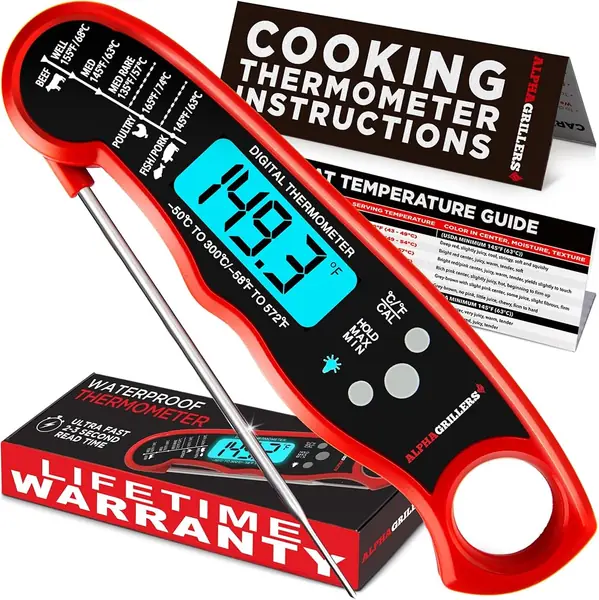
Alpha Grillers black and red digital thermometer with folding probe and blue backlight

Tight budgets

Bake Score 96/100
Response Time
1–2 seconds
Display
Backlit LCD
Power
1 CR2032 coin cell
Waterproof Rating
IP67
View on Amazon

The Alpha Grillers is the thermometer we point people to when they are not sure they want to spend much. Unfold the probe and it wakes up; fold it back and it shuts off. The read lands in a second or two, the blue backlight is bright enough for a dim kitchen, and the whole thing weighs 2.4 ounces, light enough to vanish into a drawer until you need it.

For bread, custard, and the Sunday roast, we think it does what the expensive ones do. The probe is thin enough to slide into a loaf without leaving a crater, the IP67 rating means raw dough and custard rinse straight off under the faucet, and the readout holds the number after you pull the probe out of the oven. Nothing about it feels like a compromise at the money.

The care instructions are worth reading before the first wash. The body is hand wash only, so rinse it under the tap and dry it rather than leaving it in a sink of dishes, and keep the probe out of a hot pan. The box includes a spare CR2032 in child-safe packaging, so the day the first one dies mid-bake is not the day you make a second trip to the store.

Worth Noting

  • Hand wash only despite the waterproof body
Our Verdict

We hand this to anyone spending as little as possible: a two-second read, a backlit screen, and a body you can rinse under the tap.

Check Latest Price
3

Lavatools Javelin PRO Classic Best Display

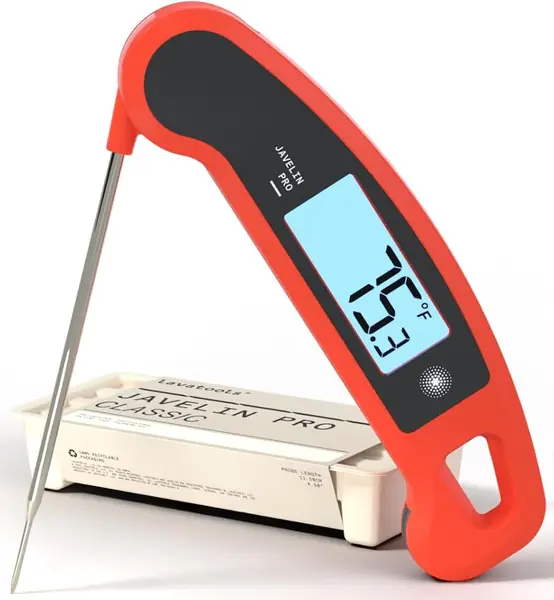
Lavatools Javelin PRO Classic instant-read thermometer in Sambal with two-inch rotating display

Frequent bakers

Bake Score 95/100
Response Time
2–3 seconds
Stated Accuracy
±0.5°F
Display
2-inch auto-rotating
Warranty
3-year limited
View on Amazon

Nobody needs a two-inch screen on a thermometer until the moment they are standing at an open oven with a pan in one hand and a probe in the other. The Javelin PRO Classic has the largest display in this group, it rotates a full 180 degrees so it stays upright whichever way you hold it, and the backlight comes on when you pick it up.

Behind the glass: a two-to-three-second read, ±0.5°F accuracy, a 482°F ceiling that clears hard crack and frying, and IP65 sealing for wiping down. At 4.6 ounces it feels like an instrument rather than a party favor. Lavatools covers it with a three-year limited warranty, the longest here, which counts for something in a category where the usual weak point is how long the thing keeps working.

Whether it earns its keep comes down to how often you look at it. We reach for the PRO when we are cycling through four things in a row — a sponge, a custard, a loaf, a pot of caramel — because the screen is legible at arm's length and we never have to bring the probe to our face to read it. For one loaf on a weekend, a cheaper thermometer reports the same temperature.

Worth Noting

  • Two-to-three-second read trails the fastest here
Our Verdict

We like it for bakers who read the number a dozen times a bake: the biggest, brightest display here, plus a three-year warranty.

Check Latest Price
4

Rubbermaid Oven Thermometer Best for Checking Your Oven

Rubbermaid stainless steel analog oven thermometer with round dial and rack hook

Checking oven accuracy

Bake Score 94/100
Temperature Range
60–580°F
Display
Analog dial
Mounting
Hangs on a rack or stands
Material
Stainless steel
View on Amazon

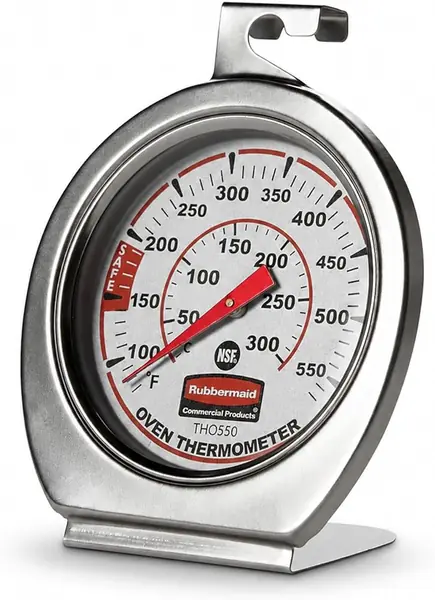
Most baking problems that get blamed on a recipe are an oven problem. Ovens cycle above and below their set temperature, and a dial reading 350°F can be sitting at 375°F by the time the cookies go in. The Rubbermaid is the least expensive way to find out what yours is up to: an analog dial that hangs from a rack or stands on one, reads 60°F to 580°F, needs no battery, and has no probe to lose.

Place it where the pan goes, not where the dial is easiest to see through the window. A thermometer on the top rack of a bottom-heating oven tells you something different from one on the middle rack, and the middle rack is where the cake tin sits. Let the oven come up to temperature, give it a few minutes to settle, then look — the useful number is the gap between what you set and what holds.

What it tells you is the temperature of the oven air, which is the thing a recipe assumes and your oven may not deliver. Ovens swing, and this dial swings with them; watch it through a full preheat and you can see the element cut in and out. It cannot tell you the temperature inside a loaf — that is a probe's job, and no oven dial does it.

Worth Noting

  • Dial is hard to read through the door glass
  • Narrow base can drop through wide rack bars
Our Verdict

We use this to check the oven rather than the cake: an inexpensive, battery-free dial that shows what your oven actually holds.

Check Latest Price
5

Taylor Candy and Deep Fry Thermometer Best for Sugar Work

Taylor stainless steel candy thermometer with twelve-inch probe and adjustable pan clip

Candy and caramel

Bake Score 93/100
Temperature Range
100–400°F
Probe Length
12 inches
Mounting
Adjustable pan clip
Stage Markings
Printed on the dial
View on Amazon

Sugar is the one baking job where you cannot hold the thermometer and the spoon at the same time. The Taylor solves that with a clip: fasten it to the side of the pot, set the probe in the syrup, and read the stage off the dial while you stir. The candy stages are printed right on the face — thread, soft ball, hard crack — so you are not consulting a chart with molten sugar in front of you.

We keep one of these for sugar and frying and prefer it to a digital for both. The 12-inch stainless probe holds your knuckles well above the steam, the 100°F-to-400°F range runs from jelly to doughnuts, and the insulated handle lets you reposition it mid-cook without hunting for a towel. There is no screen to fog up and no button to press with sticky fingers.

Twelve inches is a lot of thermometer, and it will not fit in a shallow drawer, so ours hangs on a hook beside the stove, which is where it belongs anyway. Two things make the readings better: keep the tip off the bottom of the pan, because metal against metal reads the pot rather than the sugar, and read it at eye level with the pot pulled off the heat.

Worth Noting

  • Printed stage markings wear with washing
  • Analog column takes a moment to settle
Our Verdict

We clip this to the pot when caramel and brittle are on the list — both hands stay free at 300°F.

Check Latest Price
6

TempPro TP-17 Dual Probe Best for Long Bakes

TempPro TP-17 silver digital thermometer with two probes and backlit LCD display

Long bakes

Bake Score 92/100
Stated Accuracy
±1.8°F
Temperature Range
Up to 572°F
Alarms
High/low and timer
Probes
Two stainless probes
View on Amazon

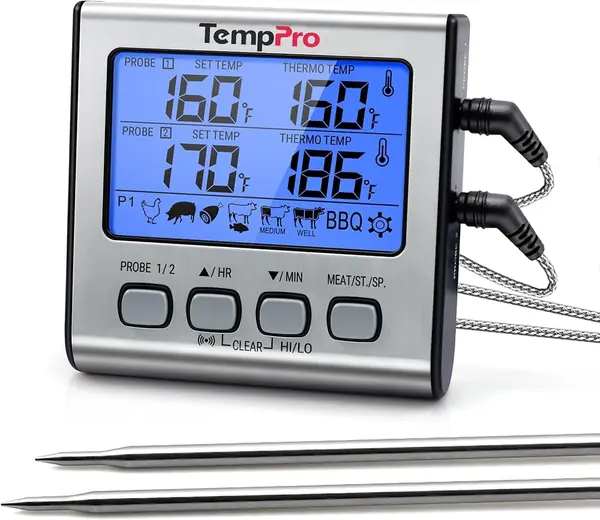
A probe you can leave in the loaf changes how you bake bread. Instead of opening the door to check and letting the heat out with it, you set a target — 200°F for a lean sourdough — and wait for the alarm. The TP-17 includes two probes, so one sits in the bread and the other hangs in the oven air, and the display shows what both are doing at once.

That display is a large backlit LCD with the food temperature, the second probe, and a timer visible together. The high/low alarm is the part that earns its place in a home bakery setup: set a band around your target and it beeps when the oven drifts out of it, which is how you catch the swing over a two-hour bake. The unit reads to 572°F, and the 8-inch probes reach the middle of a big boule.

Where we trust it less is precision. ±1.8°F is several times looser than the handheld picks here, so we use ours to answer is the loaf close rather than is the custard at 175. For the second question, an instant-read is the right tool, and the better ones on this list will read a custard to within a degree of each other.

Worth Noting

  • Probe cables are the wear point
  • No case, so probes and cables tangle
Our Verdict

We use this for bakes we do not want to open the door for: two probes, a high/low alarm, and a display that stays outside the oven.

Check Latest Price
7

Lavatools Javelin Best for Small Kitchens

Lavatools Javelin instant-read thermometer in Milk with folding probe and magnetic back

Small kitchens

Bake Score 91/100
Response Time
3–4 seconds
Stated Accuracy
±0.5°F
Probe Length
2.75 inches
Warranty
3-year limited
View on Amazon

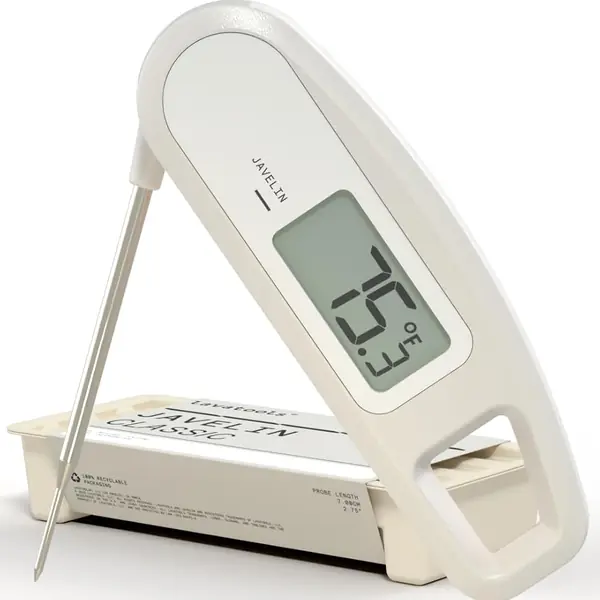
The Javelin lives on the refrigerator door in our kitchen, which is the highest compliment a thermometer can get — a tool you can see is a tool you actually check a loaf with. It folds to 4.5 inches, weighs under two ounces, and the magnets are strong enough to hold it on the fridge or the side of a stand mixer.

Inside it is the same family of sensor as the PRO: ±0.5°F, a 482°F ceiling, IP65 sealing that shrugs off a wipe-down, a three-year limited warranty, and around 4,000 hours of battery with auto-sleep after an hour of sitting. The display is 1.4 inches and does not rotate, so you turn the tool toward you rather than the other way around.

The probe is 2.75 inches, the shortest here. In a standard 8.5-by-4.5-inch loaf pan the middle of the loaf is about 2.25 inches in from the edge, so you are fine; in a deep Bundt, a tall charlotte, or a stockpot of custard, you will be reaching for something longer.

Three to four seconds is the other trade, and it is the price of a smaller, cheaper body rather than a flaw — with the probe already in the loaf, you will not notice the wait. What we notice is that it is always there, at eye level, ready when the timer goes off.

Worth Noting

  • Small 1.4-inch display
Our Verdict

We keep this one on the fridge: it folds to 4.5 inches, holds ±0.5°F, and costs less than its bigger sibling.

Check Latest Price
8

TempPro TP-19

TempPro TP-19 red instant-read thermometer with two-inch rotating display and folding probe

Big, flippable display

Bake Score 90/100
Response Time
2.5 seconds listed
Stated Accuracy
±0.9°F
Temperature Range
Up to 572°F
Display
2-inch auto-rotating
View on Amazon

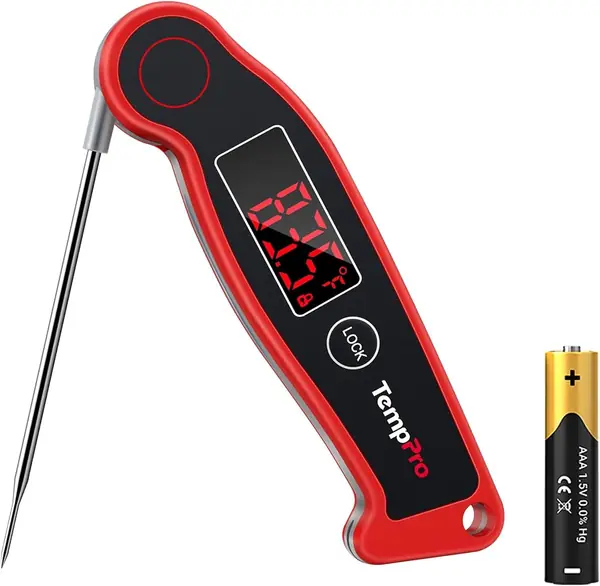
The display on the TP-19 rotates 180 degrees, so it reads upright whether you hold it in your left hand or your right, and at 2 inches across it is the biggest screen in this group. In a kitchen where two people bake and one of them is left-handed, that is not a gimmick.

The rest of the sheet is solid: ±0.9°F stated accuracy, a 572°F ceiling, a temperature lock so you can read the number after the probe comes out, IP65 sealing, and a calibration function you can set against an ice bath if the readings drift. It runs on a single AAA and switches on when you open the probe.

Speed is where the listing argues with itself: the bullet copy promises half a second, and the specifications table on the same page says 2.5 seconds. Plan for the slower number. It is quick, but it is a step behind the thermocouple in our top pick, and the gap shows up when you are holding an oven door open.

That leaves a good thermometer in a crowded spot on this list. The money buys a big, bright, flippable screen rather than another decimal place of accuracy, and for plenty of bakers the screen is the part they notice every single time. If you have ever tilted a thermometer toward the window to read it, this is the fix.

Worth Noting

  • ±0.9°F accuracy trails the leaders here
Our Verdict

We recommend it for the two-inch flipping screen and the calibration function, not the half-second read on the box.

Check Latest Price

How We Tested the Best Baking Thermometers

We started with a list of nearly 40 thermometers and filtered it by stated accuracy tolerance, probe length, response-time claims, display design, and price. Anything with a vague manual and no published tolerance got cut. We also made sure every format in the category was represented: folding instant-reads, leave-in probes with alarms, oven dials, and long-stem candy versions. Twelve of them came home with us for six months.

Accuracy got checked twice, in a 32-degree ice bath and in a pot of boiling water, with each reading compared against a reference thermometer we've trusted for years. We also tracked sugar syrup to 300 degrees and oil to 350, watching whether each unit kept pace as the numbers climbed. For speed, we started a stopwatch the second the probe went into a roast and stopped it when the display settled on a number that stopped moving.

Fit and stability matter more than they sound. We hung the dial models on an oven rack to see whether they stayed level or tipped out of sight, clipped the candy versions to a pot and stirred, and noted which clips slid down the rim. We checked probe length against a deep stockpot, opened folding probes one-handed in a greasy glove, and read every display from arm's length in a dim kitchen and outside at dusk.

Durability meant dropping each one from counter height onto tile, washing it the way the maker allows, and rechecking the seal after a week of sink duty. Value came last: did the extra money buy speed and consistency, or just a nicer box? The thermometers that survived all of it are the ones you'll see below.

How to Choose a Baking Thermometer

Start With the Job, Not the Spec Sheet

An instant-read probe answers what is happening inside a loaf, a custard, or a sponge. An oven dial answers what your oven is doing with the door shut. A clip-on candy thermometer answers what stage a pot of sugar has reached. Most kitchens end up with two of the three, because the jobs happen at different moments: one in your hand, the other while both hands are busy.

If you are buying a single thermometer, buy the instant-read. It covers more baking decisions than anything else in the drawer, and the oven dial is the cheap add-on you can pick up later.

Accuracy in the Band Where Baking Happens

Almost every number that decides a bake sits between roughly 100°F and 250°F: yeast dough, custard, bread, caramel. A thermometer can list an enormous range and still be vague in that band, so look for a stated accuracy figure rather than a maximum. ±0.5°F is instrument territory, ±1°F is good, and ±2°F is a rough guide.

Where you put the probe matters as much as the sensor. Push it past the first inch of a loaf; near the surface you are reading the oven, not the crumb.

Seconds at an Open Oven Door

Every check costs heat. A probe that settles in a second or two lets you open the door, take a reading, and close it again before the oven drops much; a slow one holds the door open long enough to matter on a delicate bake.

Advertised response times describe the sensor at its best, so trust the number that holds still rather than the first one that flashes up. A locking reading helps too — pull the probe out, shut the door, then read it at eye level.

Sugar and Frying Need a Different Tool

Sugar runs hotter than anything else in the baking drawer. Hard crack sits around 300°F to 310°F, jam sets near 220°F, and deep frying wants 350°F to 375°F. That rules out anything you have to hold over the pot, and it rules out instant-reads whose listed ceiling stops at 300°F.

A clip-on thermometer with the stages printed on the dial, a long probe, and a range to 400°F is what caramel, brittle, jam, and doughnuts actually require.

Probe, Display, and Cleanup

A thin probe leaves a smaller hole in a loaf; a long one reaches the center of a deep pan. Backlighting, a rotating or flipping screen, and big digits matter more than they sound when you are reading past a hot oven door in a dim kitchen.

On cleaning, the rating is the guide: IP67 can be rinsed under the tap, IP65 should be wiped, and a folding probe protects the tip between uses. Hand-wash instructions override the rating every time.

Frequently Asked Questions

Final Verdict

The ThermoMonster HT09 is the thermometer we point most bakers to, because it is accurate where baking is decided — custard, dough, bread — and fast enough that the oven door barely stays open.

If your bakes brown unevenly, add the Rubbermaid oven dial; it answers a question the HT09 cannot. And if sugar is the reason you are shopping, skip both and clip the Taylor to the pot.