The 5 Best Mechanical Kitchen Timers of 2026

My phone makes a perfectly good timer until my hands are covered in bread dough and the screen won't wake up. That's the afternoon I started keeping a wind-up timer on the fridge door, and the habit stuck — it ticks, you can read the time left from across the kitchen, and it rings whether or not anything is charged. We wound, set and dropped 14 of them to find the ones worth the counter space.

Here's what nobody tells you: the dial is the entire interface. You set five minutes by feel instead of pressing buttons, and the ring is a physical bell, not a speaker, so volume runs from a polite chirp to something you can hear over a vent hood. Magnets vary just as much — a timer that slides down the fridge every time the door shuts is worse than no timer at all.

Our five were accurate, loud enough and steady enough to stay where we stuck them. None of them connect to anything, which is exactly the point.

Our Top Picks

The Best Mechanical Kitchen Timers

1

ALBAYRAK Visual Kitchen Timer Best Overall
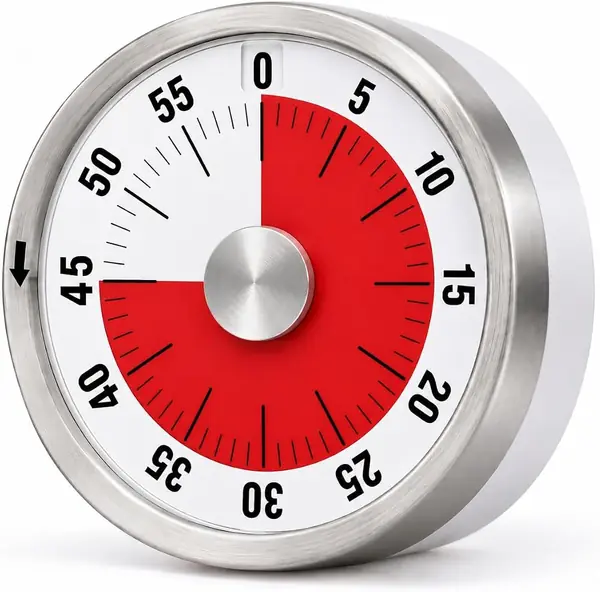
ALBAYRAK stainless steel visual kitchen timer with red dial and magnetic back

Everyday kitchen countdowns

Bake Score 88/100
Countdown Range
60 minutes
Alarm
85 dB mechanical
Mounting
Magnetic back
Body
304 stainless steel
View on Amazon

The first thing we noticed about this ALBAYRAK timer is the red wedge on its face: as the minutes run down, the color disappears, so you can see how much time is left before you read the numbers. At 2.6 inches across, it is small enough to live on the fridge or beside the stove, and the 304 stainless body gives it more heft than the plastic timers here. We think it is the best all-around mechanical timer in this group because it combines that visual countdown with an 85 dB alarm and a strong magnet.

Setting it is a two-step mechanical ritual: wind the dial past the 55-minute mark, then turn it back to the time you want. That is not a quirk to work around; it is how the spring gets enough tension to ring. We like that there is no battery door, no pairing, and no screen to wake. The alarm is a single chime rather than a repeating beep, which is fine when you are in the kitchen but easy to miss if you have moved to another floor.

The magnet is the detail that made it useful in our kitchen: it held on the fridge and the stove hood, and the small body turns easily with one hand when you are holding a spoon in the other. For everyday cooking and baking, the visual dial does more work than a plain number dial. Compared with the Taylor, it gives you a countdown you can read across the room; the Taylor gives you a longer ring.

Worth Noting

  • Single chime is easy to miss from another room
Our Verdict

For a battery-free timer that shows the time disappearing and sticks where you need it, the ALBAYRAK is our everyday pick.

Check Latest Price
2

Taylor Mechanical Kitchen Timer Best Classic Dial

Taylor brushed stainless steel mechanical kitchen timer with black dial and rubberized knob

Classic countertop cooking

Bake Score 86/100
Countdown Range
60 minutes
Alarm
Nine-second ring
Body
Brushed stainless steel
Base
Slip-proof
View on Amazon

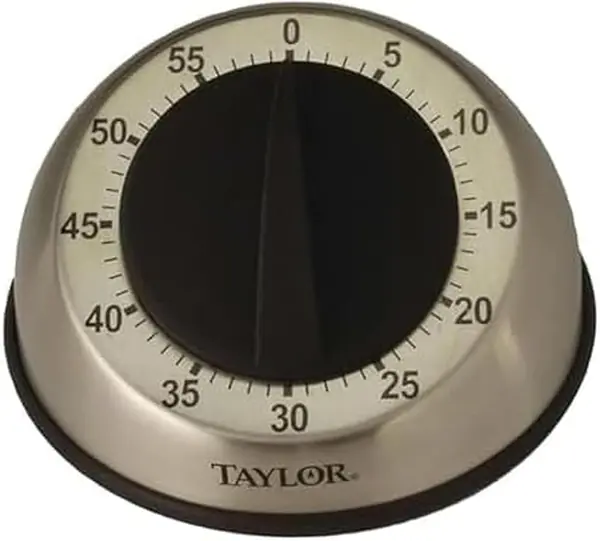
The Taylor's nine-second ring is the reason we keep coming back to it. Most mechanical timers announce the end of a countdown with a short ding; this one keeps ringing long enough to hear over running water or a stand mixer. The brushed stainless housing and rubberized knob feel more considered than the price suggests, and the black graphics on the large dial are easy to read without leaning in.

We like the old-school workflow: twist the dial to the time you want, and the alarm rings at zero. The slip-proof base is a small thing that matters when you are turning the knob with one hand, and there is no battery to remember. Compared with the ALBAYRAK, the Taylor is the better choice for a plain countertop timer: no visual disk, but a longer, more traditional ring.

The trade-off is that a mechanical dial is only as good as its movement. The Taylor can drift out of accuracy over time, and the one-year warranty is worth noting because the bell and winding mechanism are the parts that eventually give trouble. We still recommend it for the cook who wants a simple dial and a ring that lasts, not a gadget with a screen.

Worth Noting

  • Alarm may be too quiet for some kitchens
Our Verdict

For a classic countertop dial with a ring that lasts, the Taylor is our pick for cooks who want simple, battery-free timing.

Check Latest Price
3

Searon Mechanical Wind-Up Timer Best Compact Magnetic

Searon compact gray mechanical wind-up kitchen timer with stainless steel scale and magnet

Tight kitchen spaces

Bake Score 85/100
Countdown Range
60 minutes
Alarm
Mechanical bell
Mounting
Magnetic back
Warranty
2 years
View on Amazon

The two-year warranty is the first thing we check on a mechanical timer, because the winding mechanism is the part that usually fails. Searon backs this one for two years, which is more coverage than most of the timers here, and the compact 2.7-inch body still has a stainless steel scale and a magnetic back. We like it as the small, low-cost timer that can live on the fridge without taking up counter space.

Setting it follows the usual two-step: wind clockwise to 55 or 60 minutes, then turn back to the time you need. The ring is a clear mechanical bell. The magnet is handy, but it is also the weak point: the back can come loose, so treat it as a movable timer rather than a permanent fridge fixture.

Compared with the Taylor, the Searon is smaller and easier to tuck beside a coffee maker, and its two-year warranty is longer. Compared with the NUOSWEK two-pack, it gives you one timer instead of two. That warranty is why it earns a place for a small kitchen or a backup timer.

Worth Noting

  • Bell may be too quiet for a busy kitchen
Our Verdict

For a small kitchen or a backup timer, the Searon pairs a compact magnetic body with a two-year warranty and simple wind-up operation.

Check Latest Price
4

NUOSWEK Square 60-Minute Timer Best Two-Pack

Two white NUOSWEK square mechanical kitchen timers with magnetic backs and small dials

Two cooking zones

Bake Score 84/100
Countdown Range
60 minutes
Mounting
Strong magnet
Power
No batteries
Pack
2 timers
View on Amazon

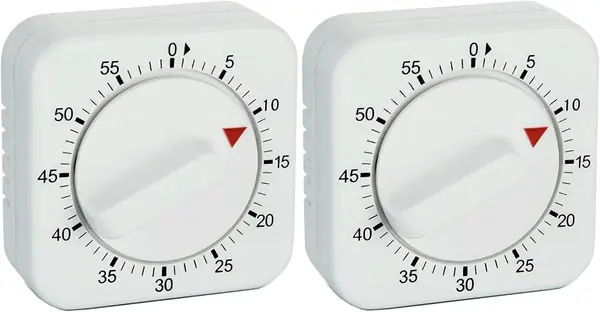
A two-pack solves a problem a single timer cannot: one can stay on the fridge and one can sit by the stove, so you are not carrying a sticky timer from one end of the kitchen to the other. Each NUOSWEK square is only 2.4 inches across, with a strong magnet on the back and a simple white face. We like the idea of splitting them between two cooking zones.

Setting is the same wind-past-the-mark routine: turn clockwise beyond 55 minutes, then back to the time you want. The ringer is a mechanical bell, but it is not a siren; in a noisy kitchen it can get lost under a vent fan. The magnet is the better part of the design, holding firmly to a fridge or metal stove panel.

The two-pack is the real advantage. Keep one by the stove and one on the fridge, and you can time two dishes without moving a timer with wet hands. The small dial is not the easiest to read from across the room, which is why we prefer the ALBAYRAK for a single timer that does everything. For a busy kitchen with two cooking zones, the pair is more useful than one fancier timer.

Worth Noting

  • Can ring slightly before zero
Our Verdict

For keeping a countdown at two cooking stations, the NUOSWEK square two-pack is our pick: small, magnetic, and simple to wind.

Check Latest Price
5

NUOSWEK Raccoon Timer Best for Kids

NUOSWEK gray raccoon-shaped wind-up kitchen timer with small dial and plastic body

Kids and classrooms

Bake Score 83/100
Countdown Range
60 minutes
Power
Wind-up mechanical
Design
Grey raccoon
Dimensions
2.3 x 2.3 x 3.6 in
View on Amazon

The raccoon face is the reason this timer gets used. A plain black dial can sit on the counter ignored; a small gray animal with a readable 1.5-inch face invites a child to turn it. We like that the numbers are clear enough for a young kid to recognize and the dial turns easily, so it can be part of a bedtime or homework routine rather than another gadget an adult operates.

Under the face is a standard 60-minute wind-up movement: turn the dial, and the bell rings at zero. It is compact at 2.3 by 3.6 inches and light enough to move from kitchen to desk. We think the raccoon earns its place as the kids' timer in this group, with a body that moves easily between rooms.

The simple movement is the risk: a timer this small can stop ticking after a short run, so test it on arrival and keep the receipt. Compared with the NUOSWEK square two-pack, the raccoon gives you one timer with more personality. For a child who needs a friendly nudge, that trade is worth it.

Worth Noting

  • Bell is too quiet for another room
Our Verdict

For a child's desk or a low-stakes kitchen countdown, the raccoon timer makes wind-up timing friendly enough that kids actually use it.

Check Latest Price

How We Tested (and Occasionally Dropped) 14 Kitchen Timers

We started by reading through listings and customer reviews for wind-up timers, then narrowed the field to 60-minute mechanical dials — no batteries, no digital displays — across a range of prices and styles, from plain brushed stainless to the animal shapes people buy for kids and classrooms. That left 14 timers, which we wound, set, and lived with for four months.

In the kitchen, we set each one for 5, 15, and 60 minutes and checked the ring against a stopwatch, then walked into the next room with the range hood running to see whether we could actually hear it. We stuck every magnetic base to a fridge door, an oven front, and the side of a stand mixer, then opened and slammed the door to see which ones slid or let go. For the desk and study timers, we noted how loud the tick was from arm's length — a couple were distracting enough that we moved them across the room.

We also dropped each timer from counter height onto tile, wiped chocolate batter off the dials with a damp cloth, and wound the springs to the limit over and over to see whether the ring got muddy or the knob started slipping. Appearance and build quality got judged last, after everything else: whether the markings were still readable from standing height, whether the housing felt like metal or like it would crack the first time it fell.

How to Choose a Mechanical Kitchen Timer

Set It Like a Spring, Not a Screen

Mechanical timers are set in two moves: wind the dial past the 55- or 60-minute mark, then turn it back to the time you want. Skip the first step and the spring may not have enough tension to ring clearly, or at all. We check that the dial moves smoothly and returns without a gritty feel, because a stiff or loose movement is the earliest sign of trouble. Practice the two-step once before you rely on it for a bake.

Match the Alarm to How You Cook

The alarm matters more than the dial. A nine-second ring like the Taylor's is easier to hear over a running faucet than a single chime, while an 85 dB alarm like the ALBAYRAK's is a better fit if you move between the kitchen and the next room. A short, quiet bell is fine for a timer that stays within arm's reach. Think about where you will be when it goes off, not just how loud it sounds on the counter.

Choose a Mount You Will Actually Use

A magnet is convenient on a fridge or stove hood, but it is not universal: some backs loosen, and a curved or hot surface is a bad match. A slip-proof base is the better choice if you work at the same counter every day. We like a timer that can do both, stand on the counter and stick to metal, because it can move with the task. Check that the magnet is recessed or firmly attached before you trust it with a timer over a hard floor.

Readability and the Person Turning It

A shrinking color disk is faster to read across a room than tiny numbers, which is why visual timers work well for kids and for anyone who sets a timer while doing three other things. A large black dial is easier for older eyes. If a child will use it, look for a knob that turns without a hard pinch and markings they can recognize. The best timer is the one the person in your kitchen will actually pick up.

Expect Some Mechanical Drift

Mechanical movements are not lab instruments. A timer can lose a few seconds over a long countdown, and a bump can knock the dial out of calibration. Test a new one against your phone or oven clock over the first week; if it is consistently early or late, exchange it while the warranty is fresh. A two-year warranty like the Searon's is worth more here than an extra feature, because the winding mechanism is the part that wears.

Frequently Asked Questions

Final Verdict

After testing the mechanical timers here, the ALBAYRAK Visual Kitchen Timer is the one we recommend first. Its red dial shows the time disappearing, the 85 dB alarm is loud enough for a normal kitchen, and the magnet keeps it within one-handed reach. If you want a classic dial with a long ring, choose the Taylor; if a child needs a timer they will actually use, choose the raccoon. The ALBAYRAK is the best default because it does the everyday job without asking for a battery or a second look.