The 7 Best Rolling Pins for Pie Dough of 2026

Pie dough is unforgiving. It wants cold butter, a light hand, and pressure that stays even from one end of the crust to the other, and it punishes you fast when any of that slips — I've watched a beautiful, shaggy disk turn stubborn and sticky in the time it took to answer a text. A rolling pin won't turn you into a better baker, but the right one stops working against you: it keeps the dough moving instead of tearing it, spreads pressure evenly so you're not chasing thick spots, and feels balanced enough that your forearms aren't done by the second crust.

I've rolled 14 pins through everything from all-butter dough to a batch of gingerbread that nearly broke me, and the pattern showed up quickly: weight and balance decide whether rolling feels like work or like nothing at all. A pin that's too light skips and bounces across the counter; one that's too heavy wears you out before the top crust is on. The group included tapered French pins, handled classics, marble, and stainless steel, and the way dough behaved against each surface was not a subtle difference.

Our Top Picks

The Best Rolling Pins for Pie Dough

1

Karryoung French Rolling Pin Best Overall
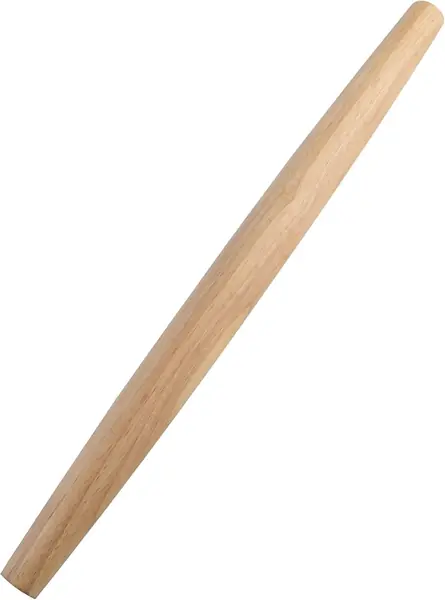
Karryoung French rolling pin, 17-inch tapered rubberwood dough roller with a smooth natural finish

Everyday pie dough

Bake Score 98/100
Material
Solid rubberwood
Length
17 inches
Weight
8.4 oz
Barrel Diameter
1.57 inches
View on Amazon

Pie dough is one of the few things in baking where you want to feel exactly what is happening under your hands, and this pin gives you more of that than anything else here. There are no handles to grip and no bearings between you and the wood — your palms ride the barrel a couple of inches from the dough, right where the pressure lands. The taper does the rest. Rock the pin on its middle and let the ends lift as you work outward, and a lump of chilled dough flattens into an even round without your leaning on any one spot.

Seventeen inches long and 1.57 inches across, it covers a 9-inch crust with room to move, and at 8.4 ounces it lifts away without denting what you just rolled. The rubberwood is sealed smooth and feels faintly cool, and a light dusting of flour is enough to keep a butter crust from grabbing. Nothing on it can work loose, which is more than we can say for the handled pins in this group.

Cleanup is a wipe with a damp cloth and a minute of air drying, since there are no joints for flour to pack into. It goes in a drawer, in a crock, or on the counter without needing a cradle. Because the finish is sealed rather than bare, it also skips the occasional mineral-oil rub that unfinished wood wants, and ours has stayed slick through a fall of steady pie baking.

Worth Noting

  • No thickness guides for exact rounds
Our Verdict

For pie dough this is the pin we reach for: your hands ride the barrel, so you feel the crust thin out instead of guessing at it through a handle.

Check Latest Price
2

Fox Run Marble Rolling Pin Best for Warm Kitchens

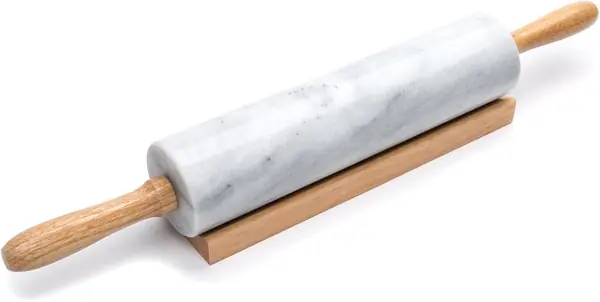
Fox Run polished marble rolling pin with wooden handles resting in its matching wooden cradle

Warm kitchens

Bake Score 97/100
Material
Marble with wood handles
Weight
4.6 pounds with cradle
Barrel Length
10 inches
Overall Length
18 inches
View on Amazon

Four and a half pounds of stone does a lot of the pressing for you, and that is the case for this pin in one sentence. Butter-heavy pie dough wants to be handled as little and as cold as possible, and the polished marble barrel gets the disk thin with very little downward force from you. The barrel is 10 inches long, set on wooden handles with nylon ball bearings, and the whole thing comes with a wooden cradle.

A warm kitchen is where it earns its keep. Wood picks up the room's heat, and a crust softens the longer you work it; marble stays cool, and a spell in the refrigerator before you start makes it colder still. We noticed the difference most on a second and third crust rolled back to back, when a wooden pin has had time to warm up in your hands.

Marble is not non-stick in practice, whatever the listing copy suggests: a soft butter crust clings to stone more than it does to floured wood, so keep the flour out and work quickly. The cradle, meanwhile, is not decoration. A stone cylinder with nothing to stop it will find the edge of the counter, and ours has lived in its cradle since the day it arrived.

Worth Noting

  • Handles and stone edges chip or snap if knocked
  • Roughly 4.6 pounds to lift and put away
Our Verdict

We recommend it for butter-heavy crusts in a warm kitchen: cold stone and four and a half pounds of weight do most of the pressing for you.

Check Latest Price
3

Quellance Rolling Pin and Mat Set Best for Even Thickness

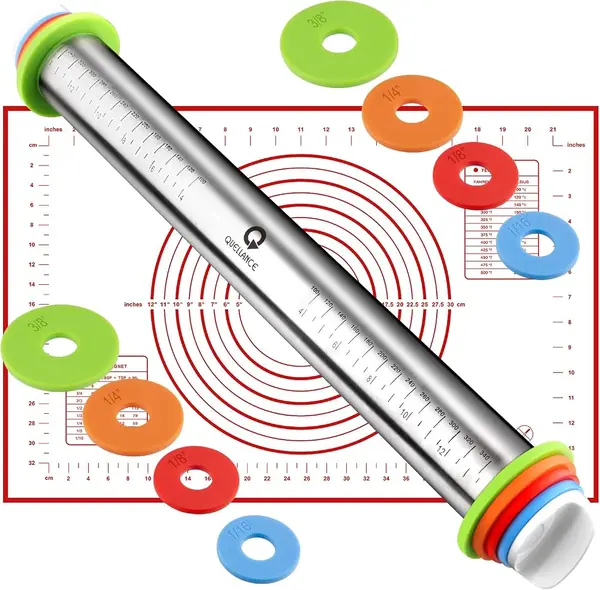
Quellance stainless steel rolling pin with red silicone pastry mat and four removable thickness rings

Even thickness

Bake Score 96/100
Material
430 stainless steel
Length
17 inches
Included
Pastry mat with measurements
Thickness Rings
1/16, 1/8, 1/4, 3/8 inch
View on Amazon

Four removable rings, marked 1/16, 1/8, 1/4, and 3/8 inch, slide onto the ends of this pin and hold the barrel exactly that far off the counter. Roll until the rings touch down and the sheet underneath is even from edge to edge. For a baker who already weighs flour and chills butter on a schedule, that repeatability is the whole appeal.

What we like for pie work is the 1/8-inch ring, which is about where a standard single crust lands. Rolling three or four crusts for a holiday bake, the difference between a lid at 1/8 inch and one at 1/4 inch shows up on the plate, and the rings settle it without any guessing. The 17-inch barrel is 430 stainless steel, non-porous and easy to wipe down, and the set includes a pastry mat printed with measurements.

Bare steel has one behavior worth knowing: it is slick when clean and grabby when a dough is damp, so dust the barrel, not just the counter, and do not count on the non-stick claim to do the work for you. The mat is the piece we underrated. Laying a rolled round on printed measurements tells you whether a 9-inch pan has enough overhang before you lift it, which is the moment you want to know.

The rings are small enough to lose. Thread them onto the barrel between rolls, because a set missing its 1/8-inch ring is missing the one a pie baker reaches for most.

Worth Noting

  • Rings set thickness, not the shape of the round
Our Verdict

Buy this set if you want every round to come out the same thickness; the four rings measure for you, and the mat tells you when a lid will fit.

Check Latest Price
4

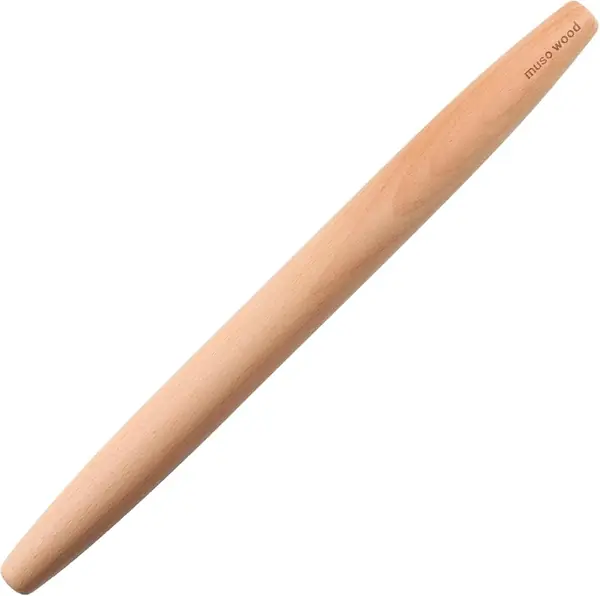
muso wood Beech French Rolling Pin Best for Small Kitchens

muso wood beech French rolling pin with tapered ends in natural beech, 15.75 inches long

Small kitchens

Bake Score 95/100
Material
European beech
Length
15.75 inches
Weight
8 oz
Diameter
1.37 inches
View on Amazon

If your kitchen is the kind where the mixer earns counter space and everything else lives in a drawer, this is the pin that fits. Fifteen and three-quarter inches long and 8 ounces, it slides in beside the spatulas and comes out without a search.

Beech, sanded three times over by hand, is why it feels better than its price suggests. The surface is close-grained and slick, the taper runs smoothly out to each end rather than stepping down, and there were no rough patches anywhere along the barrel of ours. It is also the plainest thing here in the best sense: one piece of wood, nothing to adjust.

The compact body is the point and also the trade. We like it for a single crust on a narrow counter, where a longer pin's ends hang off the edge or knock the flour can. The 1.37-inch barrel puts your hands closer together than a fatter pin does, which is steadier on a small round and slower on a big one.

It is unfinished beech, so it takes on water and stains if it sits wet; a damp wipe and a real dry is the routine. Do that and it stays as smooth as it came out of the wrapper. Ours has rolled a dozen crusts and looks new.

Worth Noting

  • Short barrel takes extra passes on wide batches
Our Verdict

This is the one we point to for a small kitchen: 15.75 inches of smooth beech that lives in a drawer and still rolls a full single crust.

Check Latest Price
5

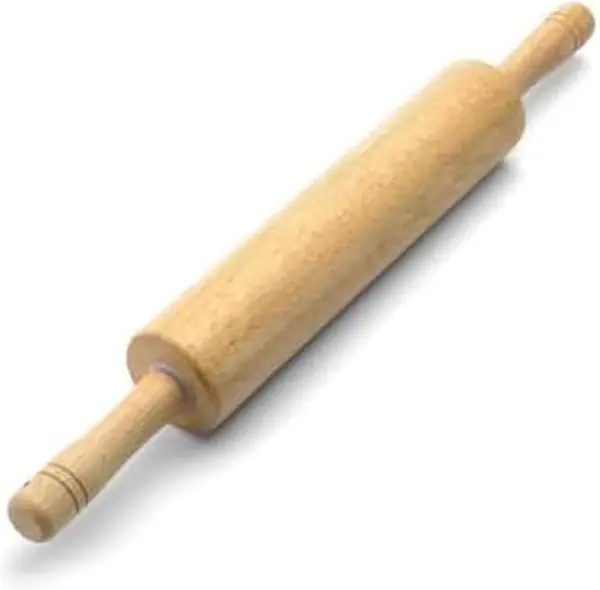
Farberware Classic Wood Rolling Pin Best with Handles

Farberware classic hardwood rolling pin, 18 inches, with ergonomic handles in natural wood

Handle lovers

Bake Score 94/100
Material
Rosewood
Length
17.5 inches
Weight
1 lb
Barrel Length
10 inches
View on Amazon

Handles are a preference, not an upgrade, and this is the pin for people who prefer them. There is a grip at each end, a 10-inch hardwood barrel between, and enough height that your knuckles clear the counter instead of dragging through the flour.

It weighs about a pound, light for its size, and the barrel covers a 9-inch round without repositioning. The rosewood arrives smooth and takes a dusting of flour well; a standard butter crust released from ours without any coaxing.

Where it is ordinary is where most pins are ordinary. This is a simple tool with no bearings, no rings, and no cleverness — just the shape everyone pictures, at a price that makes it easy to say yes. For cookies, biscuits, and a weeknight pie, that is plenty.

The trade is feel. Your pressure reaches the dough through the handles and the joint, and after rolling with a bare barrel we noticed how much more we could read through our palms. For most baking that gap is small; on a delicate crust it is real. It is a fair exchange for a grip that keeps your knuckles clean, and for everything short of a show-piece lattice, we are glad to have it in the drawer.

Worth Noting

  • Handles can work loose over time
Our Verdict

If you want handles, this is our pick: a light 10-inch hardwood barrel with a grip at each end, and the shape most bakers picture.

Check Latest Price
6

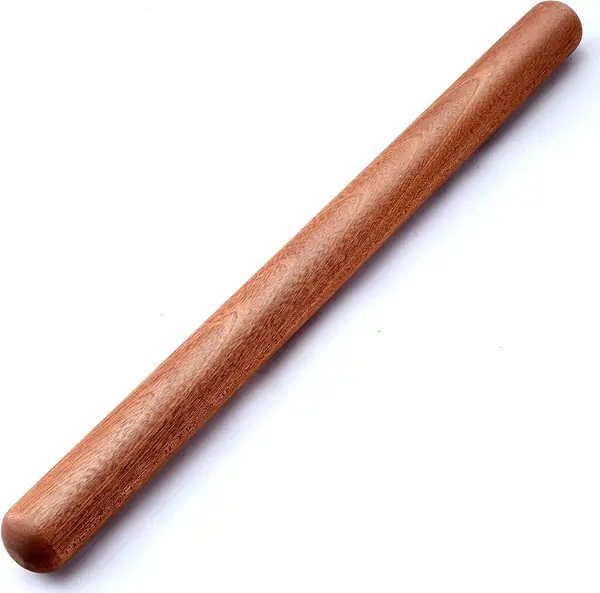
Aisoso French Rolling Pin Best for Big Batches

Aisoso French rolling pin, 17.7-inch solid natural wood dough roller in brown

Big batches

Bake Score 93/100
Material
Solid wood, unpainted
Length
17.7 inches
Diameter
1.38 inches
Handles
None, tapered ends
View on Amazon

Seventeen and seven-tenths inches is a long pin, and length is the reason to pick this one over the shorter French pins in this group. A wide sheet rolls in fewer passes, and your knuckles stay clear of the counter at the far edge of a big round.

The wood is good, too: solid, unpainted, unwaxed, sanded smooth, with a 1.38-inch barrel that carries a little more shoulder than the 17-inch Karryoung. We found the extra diameter steadier on a cold crust, where a thinner pin wants to rock off line. Both ends are rounded, which makes the pin handy for crushing garlic or herbs — a small thing a handle-free design can do and a handled one cannot.

Two things to check. The first is your drawer: at 17.7 inches this is the longest pin here, and a shallow one will not close on it. The second is the surface when it arrives. Run a hand along the barrel before the return window closes; a ding or an indent in the wood is worth exchanging rather than sanding around.

Otherwise it is bare wood, which means a rub of mineral oil when the surface starts looking dry and a prompt drying after every wipe. Do that and the long barrel keeps the slick finish it arrived with, which is the whole reason to own a pin this size.

Worth Noting

  • Long barrel will not fit a shallow drawer
  • Surface dings are worth checking on arrival
Our Verdict

The longest wooden pin here, and the one we choose for a double crust or a tray of hand pies that needs fewer passes.

Check Latest Price
7

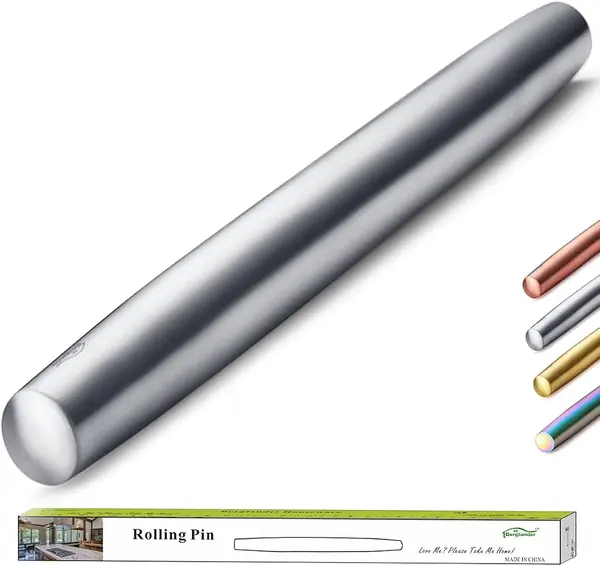
Berglander Stainless Steel Rolling Pin

Berglander stainless steel rolling pin, 16.7 inches, with a brushed matte silver finish

Chilled pastry

Bake Score 92/100
Material
18/8 stainless steel
Length
16.7 inches
Weight
8.8 oz
Finish
Matte
View on Amazon

Put this pin in the freezer for a while before you roll a butter crust and it does something no wooden pin can: it stays cold while you work. Steel holds temperature, and at 8.8 ounces this one handles easily straight out of the cold.

The rest is plain: 16.7 inches of 18/8 stainless, tapered at both ends, with a matte finish that looks brushed rather than chrome. There is nothing to break or adjust — no handles, no bearings, no wood to oil — and it wipes clean in seconds and goes back in the drawer.

Where it gives ground is grip. A dry, stiff mix like a scone dough or a firm pie dough clings to bare steel more than to wood, and the matte surface shows every smear until you wipe it. We like it best as the second pin in a kitchen: one in the freezer, one on the counter, whichever the dough wants.

The tapered ends mean you can roll a round without lifting the pin, and at 16.7 inches it stands upright in a crock or lies flat in a drawer without a cradle or a case. Nothing about it needs looking after.

Worth Noting

  • Dough clings to bare steel on dry mixes
Our Verdict

Keep it in the freezer before you roll a butter crust; this light steel pin holds the cold and wipes clean in seconds.

Check Latest Price

How We Tested Rolling Pins for Pie Dough

We built the shortlist by reading through reviews and spec sheets across wood, marble, and stainless steel pins, then narrowed a long list of about 40 down to 14. Anything reviewers repeatedly flagged for a cracked barrel, a loose or wobbly handle, or a barrel too short to span a 9-inch pie plate got cut before we ever unwrapped it. Each pin that made it through was weighed on a kitchen scale, measured for barrel length and diameter, and checked for whether the surface was sealed or left raw.

Testing ran three months, mostly on Sundays, because that's when pies happen in my house. Every pin rolled the same all-butter dough chilled overnight, plus a shortening crust, a batch of cookie dough, and — for the decorators on the team — a fondant-covered cake. Each one rolled two disks, one on a lightly floured counter and one on a bare surface, since sticking shows up fast when there's no flour buffer. We also rolled dough straight from the fridge on a warm afternoon to see which pins kept the butter cold and which let it soften under the barrel.

Sturdiness got a crude but useful test: both palms pressed hard at the ends of the barrel to see whether it flexed, creaked, or shifted in the handles. Ease of use came down to feel — how much pressure it took to get a disk to even thickness, whether the pin steered where I aimed it or skidded off course. After each session we cleaned every pin the way its maker specified (wood got a wipe and air-dry, never a soak) and checked week to week for grain lift, chips, scratches, or handles working loose. We also noted finish and appearance, because the pin you leave on the counter is the one you actually use.

How to Choose a Rolling Pin for Pie Dough

Handles or a bare barrel

Handles give you a grip and keep your knuckles off the counter, but they also put a joint between your hands and the dough, so pressure arrives slightly muffled. A bare barrel — the French style, tapered at both ends — puts your palms on the wood a couple of inches from the work, where you can feel the crust thin out.

If your hands or wrists bother you on long rolls, handles let you lean your weight into the pin, and that is a real advantage. Otherwise, for a single crust, the tapered pin wins on feedback. Both styles roll pie dough well; the choice is about how much feel you want.

How long the barrel needs to be

A 9-inch plate wants a round roughly 12 inches across once you allow for depth and overhang, and every pin here can manage that. Length matters more for volume: a 15- to 16-inch pin is the one that slides into a drawer and handles a single crust, while a 17- to 18-inch barrel covers a double crust or a tray of hand pies in fewer passes.

Measure the drawer before you order. The longest wooden pin here runs to 17.7 inches, and a shallow drawer will not close on it.

Wood, marble, or steel

Wood is the forgiving default: warm, faintly textured, and easy on a soft dough. Marble stays cold, which helps a butter crust in a warm kitchen, and its weight does a good share of the pressing — but a pin and cradle together can weigh close to five pounds.

Steel sits in between: non-porous, chillable, and lighter than stone. Pick by the temperature of your kitchen and by how much pressure your hands want to supply.

Thickness rings and mats

Removable rings hold the barrel a set distance off the counter, so the sheet comes out even everywhere: 1/8 inch is about where a standard single crust lands, and 1/16 inch gets you a very thin one. That is genuinely useful when you are rolling a dozen lids or cutting cookies.

What rings do not do is shape the round — that is still your hands. If you roll pie dough by eye and like it that way, you are not missing anything a crust needs.

Care that keeps a pin rolling

Two things retire rolling pins: water and knocks. Wood wants a wipe with a damp cloth and a thorough dry, never a soak, plus a rub of food-grade mineral oil when the surface starts looking dry. Sealed pins skip the oil.

Marble belongs in its cradle rather than loose on a counter, since a chipped edge or a snapped handle ends it. Steel and silicone mats are the easy ones: wash, dry, done.

Frequently Asked Questions

Final Verdict

Our pick for pie dough is the Karryoung French pin. Your hands sit on the barrel, the taper spreads the pressure across the round, and there is no joint or bearing between you and the crust — which is the whole reason it takes the top spot over pins with more features.

If your kitchen runs warm or you roll a lot of butter-heavy pastry, the Fox Run marble pin is the better buy: chill it and let the stone's weight do the pressing. Buy the Quellance set instead if you want every lid to come out the same thickness without thinking about it.