The 8 Best French Rolling Pins of 2026

For years my rolling pin had handles and ball bearings, and it did the job—until the afternoon I borrowed a plain tapered dowel to roll out pie dough and realized I'd been fighting my equipment. No handles sounds like less control. In practice you press through your palms, steer from the center out, and feel the dough instead of just pressing down on it.

After rolling pie crust, cookie dough, pizza and fondant with 14 of them, we found the differences come down to length, weight, and how the surface behaves against dough. Size surprises people: a long pin spans a big crust in a single pass, but a 20-inch dowel won't fit a crowded drawer, and the short ones are what I reach for on small batches. Wood gets wiped, never soaked; metal handles a sink of suds.

None of these cost much, which is exactly why a bad one is so irritating—a pin that's slightly off rolls slightly off dough. The list covers both ends of the drawer-space spectrum and everything between.

Our Top Picks

The Best French Rolling Pins

1

KARRYOUNG French Rolling Pin, 17-Inch Best Overall
KARRYOUNG 17-inch rubberwood French rolling pin with tapered ends and sealed wood finish

Everyday home baking

Bake Score 98/100
Length
17 in
Material
Rubberwood
Barrel Diameter
1.57 in
Weight
8.4 oz
View on Amazon

Most French pins in this group commit to one idea: short and nimble, or long enough to cover a whole sheet of pastry. The KARRYOUNG sits in the middle at 17 inches, and after rolling pie crust, cookie dough, and a stubborn batch of pizza dough with it, we think that middle ground is the right default for a home kitchen. It is the pin we hand to someone who bakes a few times a month and wants one tool that does all of it.

The barrel is 1.57 inches across, thick enough that there is real wood under your palms when a dough fights back, and the taper at each end is gentler than a classic French profile. That gentler shape keeps more of the pin in contact with the dough, which we found forgiving while pivoting to round out a crust. It steers without the narrow, sharp taper that can dig a line into a soft sheet.

Rubberwood is a sensible choice for a kitchen tool. The surface is sealed and smooth, so a light dusting of flour keeps dough from grabbing, and cleanup is a wipe with a damp cloth. The whole pin weighs 8.4 ounces, which keeps your wrists fresh over a long session but means you supply the muscle on cold, stiff dough.

Seventeen inches is also about the practical limit for most drawers and counters, so it stores without a fight. Past that you are into the 20-inch range, which is a different tool for a different baker.

Worth Noting

  • Light 8.4-ounce body means you supply the pressure
  • Wood must be wiped clean and dried, never soaked
Our Verdict

Our pick for most kitchens: 17 inches covers pie crust through pizza, and the forgiving taper makes the handle-free motion easy to learn.

Check Latest Price

2

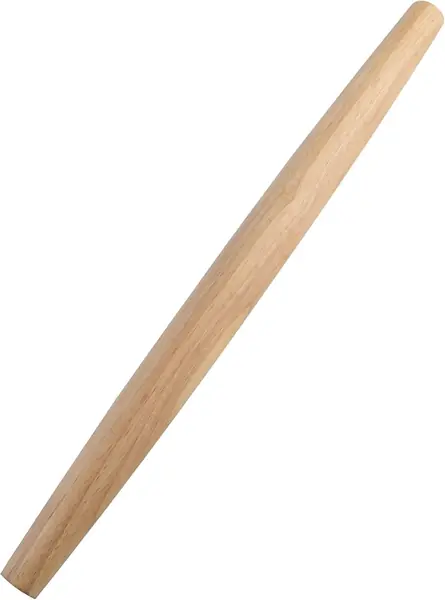
J.K. Adams French Tapered Rolling Pin, 20.5-Inch Best for Big Batches

J.K. Adams maple French tapered rolling pin, 20.5 inches, natural light wood

Large batches and sheets

Bake Score 97/100
Length
20.5 in
Material
Maple
Barrel Diameter
1.75 in
Weight
14.4 oz
View on Amazon

Twenty and a half inches is a lot of rolling pin. On a small counter it reaches past the dough, and it will not drop into a shallow drawer the way a 15-inch pin will. We are still glad it is in the group, because on a big sheet of pastry or a double batch of cookies, that length stops being excess and becomes the reason to own it.

At 1.75 inches across and 14.4 ounces, it is the heaviest and thickest wood pin here. That mass does work for you: you lean into stiff dough and let the pin flatten it instead of pushing from the shoulders, and it stays steady through a long roll. The maple is only lightly finished, which matters more than it sounds, because the fine texture holds a dusting of flour rather than letting it slide off, so a soft dough releases instead of tearing.

What we appreciate most is that the size does not cost control. It pivots smoothly on those tapered ends, so rounding out a crust is a matter of pressure rather than wrestling. Add a lifetime warranty and Vermont woodworking behind it, and this is the pin we point to for anyone who bakes in volume.

It asks something back: hand washing, an occasional coat of food-safe mineral oil, and more money than anything else here. For a weekly baker, that is a fair trade for a tool that will outlast the kitchen it lives in.

Worth Noting

  • Too long for shallow drawers and small counters
  • Wood needs periodic mineral-oil conditioning
Our Verdict

Worth it for weekly bakers who roll wide sheets: the heft and flour-friendly maple make big jobs easier, if you have the counter and a deep drawer.

Check Latest Price
3

Ultra Cuisine French Rolling Pin with Measurements Best for Cold Dough

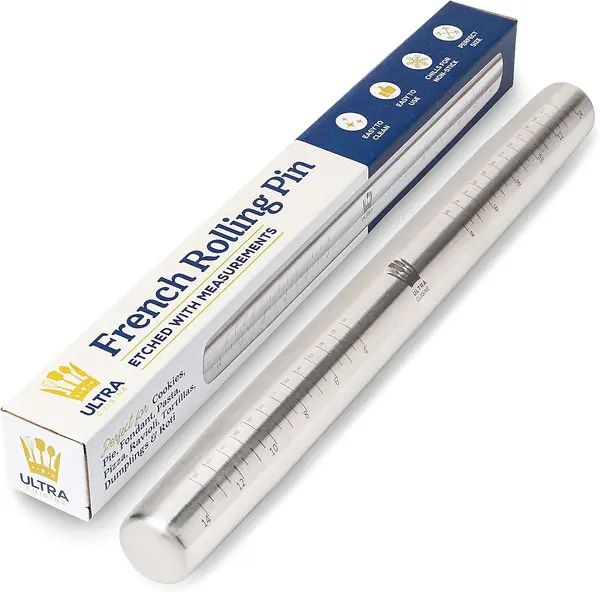
Ultra Cuisine stainless steel French rolling pin with etched measurement markings along the barrel

Pie crust and laminating

Bake Score 96/100
Length
15.75 in
Material
Stainless steel
Barrel Diameter
1.5 in
Markings
Etched measurements
View on Amazon

Numbers are etched along the barrel of this one, and they change how you roll. Rather than eyeballing a crust, you check the pin against the dough, so a 12-inch pizza base or a tray of cinnamon rolls comes out the same thickness twice running. We used the markings more than we expected to, especially for anything that gets cut into portions.

That feature is why this stainless pin earned a place over a second wood one. Steel is nonporous: it goes in the dishwasher, needs no oiling, and can sit in the freezer before you roll a cold-butter pie dough, a trick that keeps the dough from softening under your hands. At 15.75 inches and 10 ounces it is light and quick to pivot, more nimble than the wood pins here.

The trade-off is texture. Steel is slick, and slick cuts both ways: dough does not stick, but the pin can skate across a taut crust instead of gripping it. A little more flour on the bench and a lighter hand fix most of that. If you like the slight grab of wood under a soft dough, you will miss it.

Worth Noting

  • Slick steel can slide over dough instead of gripping
Our Verdict

The pick for pie dough and laminated pastry, and for anyone who wants to skip hand washing: chill it, roll, then put it in the dishwasher.

Check Latest Price
4

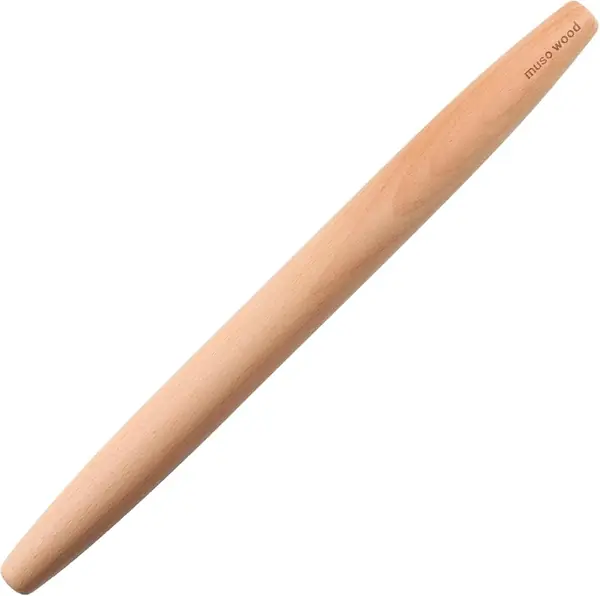
muso wood Beech French Rolling Pin, 15.75-Inch Best Value

muso wood 15.75-inch beech French rolling pin with tapered ends, natural finish

First pins, tight budgets

Bake Score 95/100
Length
15.75 in
Material
Beech wood
Barrel Diameter
1.37 in
Weight
8 oz
View on Amazon

There is not much money riding on this pin, and that is part of its appeal. What you get is the size most recipes assume, 15.75 inches long and 1.37 inches across, in European beech that has been sanded three times by hand. Out of the wrap it felt smoother than we expected at this end of the price range, with no burrs and no rough patch at the tapered ends.

Beech is dense and fine-grained, which is why it takes that finish so well. The surface is closed enough that dough releases with a light flouring, and the taper lets you lift and turn a crust without stretching it. At 8 ounces the pin is light enough to roll with for half an hour without thinking about your wrists.

This is the pin we hand to a new baker, because the proportions are the ones in most recipes and there is nothing to learn beyond keeping your palms on the barrel. The classic size also means it stores where a longer pin will not, in the drawer by the flour in our case.

Worth Noting

  • Narrow 1.37-inch barrel covers less dough per pass
Our Verdict

Our value pick: classic 15.75-inch proportions and a hand-sanded beech surface, for a pin that costs very little and should last years.

Check Latest Price
5

AISOSO French Rolling Pin, 17.7-Inch

AISOSO 17.7-inch wooden French rolling pin, unpainted brown wood with tapered ends

Wide sheets on a budget

Bake Score 94/100
Length
17.7 in
Material
Wood
Barrel Diameter
1.38 in
Finish
Unpainted, unwaxed
View on Amazon

If you roll big sheets, a slab of cinnamon rolls, a full round of pizza dough, pasta rolled long, this is the pin that keeps your hands off the dough. At 17.7 inches it is the longest wood pin here apart from the J.K. Adams, and it is slimmer at 1.38 inches, so it feels like a rod rather than a barrel.

The wood arrives bare: no paint, no wax, sanded fine, with rounded ends that double as a muddler for garlic, herbs, or spices. We like the unfinished surface for dough, since bare wood takes a dusting of flour and holds it, which is what keeps a soft dough from sticking. It wipes clean with a damp cloth and wants nothing more than that.

If you roll to set thicknesses with guide rings, check that a set fits a 1.38-inch barrel before you count on them, because that diameter is less common than 1.5 inches and it is the one practical snag we found. Otherwise this is a lot of pin for the money, and the length does the work on wide sheets.

Worth Noting

  • 17.7 inches crowds a small counter and drawer
Our Verdict

A long, bare-wood pin for bakers who roll big sheets and do not want to spend much, provided your counter has room.

Check Latest Price
6

QUELLANCE Wood French Rolling Pin with Baking Mat

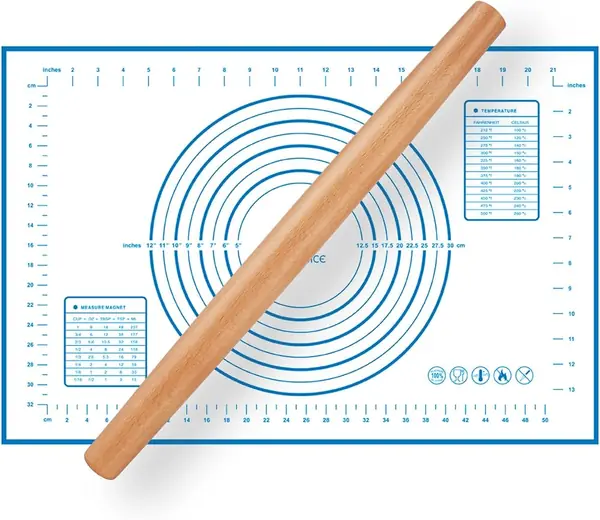
QUELLANCE beech French rolling pin with blue silicone measuring baking mat

Beginners who want a mat

Bake Score 93/100
Length
16 in
Material
Beech wood
Barrel Diameter
0.83 in
Includes
Silicone mat, 23.6 by 15.7 in
View on Amazon

The mat is the reason to look at this set. It is a 23.6-by-15.7-inch silicone sheet printed with measuring guides, and it grips a countertop instead of sliding while you work, so you can roll, measure, and cut a batch of tortillas without flouring half the kitchen.

The pin is the odd one in this group: 16 inches long but only 0.83 inches across, closer to a dowel than the thick barrels elsewhere here. We found that slim shape nimble, easy to flick around a small round of fondant or a single pie crust, and the taper gives a clear pivot point for rounding edges.

Beech, burnished smooth, wipes clean in seconds, and the mat rinses in the sink and rolls up for storage. On a small counter, though, a mat this size is most of the workspace, so measure before you commit.

Worth Noting

  • Thin, light barrel needs arm pressure on stiff dough
Our Verdict

A good beginner set: a slim, nimble 16-inch pin plus a measured silicone mat that stays put on the counter.

Check Latest Price
7

GOBAM Wood Rolling Pin, 11-Inch Best for Small Batches and Drawers

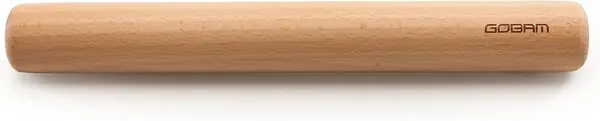
GOBAM 11-inch beech wood rolling pin, slim tapered barrel, natural finish

Small batches and drawers

Bake Score 92/100
Length
11 in
Material
Beech wood
Barrel Diameter
1.38 in
Weight
7.05 oz
View on Amazon

Eleven inches sounds tiny next to the 17- and 20-inch pins here, and it is, but it is also the length that lives in the drawer with the spatulas and stays out on a small counter without taking it over. For tortillas, dumplings, and chapati, where you work one small round at a time, it is the pin we kept reaching for.

It is beech, burnished and finished with cooking oil, 1.38 inches across with tapered ends, and it wipes clean and dries fast. The hand-polished surface has enough grip to hold a light dusting of flour, so dough does not skate away from it.

At 0.2 kg it is the lightest pin here, easy to work one-handed while the other hand turns a tortilla or lifts an edge to check for sticking.

Our take: it earns its drawer space in a small kitchen, and it is the one we reach for when the job is a stack of flatbreads rather than a sheet of pastry.

Worth Noting

  • 11-inch barrel is too short for wide pastry
Our Verdict

The pin for small batches and cramped kitchens: short, light, and easy to keep in a drawer.

Check Latest Price
8

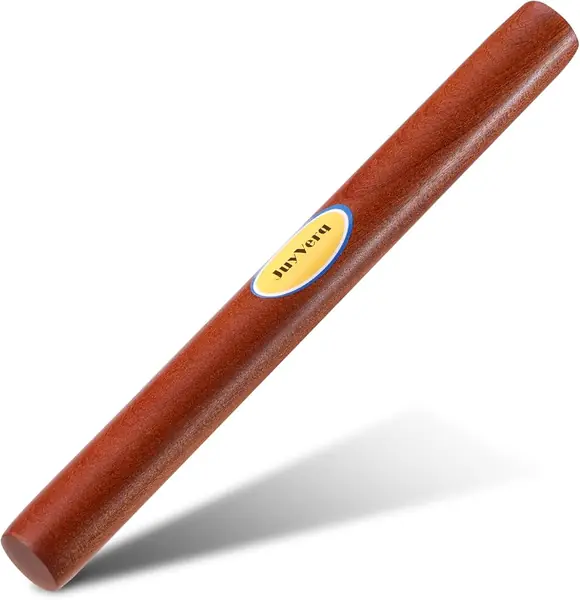
JuyVerq Wood Rolling Pin, 15.75-Inch Best for Small Jobs and Kitchens

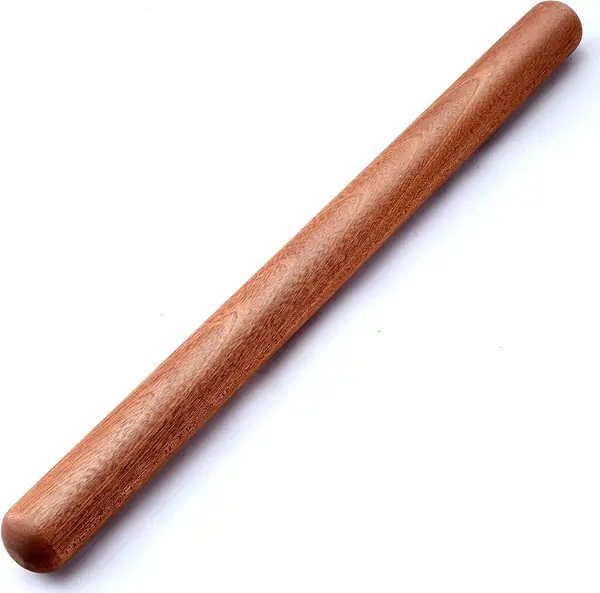
JuyVerq 15.75-inch sapele wood French rolling pin with oiled finish, tapered ends

Small jobs and kitchens

Bake Score 91/100
Length
15.75 in
Material
Sapele wood
Barrel Diameter
1.25 in
Weight
7.76 oz
View on Amazon

What surprised us about this pin was the weight, or the lack of it. It is 0.22 kg of sapele and it sits in the hand like a pencil next to the J.K. Adams, easy on the wrists and easy to steer over a small piece of dough.

The barrel is 1.25 inches across, the slimmest of the full-size pins here, polished and treated with edible oil so dough releases with a light flouring. Sapele is a dense hardwood and the finish shows it: even grain, rounded ends, no rough spots where your palm sits.

Where it shines is small work, a single pie crust, a round of fondant, empanadas, a batch of cookies, and in kitchens where a 17-inch pin would be in the way. Where it runs out of authority is a stiff bread dough or a wide sheet, where a thin, light barrel means more passes and more pressure from you.

For very little money it is a capable pin, and the light weight is why we kept picking it up for quick jobs instead of hauling out something heavier.

Worth Noting

  • Bare wood wants an occasional re-oil
Our Verdict

A light, slim pin that suits small batches and small kitchens, and the least expensive way to try the handle-free shape.

Check Latest Price

How We Tested French Rolling Pins

We started by gathering the French pins people actually buy, then narrowed the group by taper, length, material, and price so the final field ran from a stubby 11-inch dowel to a full 20-inch pin, in beech, sapele, and stainless steel. Fourteen made the cut, and each one got four months of use.

Testing happened where rolling pins actually live: a flour-dusted counter on Saturday mornings, weeknight pizza, a long stretch of cookie batches, and a birthday cake's worth of fondant. With every pin we rolled chilled pie dough to an eighth of an inch and measured the middle and the edges to see whether the thickness held, counted the passes it took to work a 12-inch round, and noted whether dough grabbed at the surface or needed extra flour. We also paid attention to how each one moved under the hands—whether the taper let us steer at the ends or made the pin wander off course.

Cleaning got its own round. After each session we wiped the wooden pins with a damp cloth and let them air-dry, then checked the surface for raised grain, roughness, and hairline cracks that would trap dough; the steel pin went into soapy water and through the dishwasher twice. We measured every pin against a standard drawer and a utensil crock, because a long dowel that rolls beautifully can still be a nuisance to store. Last, we set what each one cost against how it performed, since a pin only has to be good once to earn its price back.

How to Choose a French Rolling Pin

Match the Length to What You Roll

Short pins of 11 to 13 inches suit tortillas, dumplings, and drawers that will not take anything longer. Fifteen to 17 inches covers pie crust, cookies, and pizza without overhanging most counters, and that is the range we treat as the default. Past 20 inches you are buying coverage for wide pastry sheets, which is a real need if you laminate dough and an awkward one if your workspace is small.

Measure the drawer before you fall for a long pin. A 20.5-inch maple like the J.K. Adams will not drop into a shallow one, and a pin that lives on the counter instead of in a drawer is a pin you have to find room for.

Taper, Diameter, and Control

The tapered ends are the whole idea. You press near an end to pivot and round a circle, and you work from the middle for even pressure. A pronounced taper steers sharply but leaves less wood on the dough; the milder shape on the KARRYOUNG keeps more of the barrel in contact, which is more forgiving while you learn.

Diameter decides heft. Barrels of 1.5 to 1.75 inches flatten stiff dough with less effort, while a slim 0.83-inch pin like the QUELLANCE is nimble for fondant and small rounds. Handle one before you buy if you can, palms on the barrel, because that is the only grip this design gives you.

Wood, Steel, or Bamboo

Wood holds a dusting of flour, and that thin flour layer is what keeps soft dough from sticking. It also wipes clean in seconds, though it wants hand washing, prompt drying, and an occasional coat of food-safe mineral oil. Stainless steel is nonporous: dishwasher safe, never oiled, and chillable for cold-butter dough. The catch is that steel is slick, so it can skate over a taut crust rather than grip it.

Bamboo is hard and light, but tapers and diameters vary widely, and a thin pin behaves nothing like a 1.5-inch barrel. Judge it by the numbers, not by the material label.

Weight and Your Wrists

An 8-ounce pin steers easily and tires you less; a 14-ounce maple pin does more of the flattening for you. If you bake bread and stiff dough weekly, weight is worth having. If you roll delicate pastry, lighter is easier to control, and most bakers land somewhere in the middle.

For pie season specifically, remember that a metal pin can be chilled. That does more for a flaky crust than a few extra ounces ever will.

Frequently Asked Questions

Final Verdict

For most kitchens we recommend the KARRYOUNG 17-inch pin. It is the length that covers pie crust, cookies, and pizza without overhanging the counter, and the gentle taper makes the handle-free motion easy to learn. That it costs so little is a bonus, not the reason it wins.

Two requirements change the answer. If you regularly roll wide sheets or bake in volume, the J.K. Adams 20.5-inch maple is the better tool, provided you have the counter and a deep drawer. If pie dough and laminated pastry are your focus, the stainless Ultra Cuisine with etched measurements earns its place in the freezer.