The 5 Best Non-Toxic Bread Makers of 2026

The pan is the part of a bread maker that touches your food, and it's the part most product pages gloss over. "Nonstick" can mean a coating that starts flaking by the twentieth loaf, which is why so many shoppers now hunt for ceramic. Ceramic isn't automatically better, though — the cheap versions grab a loaf harder than the coating they replaced. Of the 12 machines we baked with, the good ones share more than a pan material.

Bread makers are forgiving appliances: you load the pan, press a button, and come back to something that smells like a Sunday. What separates them is everything around that — whether the knead wakes the house, whether the machine shimmies across the counter on a stiff whole wheat dough, and whether the gluten-free cycle turns out a loaf you'd serve to a guest. The manual matters too; I've watched add-ins turn to paste because nobody explained when the fruit dispenser opens.

Our five held up past the honeymoon, earned their counter space and left us confident about what's in the coating.

Our Top Picks

The Best Non-Toxic Bread Makers

1

KBS Pro 2.2LB Bread Maker Best Overall
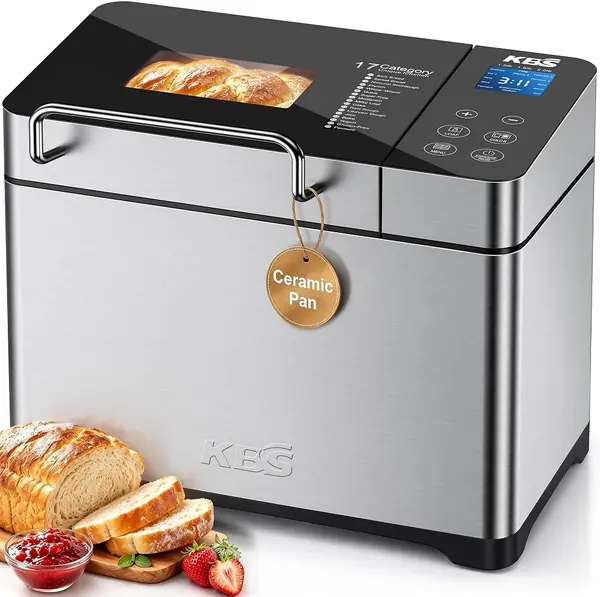
KBS Pro stainless steel bread maker with ceramic pan and glass touch panel

Most households

Bake Score 89/100
Pan Material
Ceramic pan and paddle
Loaf Capacity
2.2 lb
Programs
17 plus one custom
Delay Timer
15 hours
View on Amazon

The non-toxic question on a bread maker comes down to one part. Dough sits in the pan for three hours, and the pan is where KBS makes its claim: a ceramic pan and paddle the listing describes as healthier than a Teflon coating. Around it sits a stainless body, a 710-watt motor, and a 2.2-pound maximum loaf.

A claim alone wouldn't be enough. What settles it for us is the record behind the results — performance and taste are the strongest of any ceramic machine here, and the basic and whole-wheat cycles we ran turned out light, evenly browned loaves. The automatic dispenser drops nuts and raisins mid-cycle rather than at the start, and the 15-hour delay means you can load it at night and wake up to warm bread.

The pan is the part that needs your attention. Hand wash it with a soft sponge, skip the dishwasher, and keep metal utensils out of it — that's true of every ceramic pan here, and it's the difference between a surface that lasts and one that chips and leaves you shopping again. Dry it fully before it goes back in the machine.

The kneading paddle can be stiff to pull free after a bake, which is what the included hook is for. And at 14.7 pounds this isn't a machine you'll move for every loaf. Its footprint is about 13.5 by 10 inches, so check that corner of the counter before it arrives — the lid swings up, and the vents need air behind them.

Worth Noting

  • Manual and recipe measurements are hard to follow
Our Verdict

For most households, this is the non-toxic bread maker we recommend: a stated ceramic pan and paddle, a 2.2-pound loaf, and the most consistent results in this group.

Check Latest Price
2

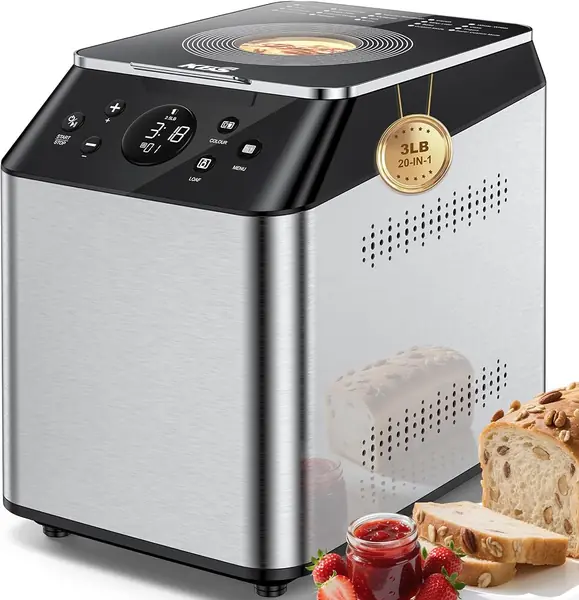
KBS 3LB Bread Maker Best for Big Families

KBS 3-pound bread maker with ceramic pan, dual heaters, and fruit dispenser

Large families

Bake Score 87/100
Pan Material
Ceramic, sintered at 1832°F
Loaf Capacity
3 lb
Weight
15.4 lb
Custom Programs
2
View on Amazon

Three pounds is the number that decides this machine. A loaf that size covers eight to ten people in one bake, which turns bread from a daily job into a twice-weekly one — and if you're heating the kitchen anyway, that's the more efficient way to do it. The pan is ceramic, as on our top pick, and the machine has two infrared heaters rather than one, which matters most at this size: more dough between the heat and the middle needs more heat around it.

The extras are the ones a big machine should have. There are two custom program slots, a fruit-and-nut dispenser that releases additions mid-cycle, and a control panel angled up toward you instead of lying flat — a small thing we appreciated more than expected on a machine this tall. A brushless motor keeps the kneading quiet enough for a kitchen with people in it.

Weight is the trade. At 15.4 pounds and roughly 13 inches tall, this is a machine that lives on the counter with clearance above for the lid to open, not one you lift in and out of a cupboard. If your kitchen is short on either, the 2.2-pound KBS is easier to live with and still bakes more than two people eat in a week.

One detail we didn't expect to care about: the box includes a heat-resistant mitt, and lifting a hot 3-pound pan out of a machine this tall is exactly the moment you want one. Two ceramic paddles come with it, so a worn paddle doesn't sideline the whole machine.

Worth Noting

  • Alert beeps are much louder than the motor
Our Verdict

Buy this one when a single loaf has to feed eight people: a ceramic pan like our top pick's, two heaters instead of one, and a 3-pound capacity.

Check Latest Price
3

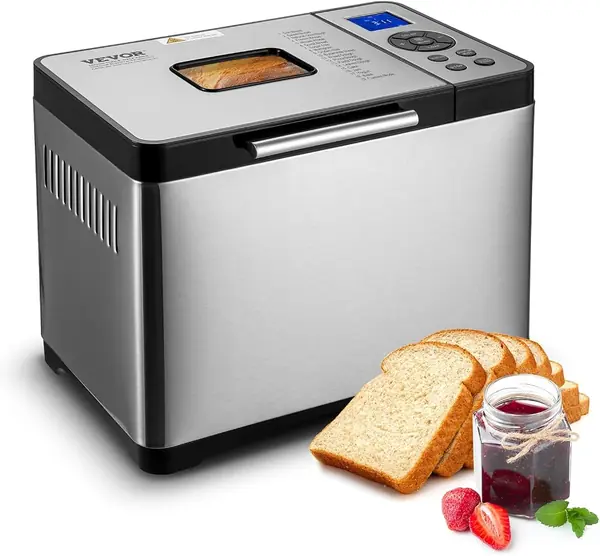
VEVOR 19-in-1 Bread Maker Best Budget Ceramic

VEVOR stainless steel bread maker with food-grade ceramic pot and digital controls

Tight budgets

Bake Score 84/100
Pan Material
Food-grade ceramic pot
Loaf Capacity
2 lb
Programs
19
Weight
9.7 lb
View on Amazon

This is the least expensive ceramic machine in the group, which is the first thing to say about it and not the reason to buy it. VEVOR calls the inner pot food-grade ceramic and says it won't release harmful substances during baking. The pot is heat-resistant and lifts out in one piece for washing.

For the money you get 19 programs, three loaf sizes from 1 to 2 pounds, three crust colors, a 15-hour delay, and an ingredient reminder that beeps when it's time to add nuts or raisins by hand. At 9.7 pounds it's the lightest machine here — light enough to lift down from a shelf and back up again without rearranging your afternoon.

It performs where it counts. The programs cover the breads most people actually bake, the pan releases a buttered loaf cleanly, and the machine holds temperature through a long whole-wheat cycle, which is the thing that decides whether you keep using it after the novelty wears off. What it lacks is the polish of the KBS machines, and the price difference is the honest reason to pick it anyway.

Two practical notes. The pan is hand-wash only, so treat it the way you would any ceramic surface. And the one-hour keep-warm matters more than it sounds: finish a bake before you leave the house and the loaf is still warm when you cut into it.

Worth Noting

  • Add-ins wait on a reminder beep, not an auto dispenser
Our Verdict

The least expensive way into a ceramic pan here, and a capable 2-pound machine, as long as you bring your own recipes.

Check Latest Price
4

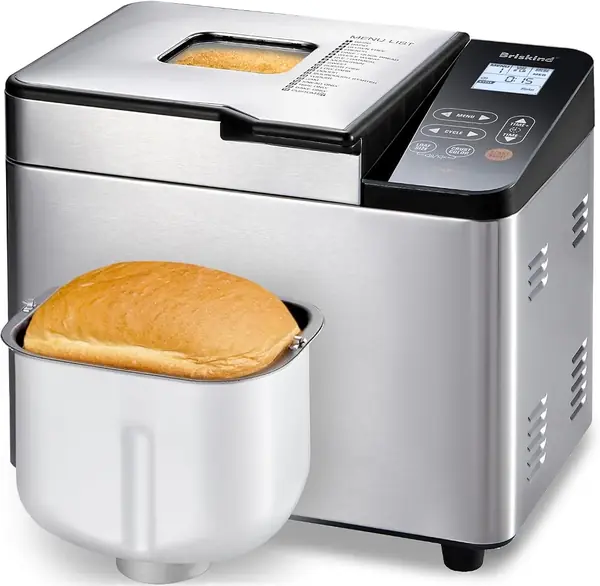
Briskind 2LB Bread Maker Best for Small Kitchens

Briskind stainless steel bread maker with horizontal ceramic-coated pan and touch panel

Small kitchens

Bake Score 83/100
Pan Material
Ceramic nonstick coating
Loaf Capacity
2 lb
Programs
19
Footprint
10.4"D x 13.8"W x 11.4"H
View on Amazon

Most machines at this price bake a tall, narrow loaf — fine torn at the table, awkward in a sandwich. Briskind's pan lies flat, so the bread comes out wide and low, with slices that fit a toaster and hold a filling without falling apart.

The horizontal pan is the detail we appreciate most, and it comes in the narrowest body here: 13.8 inches wide, 10.4 deep, and 11.4 tall, which is the difference between a counter that still works and one that doesn't. The pan carries a ceramic nonstick coating the listing describes as free of harmful chemicals, and the glass touch panel stays legible with flour on your hands.

The catch is history. There's less of it behind this machine than behind the KBS models, and a shorter record is a real thing to weigh when the coating is the reason you're buying. What it does have is a book written for someone who has never baked: clear program descriptions and a delay timer you can set without re-reading the page.

The safety extras deserve a line of their own — a grounded plug, overload protection, and overheat protection, the sort of thing you notice only when a machine lacks it. At 600 watts it's the least powerful of these, so plan on the whole-wheat cycle rather than a quick one when the dough is dense.

Worth Noting

  • Ceramic coating on metal, not a solid ceramic pan
  • 600W motor, the least powerful in this group
Our Verdict

A good fit for a small kitchen: the narrowest machine here, a clear manual, and a ceramic-coated pan, though its long-term record is thinner than the KBS machines'.

Check Latest Price
5

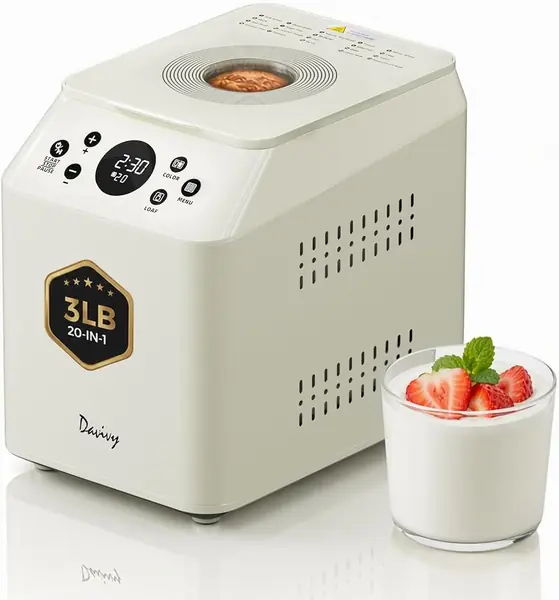
Davivy 3LB Bread Maker Best for Deep Counters

Davivy stainless steel bread maker with 3-pound ceramic pan and fruit dispenser

Deep counters

Bake Score 82/100
Pan Material
PFAS-free sintered ceramic
Loaf Capacity
3 lb
Programs
20
Footprint
16.1"D x 9.4"W x 11.4"H
View on Amazon

Sixteen inches of counter depth is a lot to hand over to a bread maker, and it's the first thing to know about this one. The Davivy is 16.1 inches front to back — the deepest machine here by several inches — so it wants a genuine stretch of counter rather than the strip beside the sink.

What you get for that space is the most interesting pan in the group. A ceramic pan can mean a coating sprayed onto metal or a ceramic body fired on its own, and Davivy sells the second: sintered genuine ceramic, with a PFAS-free claim on the pan and paddle both. It backs that with 20 programs, a 3-pound maximum, dual infrared heaters, and a fruit-and-nut dispenser.

Set against the 3-pound KBS, the pan is the upgrade and the footprint is the tax; the rest of the two machines is close to a wash. Whether that trade earns its place depends on why you're shopping. If the coating is the whole point — you want no sprayed layer that can wear through — this is the one. If you want the most bread for the least fuss, the KBS is easier to live with.

It ships with oven mitts, a metal hook, and measuring spoons, and the mitt earns its keep the first time you lift out a hot 3-pound pan. Worth weighing: there's less of a track record behind this model than behind the KBS machines, which matters if longevity is your main worry.

Worth Noting

  • Needs 16 inches of counter depth
  • Smallest loaf is 2 pounds, with no 1-pound setting
Our Verdict

The pan is the argument here: sintered ceramic with a PFAS-free claim, in a 3-pound machine, as long as your counter is deep enough.

Check Latest Price

How We Picked and Tested Nontoxic Bread Makers

We started by pulling every machine we could find that specifies a ceramic or PFAS-free pan rather than generic nonstick, then filtered for capacity, program range, and manuals that read like they were written for a person. Twelve machines made the cut, and each one lived on a kitchen counter for seven months — mine and two colleagues' — through weekly sandwich loaves, gluten-free cycles, dough and jam programs, and overnight timer bakes.

Every machine ran the same basic white loaf five times so we could see whether it repeated, and we sliced and tasted each loaf a day later, checking the corners for dense, gummy patches and weighing the cooled bread to compare rise. We timed how long it took to program a loaf from cold, counted the button presses, and handed the manual to a colleague who had never used a bread maker to see where the first run went sideways.

Noise and stability got their own tests: we set a decibel meter beside each machine during the knead to note which ones you could talk over, and we watched whether the feet held on a wood counter through a heavy whole wheat cycle. For durability, we washed each pan by hand more than 30 times and inspected the coating for clouding, scratches, and flaking. We also weighed what each program set added over a bare-bones machine to judge value.

How to Choose a Non-Toxic Bread Maker

What Ceramic Means on a Bread Pan

Ceramic shows up on bread pans in two forms, and the difference is worth understanding before you compare prices. Some machines use a ceramic coating sprayed onto a metal pan; the Briskind here is one. Others, including the KBS models and the Davivy, describe a pan that is ceramic through and through, sintered at high heat. Both get sold as a ceramic pan, but only the coated version has a layer that can wear away.

Look for the words PFAS-free on the pan and the paddle specifically, not just on the box. A ceramic pot paired with a coated paddle leaves half the contact surface undocumented.

The Coating Only Stays Non-Toxic While It's Intact

A chipped coating is the moment a non-toxic pan stops being one, and the damage usually comes from handling rather than baking. Metal utensils, a dishwasher cycle, and dropping a hot pan into cold water are the three ways people shorten a ceramic pan's life.

Hand wash with a soft sponge, dry it fully before it goes back in the machine, and replace the pan if the surface flakes. That is why we weight durability so heavily: the pan, not the motor, is usually the part that fails first.

Match the Loaf to Your Household

Capacity numbers describe a maximum, not a default. A 3-pound bread machine bakes 3 pounds only on its largest setting, and it occupies the same counter space to bake a small loaf. Two people eating toast most mornings will finish a 1.5-pound loaf before it stales; a family of five wants 2 pounds or more.

Check the small end of the range as carefully as the large one. The Davivy, for instance, starts at 2 pounds, which is more bread than a couple needs on a weekday. Buy the capacity you'll use weekly and treat anything bigger as occasional batch baking.

Measure the Counter Before the Machine Arrives

Depth is the dimension that catches people out. These machines run from about 9.5 to 16 inches front to back, and the taller ones need clearance above for a lid that swings up and vents that need air. A bread maker also vibrates while it kneads, so a level, dry, unobstructed stretch of counter beats a spot wedged under the upper cabinets.

If the machine has to live in a cupboard between bakes, weight matters as much as size — the lightest here is under 10 pounds.

Assume the Manual Is the Weak Part

Instruction books are where this category stumbles, and the machines with the best baking records aren't always the ones with the clearest guides. Two habits cover most of it: weigh ingredients in grams instead of scooping cups, and add them in the order the recipe gives — liquid first, flour next, yeast last and kept away from the salt.

For a recipe that isn't in the book, run it on the basic cycle and match its flour weight to the loaf size you selected.

Frequently Asked Questions

Final Verdict

For most kitchens, the KBS Pro is the one to buy: a ceramic pan and paddle it states plainly, a 2.2-pound loaf, and the strongest record of good loaves in this group. It is the machine that makes the coating question feel settled rather than like a compromise you're accepting to get fresh bread.

Two alternatives are worth knowing. The 3-pound KBS is the same idea with two heaters and capacity for eight, and the Davivy is the upgrade if the pan itself is the whole point and your counter runs deep. On a tight budget, the VEVOR still puts a ceramic pot in your kitchen.