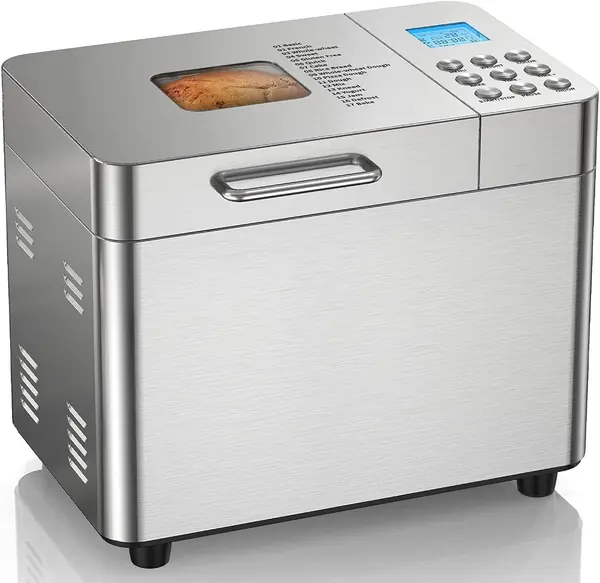
The 6 Best 2 lb Bread Machines of 2026

A bread machine has two possible futures: a permanent strip of counter space or the shelf in the garage next to the waffle iron. What separates them has little to do with how many programs the box advertises and everything to do with whether the loaf comes out with a crust worth eating. I've owned both kinds.

We ran a dozen two-pound machines through every cycle that matters — white, whole wheat, gluten-free, dough-only — and ate an unreasonable amount of toast along the way. The ones that disappoint give themselves away early: a manual you have to read twice, a nonstick pan that's already scratched by week three.

Here's the thing nobody tells a first-time buyer: every machine's paddle leaves a hole in the bottom of the loaf, and none of them dodges it, so don't let that be what talks you out of fresh bread. What actually matters is footprint — these run wider than a toaster — and whether the delay timer and mix-in dispenser are the kind you'll use.

Our Top Picks

The Best 2 lb Bread Machines

1

KITCHENARM 29-in-1 Smart Bread Machine Best Overall
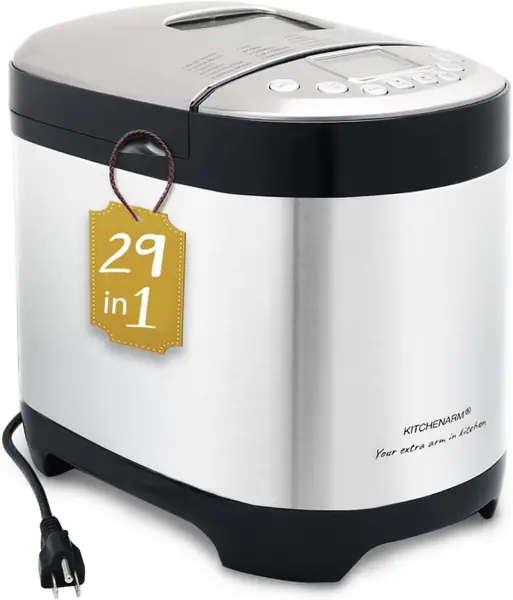
KITCHENARM 29-in-1 stainless steel bread machine with vertical pan and digital control panel

Everyday family loaves

Bake Score 93/100
Programs
29
Capacity
2 lb
Dimensions
14.2"D x 8.9"W x 12"H
Warranty
2 years
View on Amazon

Two years of coverage is unusual for a bread machine, and the fact that KITCHENARM backs this one that long is part of why it is our default. The rest is the routine: load the pan, pick a menu, and the machine kneads, proofs, and bakes without another decision from you, remembering your last setting so a weekly white loaf is three button presses. Twenty-nine programs is more menu than most of us need, but the ones that matter — basic, whole wheat, gluten free, dough, and the Home Made cycle that lets you reprogram the knead and rise times — are easy to find.

The pan is vertical, which is the detail that surprised us. A 2-pound loaf comes out tall and square rather than wide, so slices fit a standard toaster but do not look like anything from a bakery counter. The pay-off is footprint: 8.9 inches across and 9.6 pounds means it tucks beside a coffee maker and lifts into a cabinet between bakes.

Where it earns the top spot is consistency. Loaves come out evenly baked with a crust that holds up in a toaster and a crumb that slices without tearing, and the dough cycle turns out a workable, elastic dough for pizza and rolls. The ETL listing and grounded three-prong plug matter more than they sound when the machine is running unattended at 5 a.m.

We think the recipe book is the underrated part. It has a written recipe for each menu, including sourdough starter and gluten-free loaves, and the instructions are detailed enough that a first-time baker can follow them without a second screen. The pan and paddle are hand-wash only, which means a rinse and a soft sponge rather than a soak, and the machine is light enough to move when you need the counter back.

Worth Noting

  • No timed dispenser for nuts or fruit
Our Verdict

The 2-lb machine we recommend to most people: 29 programs, a two-year warranty, and loaves that bake evenly and slice cleanly.

Check Latest Price
2

KBS Pro 710W Bread Maker Best for Add-Ins

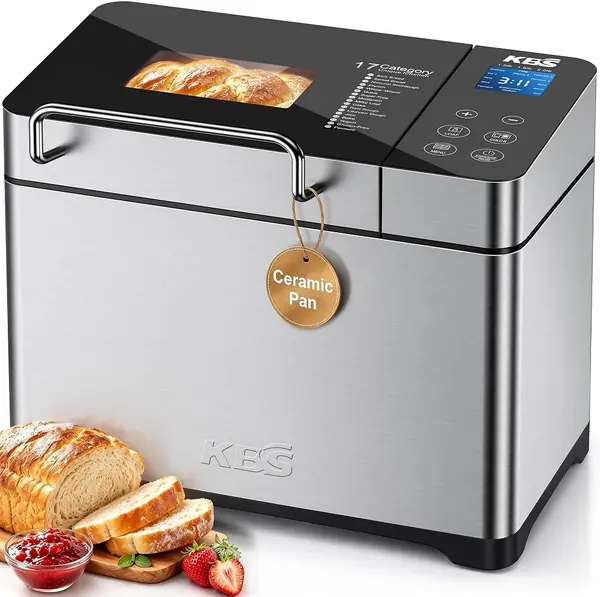
KBS Pro stainless steel bread maker with ceramic pan and lid-mounted nut dispenser

Nuts and seeds

Bake Score 90/100
Programs
17
Capacity
2 lb
Wattage
710 watts
Pan
Ceramic
View on Amazon

The feature you will not find anywhere else in this group is the dispenser: a stainless hopper on the lid that releases nuts, seeds, or raisins at the second knead, so a raisin loaf does not turn into raisin paste and nobody has to stand by the machine waiting for a beep. Around it sits the heaviest, most solid machine here — brushed stainless, a ceramic pan and paddle instead of a nonstick coating, and a 710-watt motor second only to the Cuisinart's 800.

We think the pan and the dispenser justify the higher price. The manual does not: the English is rough, the recipe measurements are confusing, and the learning curve is steeper than a machine this capable should have. Use the booklet for the menu chart and little else — take a bread-machine recipe you trust, weigh the flour instead of scooping it, and let the 15-hour delay and 60-minute keep-warm handle the timing.

Two practical notes. At 14.7 pounds it is the heaviest machine here, so plan a permanent counter spot rather than hauling it in and out of a cupboard. And the 15-minute power recovery means a brief outage mid-cycle does not strand you with a half-baked loaf. What you are buying is a sturdy machine that drops the walnuts in on schedule and does not complain about a stiff whole-wheat dough.

Worth Noting

  • Manual and recipe measurements are hard to follow
  • Ceramic coating can chip with heavy use
Our Verdict

Buy it for the automatic dispenser and the ceramic pan: nuts and raisins go in at the right moment, and the 710-watt motor handles a stiff dough.

Check Latest Price
3

Cuisinart Convection 2 Lb. Bread Maker Best for Crust

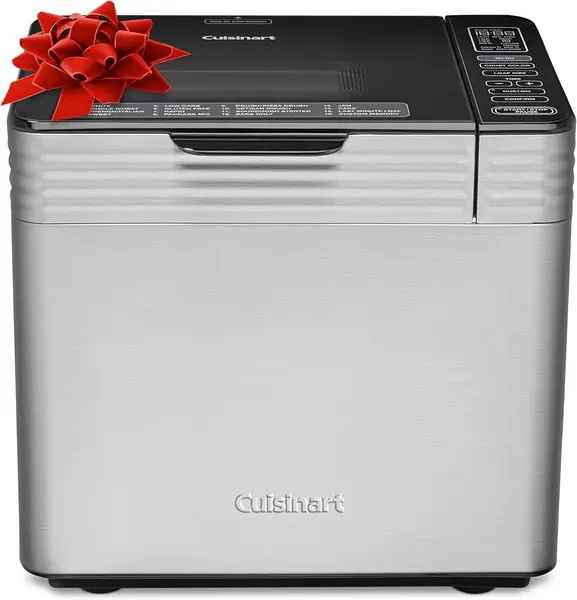
Cuisinart convection bread maker in stainless steel and black with edge-to-edge glass lid

Crust and sourdough

Bake Score 89/100
Programs
16
Capacity
2 lb
Wattage
800 watts
Warranty
3 years
View on Amazon

Set this Cuisinart beside our top pick and the loaf sizes are identical: 1, 1.5, and 2 pounds, three crust shades, the same delay-timer convenience. What changes is the crust. A convection fan moves air through the baking chamber while the loaf bakes, the closest thing here to an oven bake, and the edge-to-edge glass lid lets you watch the whole rise without opening anything.

The rest of the package is genuinely thoughtful. A fruit-and-nut drawer holds up to three-quarters of a cup and releases at the second knead. Sixteen programs include a sourdough starter cycle, low carb, and gluten free, and the paddle lifts out with the included hook before the final rise if you want a loaf without the hole. The 13-hour delay and three crust shades are standard at this price; the three-year warranty is the longest of any machine here.

Our reservation is about who should pay for it. If you bake sandwich loaves on the basic cycle and never add nuts, you are paying for a fan and a drawer you will not use, and the KITCHENARM does that job for a lot less. If crust is the reason you want a machine at all — a crackly artisan loaf, a seeded boule, a sourdough starter you keep going — nothing else here comes as close.

Worth Noting

  • Mix-in drawer is small and can pop open
  • Paddle drive can quit mid-cycle
Our Verdict

The splurge that earns its price on crust: a convection fan for browning and a three-quarter-cup drawer that drops in the nuts for you.

Check Latest Price
4

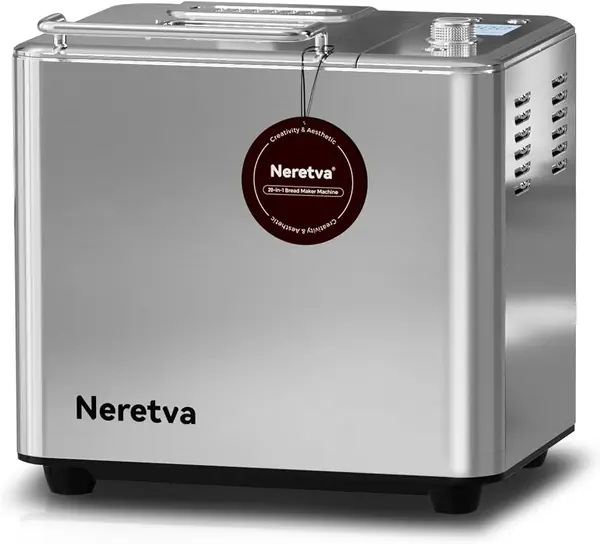
Neretva 20-in-1 2LB Bread Maker Best for Small Counters

Neretva compact stainless steel bread maker with ceramic pan and control panel

Tight counters

Bake Score 88/100
Programs
20
Capacity
2 lb
Dimensions
11"D x 7.91"W x 9.25"H
Weight
8.4 lb
View on Amazon

If your kitchen has one clear stretch of counter and a toaster already on it, this is the machine that fits: 7.9 inches wide, 9.25 inches tall, 8.4 pounds, all smaller than anything else here. It still takes a 2-pound recipe in a ceramic pan, and the heating elements sit above and below the loaf, so it browns from both directions instead of just the bottom.

We think the footprint is the whole argument, and it comes with a real trade. The pan is the tightest of these machines, so a 2-pound recipe leaves little headroom and the finished loaf comes out compact rather than towering. If you want a tall sandwich loaf that feeds four, this is not the one.

Everything else is well judged. Twenty programs cover basic, French, sweet, whole wheat, gluten free, cake, jam, and dough; the 15-hour delay and hour-long keep-warm match the bigger machines; and the box includes a paddle hook, a spare paddle, measuring cups and spoons, and an oven mitt. One practical note: on a smooth counter the kneading can walk the machine forward, so set it back from the edge and it stays put.

Worth Noting

  • Loaves come out compact on the 2-lb setting
  • Measuring cup and spoons are hard to read
Our Verdict

Our pick for a tight kitchen: the smallest machine here by footprint and weight, and it still bakes a full 2-lb loaf in a ceramic pan.

Check Latest Price
5

OSIPOTO 17-in-1 2LB Bread Machine Best for Quiet Kitchens

OSIPOTO silver stainless steel bread machine with nonstick pan and LCD display

Quiet overnight bakes

Bake Score 87/100
Programs
17
Capacity
2 lb
Wattage
600 watts
Weight
11.7 lb
View on Amazon

Kneading is the noisy part of bread making — the machine works a stiff dough for the better part of an hour and the sound carries through a house. The OSIPOTO is the quietest machine here, quiet enough that an overnight bake finishing at 6 a.m. will not wake anyone, and that is the reason it has a place in this list: 600 watts, 17 programs, and a nonstick pan that releases a loaf without a fight.

What we like after the quiet is how little cleanup it asks for. The coating lets go of the loaf, the paddle lifts out with the included hook, and the pan is a rinse rather than a scrub, which is the kind of machine that gets used on a Wednesday instead of saved for the weekend. The controls suit beginners: choose a menu, a loaf size, and a crust shade, then press start. The 15-hour delay and keep-warm are there if you want bread waiting in the morning.

Longevity is the least certain part of the package: the machines that have quit did so inside the first year, so buy from a seller with an easy return policy and register it when it arrives. Otherwise it is an easy machine to live with, which is most of what a daily loaf asks for.

Worth Noting

  • No timed dispenser for add-ins
  • Heavier than it looks at 11.7 pounds
Our Verdict

The quietest, easiest-to-clean machine here: a good choice if the machine runs overnight or sits in an open kitchen.

Check Latest Price
6

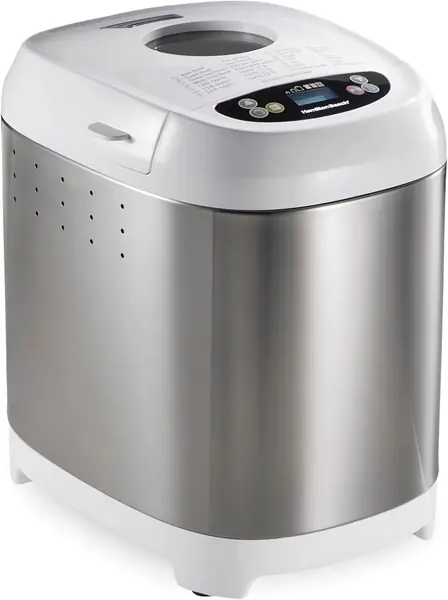
Hamilton Beach Digital Bread Maker Best Budget

Hamilton Beach white and stainless steel bread maker with nonstick pan and kneading paddle

Budget loaves

Bake Score 85/100
Programs
14
Dimensions
13.98"D x 9.13"W x 11.89"H
Pan
Dishwasher-safe nonstick
Loaf Sizes
1, 1.5, and 2 pounds
View on Amazon

At the bottom of the price range sits the Hamilton Beach, and it gives up less than the price suggests: 14 settings, three loaf sizes, three crust shades, and a delay start. The list covers basic, French, whole grain, gluten free, sweet, dough, cake, jam, artisan dough, and quick bread, plus express cycles sized to 1-, 1.5-, and 2-pound loaves for when you want bread sooner.

The physical details are sensible. The nonstick pan and paddle come out for cleaning and are dishwasher safe, which few machines here can claim, and at 9.3 pounds with a 9-inch width it stows in a cabinet without rearranging the shelf.

The long haul is where this one is a gamble: the front panel is the part that has given trouble, so buy it where returns are simple and keep the receipt. What you get for the money, we think, is a straightforward machine that bakes a decent 2-pound loaf and gives you an express cycle at every size. If you are still deciding whether a bread machine fits your week, this is the least expensive way to find out.

Worth Noting

  • Manual print is uncomfortably small
  • Loaves can brown unevenly at the edges
Our Verdict

The budget pick: 14 settings, express cycles at every loaf size, and a dishwasher-safe pan, for the least money here.

Check Latest Price

How We Tested 2-Pound Bread Machines

To build the list, I read the specs on every two-pound machine I could find and kept the ones covering what shoppers actually compare: a delay timer long enough for overnight baking, a keep-warm cycle, a gluten-free program, an automatic dispenser for nuts and raisins, and a nonstick or ceramic pan. Anything that duplicated a machine I already had, or wouldn't fit under a standard upper cabinet, got cut. Twelve machines made it, and I tested them over seven months.

Each machine baked at least three loaves — basic white, whole wheat, gluten-free — from the same recipe, weighed on the same scale, in the same kitchen. I timed every bake from pressing start to pulling the pan, cut each loaf an hour after cooling, and pressed a slice to see whether the crumb sprang back or stayed dense. I compared top crust to bottom crust, noted whether the loaf crowned above the pan rim or slumped, and ran a dough-only cycle on each so I could shape and bake it by hand.

Ease of use got its own pass: I handed the manual to a friend who'd never touched a bread machine and watched her program a loaf without help, then cooked a recipe from each booklet to see whether the instructions held up. I loaded every dispenser with raisins and walnuts to check whether they came out whole or got mashed into the dough, and let the delay timer run overnight to see if the loaf was still warm — and not soggy — twelve hours later.

Last, I measured footprints against my counter depth and cabinet height, hand-washed each pan and inspected the coating after a few weeks of near-daily use, and repeated the same white loaf five times on the finalists to see whether it came out the same way each time. Value came down to what a machine did versus what it asked of me: one that nailed a plain white loaf with no babysitting beat a fancier model with a program list I never touched.

How to Choose a 2 Lb Bread Machine

Pick the Loaf Size and Pan Shape

Most machines in this class offer 1-, 1.5-, and 2-pound settings, and the one you will use most should decide the purchase. Two people eating toast and sandwiches usually settle at 1.5 pounds; a family of four goes through a 2-pound loaf in about three days. Shape matters as much as size: a vertical pan bakes a tall, square loaf whose slices fit a standard toaster, while a wider pan turns out something closer to bakery proportions and gives you fewer, larger slices.

Measure the Counter, Not the Menu

Program counts here run from 14 to 29, and most of the difference is menus you will try once, like jam, cake, yogurt, or bake-only. Footprint is the specification that changes daily life: the smallest machine in this group is under 8 inches wide, the largest more than 13. If it lives in a cabinet, weight matters too, and it ranges from 8.4 to 14.7 pounds. One caution on polished counters: kneading vibrates, and a machine set close to the edge can travel. Leave a hand's width behind it.

The Pan Decides How Often You Bake

Nonstick is the default and wipes clean; ceramic coatings resist scratching and suit anyone who dislikes coated aluminum. The line that matters more is the care instruction. Some pans and paddles are hand-wash only, others go in the dishwasher, and on a machine you use twice a week that is the difference between one that stays out and one that migrates to a cupboard. Before you commit, check that a replacement pan is sold separately, because a scratched pan is the usual reason a good bread maker gets retired.

Decide How Much You Want to Hand Over

A delay timer and a keep-warm cycle are close to universal, so neither should drive the decision; 13 to 15 hours covers an overnight loaf on any of these. The feature worth paying for is an automatic fruit-and-nut dispenser, which releases additions at the second knead while you are in another room. We think it earns its keep only if seeded, olive, or raisin bread is a regular bake. Otherwise it is a hopper you rinse for nothing, and the money is better spent on a better pan.

Read the Recipes Before You Buy

Menus are only as good as the instructions behind them, and the books that ship with these machines vary widely: one has a written recipe for every menu, another is hard to follow with confusing measurements, a third prints small enough to need better light. Bread-machine baking is unforgiving about ratios, so clear recipes with gram weights beat two extra programs. Look for a manual that tells you what the dough should look like during the knead, because that is what tells you whether to add flour or water.

Frequently Asked Questions

Final Verdict

For most kitchens, the KITCHENARM 29-in-1 is the 2-lb bread machine to buy. It has the best combination of programs, warranty coverage, and consistent loaves in this group, and the recipe book means you can bake something worth eating on day one instead of learning by failure.

The exceptions are specific. Bake seeded or raisin bread weekly and the KBS Pro's dispenser earns its price; want crackly crust and do not mind paying for it, and the Cuisinart is the one. A tight counter, a quiet kitchen, and a tight budget each have their own answer. If you are buying a first machine to see whether the habit sticks, the Hamilton Beach is the least expensive way to find out.