The 7 Best Gluten-Free Bread Makers of 2026

Gluten-free bread is expensive, fragile, and prone to collapsing in the middle, so a machine that claims a gluten-free cycle has a lot to prove. The right one takes the guesswork out of mixing, rising, and baking—turning a bag of gluten-free flour into a loaf you can actually slice for sandwiches instead of crumbling over the counter. It should also be easy enough to use on a weeknight, quiet enough that you can ignore it, and compact enough to earn counter space.

I’ve made plenty of disappointing gluten-free loaves, and the differences between machines show up fast: one loaf rises high with an even crumb, while another comes out dense and gummy from the same flour. We baked the same gluten-free recipes in 12 bread makers, following each manual and checking how clearly the instructions explained settings, loaf sizes, and crust choices. We also weighed value and reliability—whether a machine turned out consistent loaves and whether its pan, paddle, and hinges felt built to last.

Our Top Picks

The Best Gluten-Free Bread Makers

1

KITCHENARM 29-in-1 Smart Bread Machine Best Overall
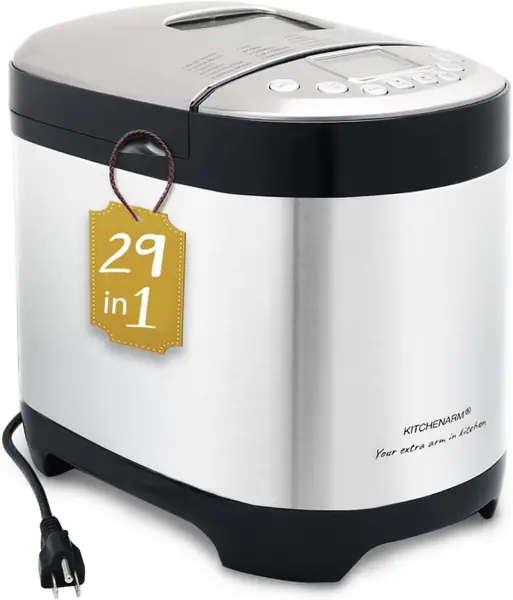
KITCHENARM 29-in-1 stainless steel bread machine with digital control panel and loaf pan

Everyday gluten-free baking

Bake Score 93/100
Programs
29
Weight
9.6 lb
Loaf Sizes
1, 1.5, and 2 lb
Custom Menus
4
View on Amazon

Gluten-free flour is where most bread machines come unstuck. A cup-for-cup blend, an almond-flour mix, and a rice-flour blend bound with psyllium each want a different amount of liquid and a different stretch in the pan, and a fixed program treats all three the same. The KitchenArm's answer is the feature we care about most: four menus you build yourself, stage by stage, then call up with one press. Once you land on a loaf that works with your blend, the machine remembers it.

That flexibility is what earns it the top spot. There are 29 programs here, and a dedicated gluten-free cycle covers the days you don't want to think, but the custom menus are what turn a generic appliance into one tuned to your kitchen. The recipe book leans toward whole grains and non-wheat flours instead of assuming bread flour, which is rarer than it should be, and the one-press start remembers your last settings so a repeat loaf is two buttons.

The rest is sensible rather than flashy: three loaf sizes, three crust shades, a spare paddle, two sets of cups and spoons, an ETL listing with a grounded plug, and a two-year warranty that is one of the longer ones in this group. At 9.6 pounds and under nine inches wide it doesn't dominate a counter, which matters for a machine that will spend a lot of time sitting on one.

The pan is vertical rather than horizontal, so a 2 lb loaf comes out tall and narrow — easy to toast, less useful if you want long sandwich slices. That's the shape compromise, and nothing else about the machine asks you to adjust.

Worth Noting

  • Pan and paddle are hand-wash only
Our Verdict

The machine we point gluten-free bakers to first, because four programmable menus let you tune the cycle to your own flour blend.

Check Latest Price
2

Zojirushi Virtuoso Plus Breadmaker Best Splurge

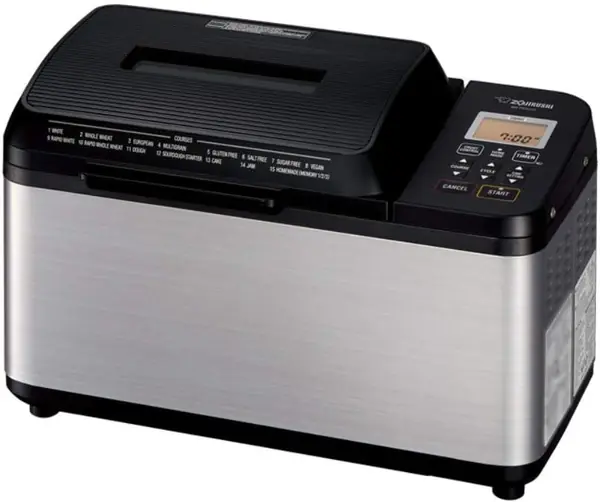
Zojirushi Virtuoso Plus black and stainless breadmaker with LCD display and baking pan

Long-term daily baking

Bake Score 92/100
Programs
7
Capacity
2 lb
Weight
24 lb
Kneading Blades
2
View on Amazon

Nothing else here costs as much, and after baking with it we can see where the money went: two heaters, one under the pan and one in the lid, and two kneading blades instead of one. Gluten-free baking is exactly the case where that pays off. A gluten-free batter is heavy and slack, and a single paddle tends to shove it around the pan rather than work it, while a lid heater browns a crust that would otherwise stay pale and soft.

The 24-pound body turns out to be a feature too. Lighter machines here have a habit of creeping toward the counter edge mid-knead; this one stays where you set it. Setup is genuinely easy — the course key is printed on the lid, so you aren't digging through a manual — and the gluten-free course sits alongside six others, including multigrain, rapid whole wheat, salt-free, sugar-free, and vegan.

The trade-offs are real. Seven programs is a short list next to the KitchenArm's 29, and the homemade setting lets you bake from your own recipe without handing you control of the cycle itself. It's the widest machine in this group at 18 inches, and its one-year warranty is among the shortest here. What you're buying is repeatability in a machine you won't have to think about for years.

Worth Noting

  • Widest, heaviest machine in this group
  • One-year warranty, among the shortest here
Our Verdict

Buy it if gluten-free baking is a long-term habit: dual heaters and twin kneading blades turn out the most even loaves here, and the build is the most substantial.

Check Latest Price
3

KBS Blue Bread Maker Best Features

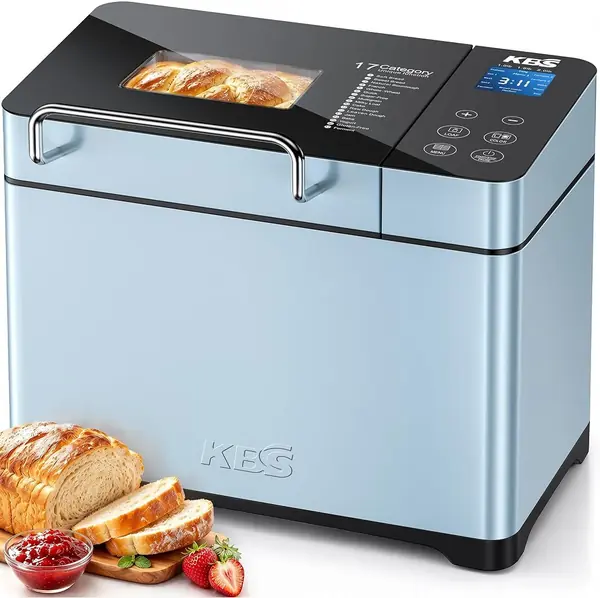
KBS blue stainless steel bread maker with ceramic pan and touchscreen control panel

Large loaves, add-ins

Bake Score 90/100
Programs
17
Capacity
2.2 lb
Pan
Ceramic nonstick
Nut Dispenser
Automatic
View on Amazon

An automatic nut dispenser sounds like a gimmick until you bake gluten-free. Seeds, chopped nuts, and raisins do a lot of the work of making a gluten-free loaf taste like something other than a delivery system for butter, and dropping them in at the right moment is the step most of us skip. The KBS does it on its own, and it will also pick a cycle back up after a short power interruption — a small thing until the afternoon your kitchen circuit trips mid-rise.

At 2.2 pounds it has the second-largest pan here, and the ceramic pan lets go of a loaf more cleanly than the nonstick pans on the cheaper machines. Seventeen programs cover gluten-free and sourdough, the glass touch panel is legible at a glance, and 710W puts it near the top of this group for power. We think it's the most feature-complete machine here after the Zojirushi, for a good deal less.

The manual is the weak link. Recipe quantities take translating, and the instructions assume more bread-making instinct than a first-time gluten-free baker brings. Weigh your ingredients and work from a recipe you already trust, and the gap closes.

Worth Noting

  • Paddle can be stiff to remove from a baked loaf
  • Ceramic pan coating can chip with use
Our Verdict

For a big household that wants the extras — hands-free add-ins, a ceramic pan, and a 2.2-pound loaf — this is the one we point to.

Check Latest Price
4

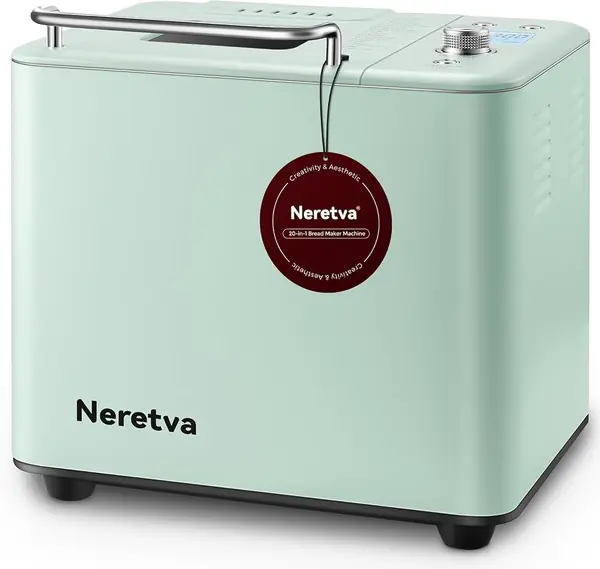
Neretva 20-in-1 Bread Maker Best for Small Kitchens

Neretva mint green bread maker with ceramic nonstick pan and metal body

Small kitchens

Bake Score 89/100
Programs
20
Capacity
2 lb
Weight
8.4 lb
Pan
Ceramic nonstick
View on Amazon

Bread machines are usually appliances you hide. This is the one here we didn't mind leaving out — a mint-green metal body, a rounded shape that nods at mid-century, and a footprint about eight inches across. If your counter is short and your kitchen is on display, that counts for more than a program you'll never use.

It backs the looks up with 20 programs including a gluten-free cycle, dual heaters top and bottom, a ceramic-lined pan, a 15-hour delay, and an hour of keep-warm. In the box you get a paddle hook, a spare paddle, measuring cups and spoons, and a heat-resistant mitt, which is the kind of inclusion that tells you someone thought about lifting a hot pan out of a small machine.

Where it earns its place is the counter. At 8.4 pounds it's light enough to move and small enough to leave out, and the ceramic pan releases a loaf without a fight. The included recipe book is thin, so plan on your own gluten-free recipes, and stand it on a nonslip mat away from the counter edge — a light body working a heavy batter can shift while it kneads.

Worth Noting

  • Compact pan turns out modest loaves
Our Verdict

A good-looking compact machine for a small kitchen, with a real gluten-free cycle and dual heaters — just expect loaves sized for one or two.

Check Latest Price
5

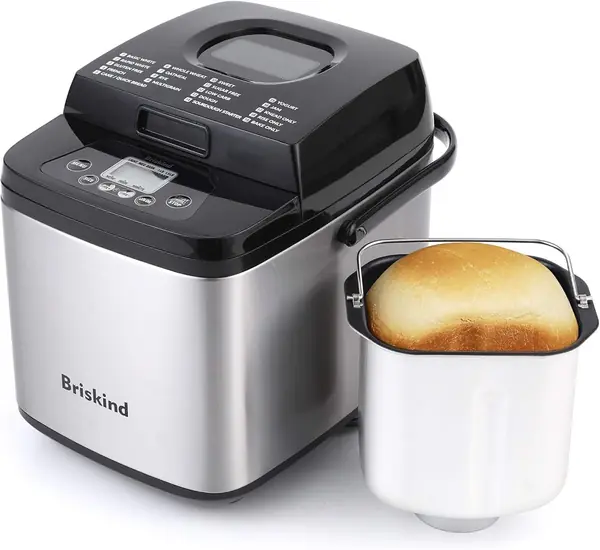
Briskind 19-in-1 Compact Bread Maker Best for Small Households

Briskind compact stainless steel bread maker with carrying handle and control panel

Small households

Bake Score 88/100
Programs
19
Capacity
1.5 lb
Weight
7.8 lb
Carrying Handle
Yes
View on Amazon

The carrying handle is what sold us. At 7.8 pounds and roughly the size of a small toaster oven, this is the one machine here you can bake in, let cool, and then put away in a cabinet — or buckle into an RV. The 1.5-pound pan is the other half of that idea: gluten-free bread is at its best within a day or two, and a smaller loaf means less of it going stale before you get to it.

It isn't stripped down. Nineteen programs include gluten-free, French, whole wheat, rapid, cake, jam, and yogurt; there are two loaf sizes, three crust shades, a 15-hour delay, an hour of keep-warm, and a grounded plug with overload and overheat protection. The recipe book is one of the better ones here, clear enough that a first loaf usually works, and the controls are simple enough to hand to someone who has never baked bread.

Worth Noting

  • Topped out at a 1.5 lb loaf
  • Some units stop working within a year
Our Verdict

Our pick for one- and two-person kitchens: small, light, genuinely portable, and still a proper gluten-free loaf.

Check Latest Price
6

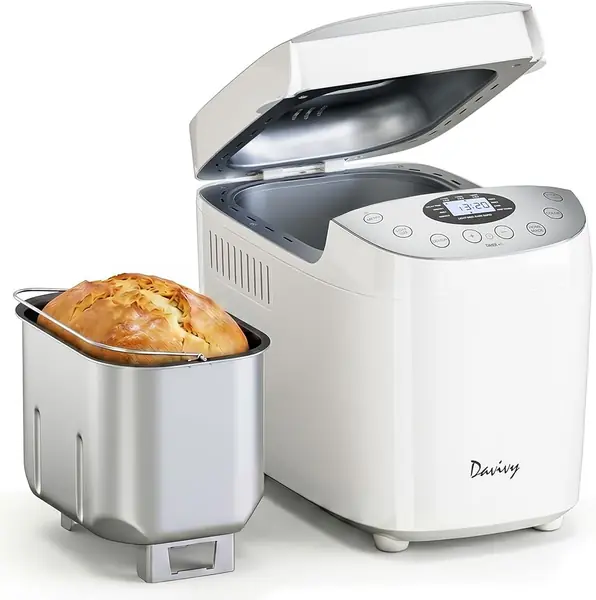
Davivy 3 lb Bread Maker Best for Big Batches

Davivy silver bread maker with nonstick pan, dual kneading paddles, and measuring tools

Big batches

Bake Score 83/100
Programs
15
Capacity
3 lb
Wattage
850W
Kneading Paddles
Dual, spare pair included
View on Amazon

Three pounds is the biggest loaf in this group by a wide margin — the next-largest pan here is 2.2 pounds. If you bake for a family that finishes a loaf in two days, or you want one session to cover sandwiches plus a batch of dough, that capacity is the whole argument, and it's the one we keep coming back to.

It gets there on two kneading paddles working as a pair, which is the right call in a pan this size, because a single paddle has far more dough to move in a 3-pound batch. Davivy throws in a spare pair of paddles, two measuring spoon sets, a cup, a hook, and silicone baking gloves — generous, and the spare pair is the kind of inclusion that only matters once the original is in the wash.

Fifteen programs cover the essentials, including gluten-free, and at 850W it's the most powerful machine in this group. For a household that bakes one large loaf a week, that's a lot of machine for the money; for everyone else, the smaller pans here are easier to live with.

Worth Noting

  • Loaves can stick in the pan
Our Verdict

Worth it only if you need the biggest loaf here: 3 pounds, twin paddles, and the most power in the group.

Check Latest Price
7

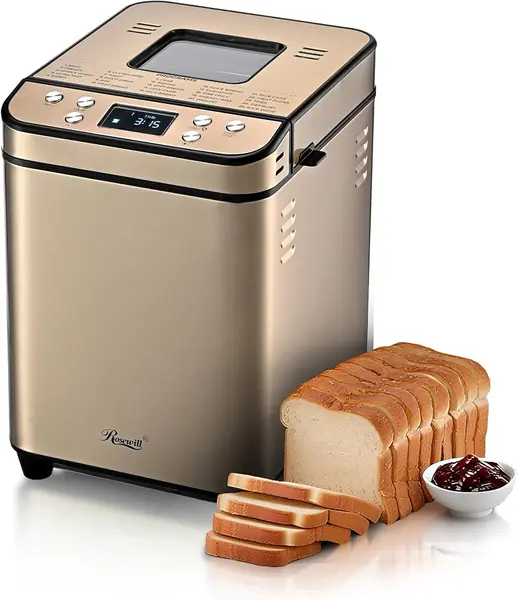
Rosewill 25-in-1 Automatic Bread Maker

Rosewill honey-colored bread maker with dual heaters, nonstick pan, and control panel

Budget first machine

Bake Score 82/100
Programs
25
Capacity
2 lb
Wattage
700W
Heaters
Dual, top and bottom
View on Amazon

The gluten-free setting is why this machine made the list. It's the least expensive one we recommend, and its gluten-free cycle turns out loaves that hold together and slice — which, with gluten-free crumb, is not a given.

The spec sheet is generous for the money: 25 programs, dual heaters top and bottom, 700W, three loaf sizes, three crust shades, a 15-hour delay, an hour of keep-warm, and a small interior light you can switch on to watch the loaf climb. The pan is nonstick and free of BPA and PFAS, and the honey finish reads warmer than the usual stainless box.

The recipe book is the weak spot. It measures in ounces, reads like a translation, and assumes a baker's instincts. Weigh everything, work from a gluten-free recipe you already trust, and the gap closes. At 8.3 inches wide and 8.8 pounds it's one of the smaller bodies here, so it sits on a counter without much complaint.

That leaves it as a first gluten-free bread machine for someone who wants to spend the least and is willing to do the measuring. It doesn't have the programmable cycles of the KitchenArm or the pan of the KBS, but the gluten-free result is there for a fraction of the outlay — and that is the whole reason to consider it.

Worth Noting

  • One-year warranty is on the short side
Our Verdict

The budget way into gluten-free baking: a working gluten-free cycle and dual heaters, as long as you bring your own recipes and a scale.

Check Latest Price

How We Tested Gluten-Free Bread Makers

To build the shortlist, I started with machines that explicitly offer a gluten-free program—not just a gluten-free recipe booklet—then filtered by loaf sizes, dual heaters, nonstick or ceramic pans, delay timers, and whether the footprint would fit under a standard cabinet. That left 12 machines, which we tested for nine months in home kitchens rather than a lab.

We baked the same gluten-free sandwich loaf and a smaller one-pound test loaf in each, following each owner’s manual step by step and noting where instructions were vague about which paddle to use, when to add mix-ins, or how to adjust for a humid day. After the loaves cooled, we sliced them, pressed the crumb with a finger, and checked whether each held together for a sandwich or turned gummy at the center. A small group tasted the plain loaves blind, rating flavor, crust, and any aftertaste.

Ease of use got judged with wet hands and a timer running: how many button presses to start, whether the display made sense, and how hard the pan was to clean. We measured counter footprint, lifted each machine by its handle—or noted that it lacked one—and listened during kneading from the next room, tracking noise level. We ran repeated cycles to see whether pans scratched, paddles loosened, or hinges stiffened, and compared price against consistent results and failed loaves.

How to Choose a Gluten-Free Bread Maker

What the Gluten-Free Cycle Is Actually Doing

Without gluten there is no network to develop, so a gluten-free cycle skips the punch-down and second rise that wheat bread needs and stretches the bake to set a crumb that has nothing to hold it up. Every machine here names a gluten-free program, so the program existing isn't the differentiator — how it is timed is. A short knead and one long rise suit a rice-and-tapioca blend; a machine tuned for a fast wheat bake will leave you with a dense brick.

Look at the manual's gluten-free course length before you buy and compare it with the recipes you plan to use. If the numbers don't line up, that machine will fight your flour.

Why a Cycle You Can Rewrite Beats a Longer Menu

Flour blends vary enormously. A cup-for-cup blend, an almond-flour mix, and a rice-flour blend bound with psyllium each want different hydration and a different stretch in the pan, and a fixed program cannot know which one is in the bucket. The KitchenArm's four programmable menus and the Zojirushi's homemade setting both address this from different directions: one lets you rewrite the stages, the other lets you follow someone else's recipe on a cycle the machine controls.

If you will bake with one blend forever, a good fixed gluten-free cycle is enough. If you experiment, or someone in the house reacts to a specific flour, pay for the programmable stages.

Pan, Paddle, and Getting the Loaf Out

Gluten-free batter is sticky and heavy, and it grips. Ceramic and quality nonstick pans release it more cleanly than the thin coatings on cheap machines, and a wide pan does better with two paddles than one, because a single paddle has more dough to move. The paddle itself is the other half of the problem: it bakes into the bottom of the loaf, and a stiff one takes a hook rather than a knife.

Grease the pan even when the listing says nonstick, use the removal hook every time, and let the loaf sit briefly before you turn it out. Those three habits do more for clean slices than any program.

Size, Weight, and Whether It Stays Put

Loaf sizes here run from 1.5 to 3 pounds, and the right one is about how fast you eat bread, not how many people sit at the table — a gluten-free loaf is at its best in the first two days. The machines in this group span roughly 8 to 18 inches across, so measure your counter headroom before you commit to a wide one.

Weight is worth noticing too. A 7- or 8-pound machine working a heavy batter can creep toward the counter edge; stand any light model on a nonslip mat, away from the lip, and the problem mostly disappears.

Warranty and the Pan Coating

These are appliances with motors and heating elements, and they don't last forever. Two years of coverage is the better end of what's on offer here, and one year is the short end — register the machine and keep the receipt, because the pan coating, not the electronics, is usually what ends a bread maker's useful life.

Hand-wash the pan and paddle. Dishwasher detergent and heat dull ceramic and nonstick alike, and once the coating chips, every loaf starts sticking.

Frequently Asked Questions

Final Verdict

The KITCHENARM 29-in-1 is the machine we point gluten-free bakers to. The dedicated gluten-free cycle handles a standard blend on day one, and the four programmable menus are what make it hold up as your flour, your hydration, and your technique change — which they will.

Spend more on the Zojirushi only if gluten-free bread is a years-long habit and you want the even browning that dual heaters and twin paddles give you. Feeding one or two people, the Briskind's small pan and carrying handle make more sense than a bigger machine you'll resent storing.