The 6 Best Bread Machines for Sourdough of 2026

The hard part of sourdough was never the flour — it's the clock. Feeding the starter, catching the dough at the right rise, being home when it's ready for the oven. A bread machine can't build a starter for you, but a good one handles the mixing, kneading, proof, and bake on a schedule you set the night before.

I've kept a starter on my counter for years, and that starter went into 12 machines, from a 1-pound pan to a 3.5-pound workhorse. We watched for what only surfaces after the tenth loaf: pan coatings that survive scrubbing, a sourdough program that gives a starter a real head start rather than a yeast schedule with a longer rest, instructions that don't assume you already know what a levain is.

Capacity matters more than the spec sheet admits, too: dough at the low end of a machine's range bakes flat and pale, so buy for the loaf you make most weeks. There's a pick for small kitchens, one for overnight bakers and a few for anyone chasing an open, tangy crumb.

Our Top Picks

The Best Bread Machines for Sourdough

1

KITCHENARM 29-in-1 Bread Machine Best Overall
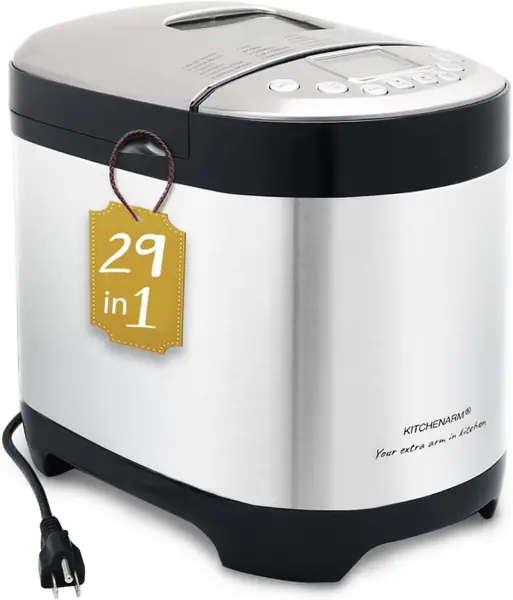
KITCHENARM 29-in-1 stainless steel bread machine with control panel and loaf pan

Everyday sourdough baking

Bake Score 93/100
Capacity
2 lb
Programs
29
Warranty
2 years
Custom Menus
4
View on Amazon

The four HOME MADE memory slots are the reason this machine earns the top spot. Sourdough is a timing problem before it is a bread problem: starter strength, room temperature, and how long you let the dough sit all change the schedule. Being able to save a knead-rise-bake sequence, then call it up again, is more useful than a single preset button that may not match your starter. The 29-menu setup gives you plenty of starting points, and we like that the machine saves the last settings so a repeat loaf is a few presses away.

The 2-pound ceiling is the main trade-off. That is enough for a compact everyday loaf and a good fit for a two-person household, but it is not the machine for a family that goes through a large sandwich loaf every few days. We also appreciate the recipe book and manual: sourdough is one category where vague instructions sink a new baker, and this one gives you enough detail to follow a schedule rather than guess at it. The menu chart is the part to read first, especially if you are adapting a recipe to a starter with a different hydration.

Worth Noting

  • Hand-wash-only bread pan
Our Verdict

The KITCHENARM 29-in-1 earns our top pick because its four custom menus let you save a repeatable ferment schedule, and the recipe support is unusually strong for new sourdough bakers.

Check Latest Price
2

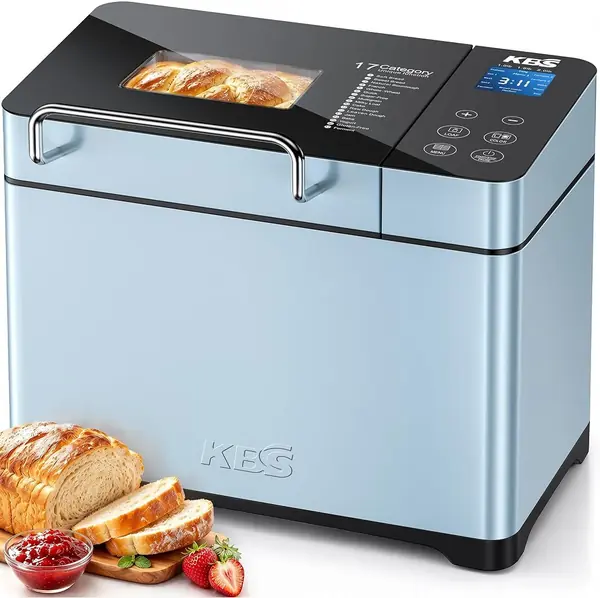
KBS Blue 2.2LB Bread Maker Best Sourdough Preset

KBS Blue 2.2LB bread maker with ceramic pan and blue stainless body

One-button sourdough preset

Bake Score 89/100
Capacity
2.2 lb
Programs
17
Delay Timer
15 hours
Sourdough Program
Yes
View on Amazon

A dedicated sourdough program is rare enough in this group that it deserves the first look. The KBS Blue puts it on the same one-touch menu as white, French, and gluten-free, and the 2.2-pound capacity gives you a little more headroom than the common 2-pound pan. The ceramic pan is the other draw: it is a nicer surface to clean than ordinary nonstick, and the automatic nut dispenser keeps additions out of the first knead.

We like the preset for a first sourdough attempt, but we do not treat it as a substitute for a long ferment. A machine's sourdough cycle still runs on a clock, and a lively starter can push past it. The dough cycle is the escape hatch: run the ferment until the dough looks right, then bake it in the machine or finish it in the oven. The preset is the starting point, not the whole method.

The 15-hour delay timer and 53 recipes make it a useful everyday machine, and the blue stainless body is one of the few finishes here that looks deliberate rather than appliance-gray. The 2.2-pound loaf is still a compact loaf, so a family that wants a tall sandwich bread should look at the 3-pound KBS.

Worth Noting

  • Manual is hard to follow
  • Paddle can be hard to remove
Our Verdict

For a dedicated sourdough preset and a ceramic pan without learning a custom menu, we like the KBS Blue as the easy-button choice.

Check Latest Price
3

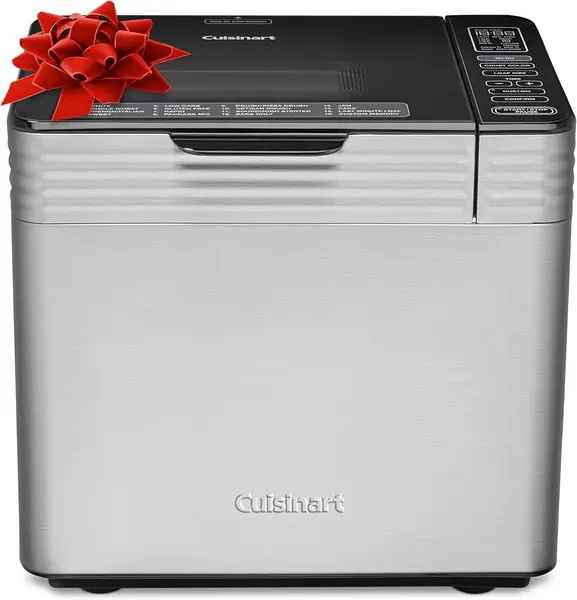
Cuisinart Convection Bread Maker Best for Crust

Cuisinart Convection bread maker with stainless steel body and glass-top lid

Crust-focused sourdough

Bake Score 88/100
Capacity
2 lb
Programs
16
Delay Timer
13 hours
Crust System
Convection fan
View on Amazon

The convection fan is what separates this Cuisinart from the rest of the group. It circulates air during baking, which gives the crust a more even color than a still-air machine and makes the loaf feel closer to oven-baked. The 2-pound pan is a compact loaf, and the edge-to-edge glass top lets you watch the rise without opening the lid.

The Custom Memory slot is the feature we care about most. It lets you save a batch with your own timing, which is exactly what a starter-driven schedule needs. The removable paddle is another practical touch: take it out before the final rise and you avoid the hole in the bottom of the loaf. The 16 programs cover the usual loaves, and the mix-in dispenser is a nice extra for seeded sourdough.

We recommend it for the baker who has already made a few sourdough loaves and wants more control over crust. The three-year warranty is the longest here, and it matters because this is a premium machine. If you want one-button simplicity, the KBS Blue is the easier buy; if you want to chase a darker, crisper crust, this is the one.

Worth Noting

  • Starter cycle is not a loaf preset
  • Reliability is the open question
Our Verdict

Bakers who care most about crust should choose the Cuisinart Convection; we value its fan and custom memory slot for more control than a preset alone.

Check Latest Price
4

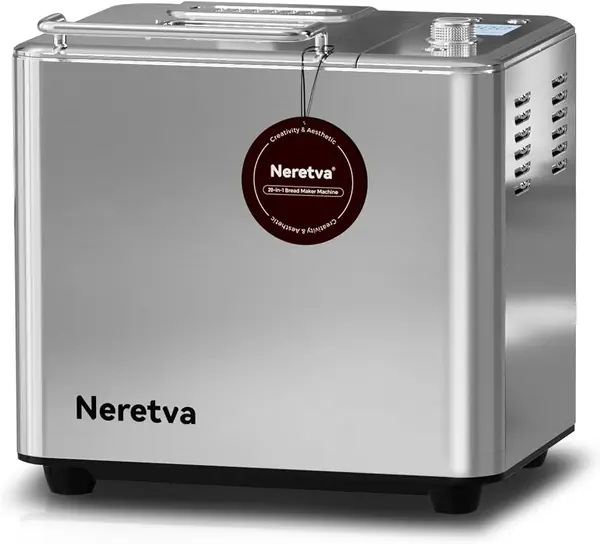
Neretva 20-in-1 Bread Maker Best Compact

Neretva 20-in-1 compact bread maker with ceramic pan and stainless body

Compact kitchens

Bake Score 87/100
Capacity
2 lb
Programs
20
Delay Timer
15 hours
Pan
Ceramic nonstick
View on Amazon

At roughly 11 inches deep and 8 inches wide, this is the machine that disappears into a corner. The 2-pound pan is correspondingly small, so the loaf is a compact one, not a family-size sandwich bread. For a one- or two-person household, that is a feature: you can bake more often without a half-eaten loaf going stale.

The 20 programs cover the usual white, French, whole wheat, gluten-free, and cake settings, and the dual heaters wrap the pan top and bottom for more even browning. The ceramic pan wipes out easily, and the 15-hour delay timer is there for yeast bread. The 20-program count is more than most people need, but the gluten-free and cake settings earn their place if the machine is going to stay out. The sourdough catch is the bake time: the sourdough segment is short enough that a cold, slow-fermented dough may need a second bake to set the center. We treat that as a finish, not a failure; if you want a hands-off sourdough cycle, the KBS Blue is the better fit.

Our Verdict

Small kitchens and small households get a compact sourdough-capable machine in the Neretva 20-in-1, and we appreciate that it does not give up program variety.

Check Latest Price
5

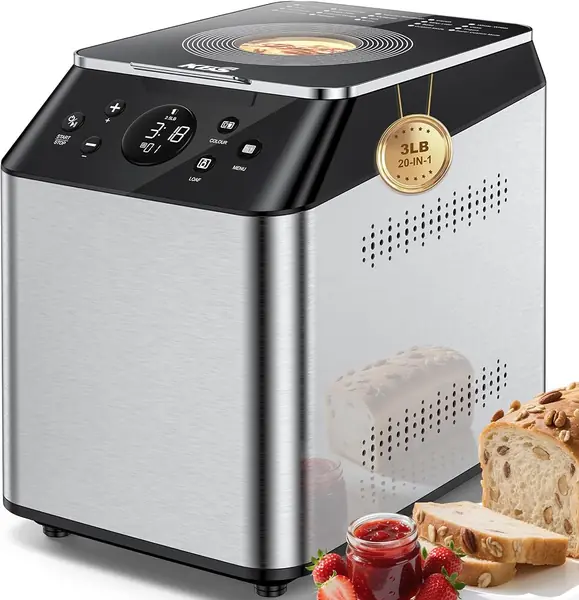
KBS 3LB Bread Maker Best Large Capacity

KBS 3LB bread maker with stainless steel body and ceramic loaf pan

Large households

Bake Score 86/100
Capacity
3 lb
Programs
20
Pan
Ceramic
Custom Programs
2
View on Amazon

Three pounds is the number that matters here. That is a full-family loaf, and it is the reason to accept a machine that takes up real counter space. The 20-menu setup includes two custom programs, which we prefer for sourdough: you can save a longer ferment instead of relying on a preset that may run short. The ceramic pan is a nice upgrade over ordinary nonstick, and the dual heaters are designed to brown the top and bottom evenly.

The angled control panel is easier to read than a flat panel when the machine is under a cabinet, and the 15-hour timer and 60-minute keep-warm are useful for standard loaves. The motor is quiet, and the ceramic pan releases a large loaf without a long soak. The 3-pound capacity is not a beginner's first batch; start with a smaller recipe until you know how your starter performs in this pan. The two custom programs are the difference between a machine that can make sourdough and one that can make your sourdough.

Worth Noting

  • Very heavy at 15.4 pounds
  • Loud notification beeps
Our Verdict

Large households that need a bigger loaf should look at the KBS 3LB, especially if they want the custom programs we prefer for sourdough.

Check Latest Price
6

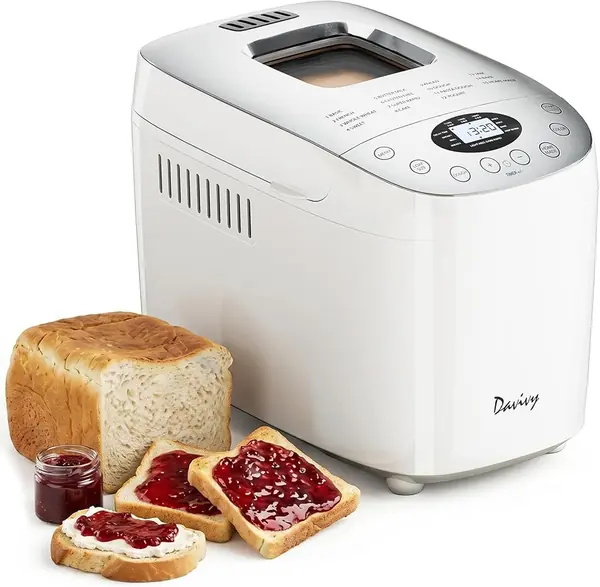
Davivy 3.5LB Bread Machine Best for Extra-Large Batches

Davivy 3.5LB bread machine with dual paddles and stainless steel body

Extra-large batches

Bake Score 83/100
Capacity
3.5 lb
Programs
15
Loaf Sizes
2.5, 3, 3.5 lb
Custom Mode
Yes
View on Amazon

The Homemade mode is the reason to consider this machine. It lets you set kneading, fermentation, baking, and keep-warm times yourself, then save the recipe for next time. For sourdough, that is closer to what you actually need than a fixed preset: you can stretch the ferment when the kitchen is cool and shorten it when the starter is moving fast.

The 3.5-pound capacity is the other standout. It bakes 2.5-, 3-, and 3.5-pound loaves, and the dual paddles do a more thorough job on a big batch than a single paddle. The pan is a traditional loaf shape, so slices look like bread from a bakery rather than tall cubes.

The 15 programs are fewer than some rivals, but the custom mode covers the gap, and the included spare paddles are a practical touch. The 15-hour delay timer and one-hour keep-warm are there for standard loaves.

We recommend it for the baker who wants one machine to handle a big sourdough bake and a lot of dough for pizza or rolls. It is not the easiest first machine; the custom mode assumes you already know how you want the ferment to run. For a big batch and a saved schedule, that is the point.

Worth Noting

  • Large 16.1-inch depth
  • Pan can be tight to seat
Our Verdict

Big-batch bakers who want a customizable homemade cycle will find the Davivy 3.5LB worth the space, and we like that it does not force a preset.

Check Latest Price

How We Tested the Best Sourdough Bread Machines

We started with roughly 40 machines pulled from retailer listings and review pages, then cut anything without a dedicated sourdough or starter program, anything whose pan coating drew repeated complaints about flaking, and anything too tall to slide under a standard upper cabinet. That left 12 machines, which we baked with for eight months.

All 12 got the same starter, fed on the same twice-daily schedule, and a country loaf scaled to each pan's capacity. For the first bake with each machine we used nothing but the manufacturer's own recipe and ingredient order, counting the button presses and timing how long it took to get from a closed manual to a running cycle. An hour after each loaf came out, we cut into it, looked at the crumb and the browning, and tasted for sourness and chew.

Then we lived with them. We set delay timers at 10 p.m. and checked the loaf at 7 a.m. to see whether keep-warm held it or steamed it soft. We held a sound meter app at arm's length during the knead cycle, measured footprint and height on a real counter, and scrubbed every pan after every bake for the full eight months, watching for scratches, sticking, and paddle seals that let water in.

By the end we could compare what each machine actually gave you for the money — pan material, how many of the programs we touched more than once, and whether the manual explained the sourdough setting in plain English or left us guessing.

How to Choose a Sourdough Bread Machine

Start With the Cycle, Not the Label

A sourdough preset is a fixed schedule. It can work with an active starter in a warm kitchen, but it cannot know that your starter is sluggish or your kitchen is cold. We prioritize a dough cycle or a customizable homemade menu, where you can extend the ferment and decide whether to bake in the machine or finish in a Dutch oven. The KITCHENARM 29-in-1's four memory slots are the clearest example; the KBS Blue's dedicated preset is the convenient starting point. Do not assume the word sourdough on the menu means a long ferment; some cycles run shorter than a real sourdough schedule.

Match Capacity to Your Loaf Habit

Two pounds is the sweet spot for most households: enough for a compact sandwich loaf without turning the machine into a counter hog. Three to three-and-a-half pounds is for big families, batch baking, or serious toast consumption, and it brings a deeper footprint and a heavier machine. The Neretva 20-in-1 sits at the compact end; the KBS 3LB and Davivy 3.5LB sit at the large end. A one-pound loaf sounds efficient, but sourdough is a slow process, and a tiny loaf can disappear before the effort feels worth it.

Look at the Pan and Paddle

Ceramic and nonstick pans both release bread, but ceramic is the finish shoppers ask about because it is marketed as cleaner and more durable. We care more about the paddle: a removable paddle lets you pull it before the final rise and avoid the hole in the bottom of the loaf. Hand-wash-only pans are common, so plan for a soak rather than a dishwasher cycle. A coating that chips or peels is a bigger problem than a coating that stains; check the warranty before you commit.

Plan for Noise, Heat, and Counter Space

Bread machines are not silent. Kneading can make a lightweight machine shift on the counter, so keep it back from the edge and give it clearance. The machine also vents heat during baking, which means it should not be boxed in under a cabinet. Measure the depth of your counter before you choose: the Davivy needs 16.1 inches, while the Neretva 20-in-1 is closer to 11. If the machine lives in a pantry, weight matters too; the KBS 3LB is over 15 pounds.

Read the Manual Before You Trust the Menu

A long menu is not a substitute for a clear recipe. Sourdough rewards weights, a timetable, and a starter note, and a manual that skips those details makes the first loaf harder than it needs to be. We prefer machines with a written recipe book and a menu chart you can follow without guessing. The KBS Blue's manual is the weak spot in an otherwise strong package; the KITCHENARM 29-in-1 is the stronger teaching tool. Read the chart before the first bake, not after.

Frequently Asked Questions

Final Verdict

For most people, the KITCHENARM 29-in-1 is the machine to buy. Its four custom menus are the closest thing here to a sourdough schedule you can actually repeat, and the recipe support gives a new baker a fair shot at the first loaf.

If you want a dedicated sourdough preset, choose the KBS Blue; if crust is the priority, the Cuisinart Convection is worth the step up.