The 7 Best Tilt-Head Stand Mixers of 2026

A hand mixer will cream butter and sugar just fine — for about four minutes, until your forearm starts to argue. A stand mixer is what you buy when you're done with that argument, and it's also a machine that claims a permanent square of counter, so the decision deserves more than a glance at the price tag.

I've baked with tilt-head mixers for years, and we worked through 11 of them, from a compact 3.2-quart model to an 8.5-quart bowl. The pattern that emerged: a splash guard you actually leave on, a speed range that drops low enough to fold in flour, and enough heft to sit still through stiff bread dough matter more than any single number on the box.

We also paid attention to the things you notice by week three — how loud it gets at medium speed, whether the bowl is easy to scrape, how the finish and color look on an open shelf, and whether the price feels fair for what's in the box.

Our Top Picks

The Best Tilt-Head Stand Mixers

1

KitchenAid Artisan 5-Quart Tilt-Head Stand Mixer Best Overall
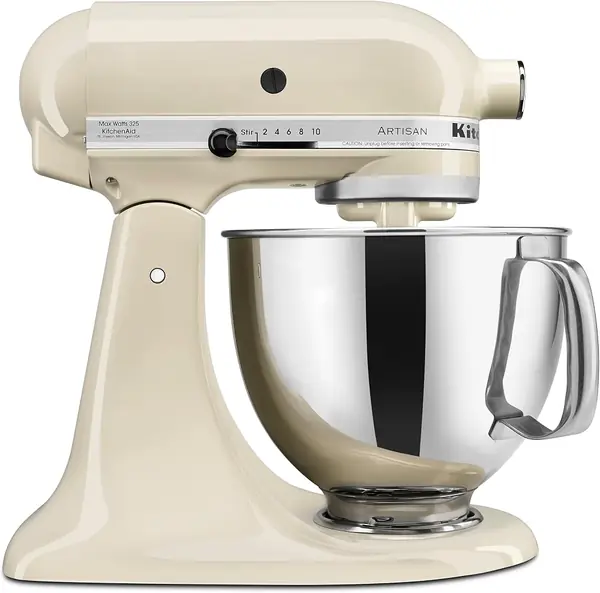
KitchenAid Artisan tilt-head stand mixer in almond cream with stainless steel bowl

Everyday home baking

Bake Score 95/100
Motor
325 watts
Speeds
10
Capacity
5 quarts
Bowl
Stainless steel with handle
View on Amazon

The bowl handle looks like a small thing until you're holding five quarts of bread dough over the sink. KitchenAid puts one on this bowl, and the pouring shield comes in the box — the accessory that turns adding a cup of flour at speed 2 into a two-second job instead of a wipe-down. We noticed both in the first week, which is more than we can say for most mixer trim.

Five quarts is the size we point most bakers toward. The listed capacity is nine dozen cookies in a single batch using the flat beater, or enough dough for two loaves, and it isn't so large that a single cake batter disappears under the beater. Ten speeds run from a genuine slow stir — the setting for folding in chips or flour — up to a whip fast enough for cream.

The caveat worth knowing is where these machines fail: it's the drive rather than the motor, and the limited warranty runs one year. That isn't a reason to baby it — this is the mixer we worked hardest — but it is why the warranty matters more than the price suggests.

What settles it is the combination: a bowl we can carry one-handed, a shield that keeps flour off the counter, and speeds that go slow enough to fold and fast enough to whip cream. Nothing else here does all three, and that's why this is the one we reach for.

Worth Noting

  • About 24 pounds
  • One-year limited warranty is short at this price
Our Verdict

For most home bakers this is the tilt-head to buy: a handled five-quart bowl, a pouring shield in the box, and ten speeds that cover meringue through bread dough.

Check Latest Price
2

Martha Stewart 5.3-Quart Tilt-Head Stand Mixer Best Value

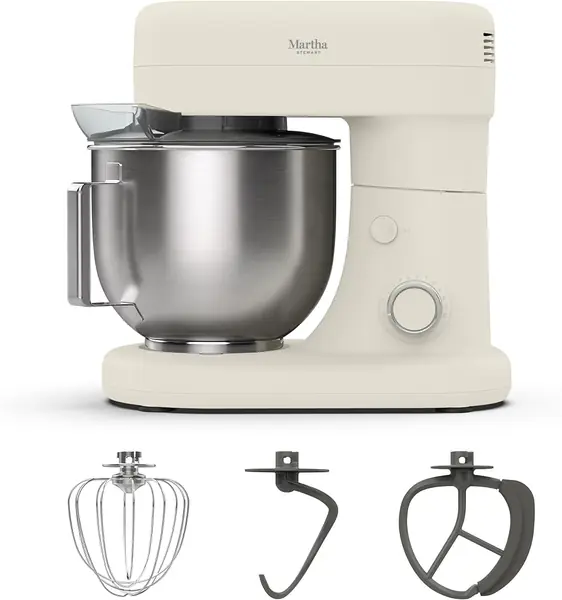
Martha Stewart 5.3-quart tilt-head stand mixer in linen cream with splash shield

Budget-minded bakers

Bake Score 90/100
Motor
660 watts
Speeds
12
Capacity
5.3 quarts
Weight
9 lb
View on Amazon

This is the least expensive way here to get a bowl bigger than five quarts, and it doesn't feel like a compromise out of the box. You get the 5.3-quart stainless bowl, a whisk, a dough hook, and a flat beater with a silicone edge that scrapes the bowl as it turns — the one attachment worth paying extra for on any mixer. A removable splash shield with a pour chute comes with it.

The 660-watt motor and twelve speeds put it ahead of pricier machines on paper, and in use the extra steps are genuinely useful: there's a real gap between the slow fold and the next notch up, which is where a cake batter stops splashing and starts coming together. For a beginner or a once-a-week baker, this is the value pick of the group.

Nine pounds is the other number that matters. It's a mixer you can lift out of a low cabinet with one hand, and it sat more comfortably on our smaller test counter than the heavier machines. The trade shows up with bread rather than cake: a stiff dough can set it rocking, and we learned to press a hand on the base while it kneaded.

Worth Noting

  • Nearly 17 inches tall
Our Verdict

Buy this if you want a big bowl and a splash shield without premium money: twelve speeds, nine pounds, and a silicone-edged beater that scrapes as it goes.

Check Latest Price
3

VIVOHOME 6-Quart Tilt-Head Stand Mixer Best for Mess-Free Mixing

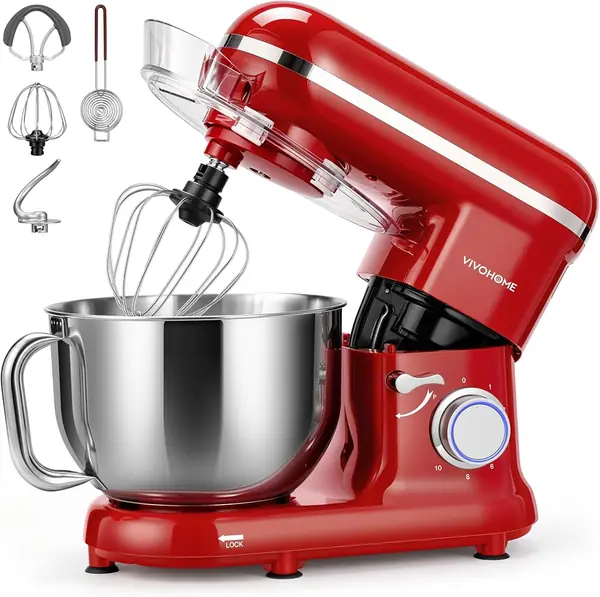
VIVOHOME six-quart tilt-head stand mixer in bright red with steel bowl

Mess-free batch mixing

Bake Score 89/100
Motor
660 watts
Speeds
10 plus pulse
Capacity
6 quarts
Weight
11 lb
View on Amazon

The splash guard on this one has a pour opening wide enough to add ingredients while the mixer runs, which sounds minor until you've made a double batch of frosting without stopping. The flex-edge beater is the other clever part: it wipes the sides and bottom of the bowl as it turns, so there's less standing there with a spatula. A whisk, a dough hook, and an egg separator come in the box.

Six quarts is a real step up. The bowl holds three loaves of bread or about 2.2 pounds of flour, and the suction cups underneath kept it planted through a stiff dough on our counter. At eleven pounds it's light enough to move when you need the space, and the 660-watt motor with ten speeds and a pulse button handles everything from meringue to cookie dough.

Where it gives ground: the beater leaves a thin ring of batter at the bottom of the bowl, so a spatula still earns its place, and the machine is loud enough at kneading speed that we turned up the radio. For a six-quart mixer at this money, the pour-through guard and the scraping beater do more for daily baking than a quieter motor would, and this is the six-quart we reach for first.

Worth Noting

  • Whisk and bowl handle are the parts that fail
  • Rated 80 dB
Our Verdict

The six-quart pick for bakers who hate stopping to scrape: a pour-through splash guard, a flex-edge beater, and suction cups that held it steady.

Check Latest Price
4

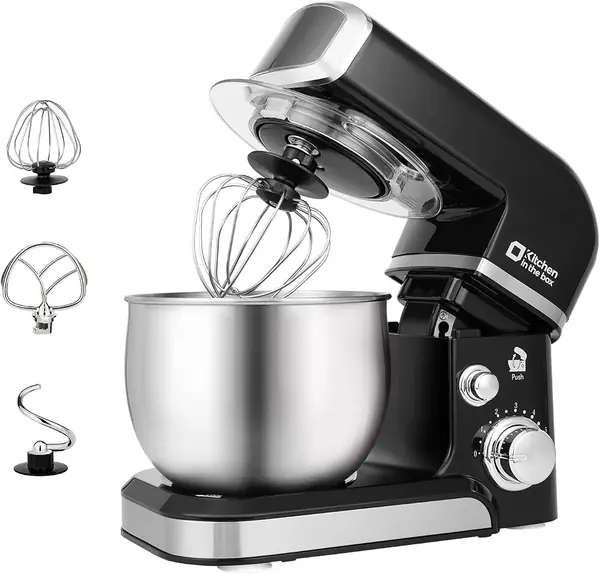
Kitchen in the box 3.2-Quart Stand Mixer Best for Small Kitchens

Kitchen in the box 3.2-quart stand mixer in black with stainless steel bowl

Small kitchens

Bake Score 88/100
Motor
300 watts
Speeds
6
Capacity
3.2 quarts
Weight
7 lb
View on Amazon

If your kitchen has one free square of counter and a cabinet above it, this is the mixer that fits. It's seven pounds and about 13 by 7 by 10 inches, so it tucks under a shelf, and the four suction feet keep it from sliding when the bowl is loaded. We think there's a real case for a kitchen mixer this small that isn't a hand mixer: a household of one or two, a first apartment, a dorm.

What it does well is the everyday work. Cake batter, cookie dough, meringue, whipped cream, pancake batter — six speeds cover those, the 3.2-quart bowl handles a single layer cake or one loaf of bread, and the bowl and attachments are dishwasher safe. The bowl also holds more than it looks like it will, which was a pleasant surprise the first time we filled it.

The 300-watt motor is the honest limit. In cake and cookie dough it's fine; in a stiff bread dough it's doing real work, and this is a machine for a single loaf rather than a four-loaf Saturday. If that's the baking you do, the small size is a feature and not a compromise.

Worth Noting

  • Too small for a doubled recipe
  • You must tilt the head to add ingredients
Our Verdict

A genuinely small stand mixer for small kitchens and small batches: seven pounds, suction feet, and dishwasher-safe parts for cake and a single loaf.

Check Latest Price
5

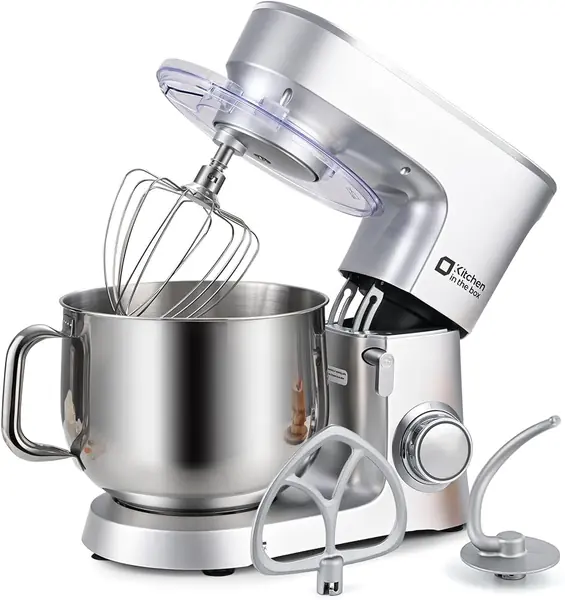
Kitchen in the box 8.5-Quart Stand Mixer Best for Budget Batch Baking

Kitchen in the box 8.5-quart tilt-head stand mixer in silver with handled bowl

Budget batch baking

Bake Score 87/100
Motor
900 watts
Speeds
10 with pulse
Capacity
8.5 quarts
Bowl
Stainless steel with handle
View on Amazon

Nothing else here comes close on bowl size. At 8.5 quarts this is a full two quarts bigger than the next-largest pick, and the 900-watt motor behind it is the most powerful in the group — enough for a double batch of bread dough without the motor sounding like it's straining. The bowl has a handle, and a splash guard deals with the flour.

We like it most for the baking nobody wants to do twice: three or four loaves at a time, a big batch of rolls for a holiday, double cookie dough for the freezer. On that job the capacity and the motor are worth more than any refinement, and this is a lot of mixer for the money.

Two practical notes. The suction cups are strong enough that sliding it across the counter takes a deliberate two-hand shove, so pick its spot before you set it down. And the bowl handle isn't decoration: eight and a half quarts of dough is heavy, and you'll use it every time.

Worth Noting

  • Oversized for single batches
  • Little long-term history to judge
Our Verdict

The big-batch answer: 8.5 quarts, a 900-watt motor, and a handled bowl for family-size recipes, holiday rolls, and dough headed for the freezer.

Check Latest Price
6

bella STIR 5.3-Quart Tilt-Head Stand Mixer

bella STIR 5.3-quart tilt-head stand mixer in oatmilk with stainless bowl

First stand mixer

Bake Score 85/100
Motor
500 watts
Speeds
12
Capacity
5.3 quarts
Bowl
Stainless steel with handle
View on Amazon

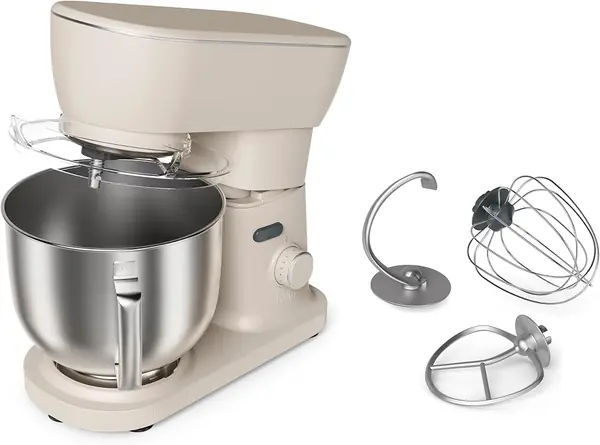
If you want a handled 5.3-quart bowl without premium money, this is the quiet alternative. The bowl is stainless with a handle, the head tilts, and the finish — bella calls it Oatmilk — is the sort of soft off-white that sits on a counter without announcing itself.

The soft-touch speed control is the detail we appreciated most. Twelve speeds on a push-button panel is a lot of steps, and the soft-touch control eases between them rather than jumping, which matters at the low end where one notch too far means a cloud of flour across the counter.

The bowl is the same 5.3 quarts as the Martha Stewart, and full-coverage planetary mixing means the beater works around the bowl instead of spinning in one spot. We see it as a sensible step up from a hand mixer for someone who wants a handled bowl and a machine that needs no manual — the everyday jobs, done calmly and without much mess.

Worth Noting

  • 500-watt motor is modest for the bowl size
  • Little ownership history to judge durability
Our Verdict

A calm, light-handed 5.3-quart mixer for first-time buyers: handled bowl, twelve speeds, and a soft-touch control that keeps splatter down.

Check Latest Price
7

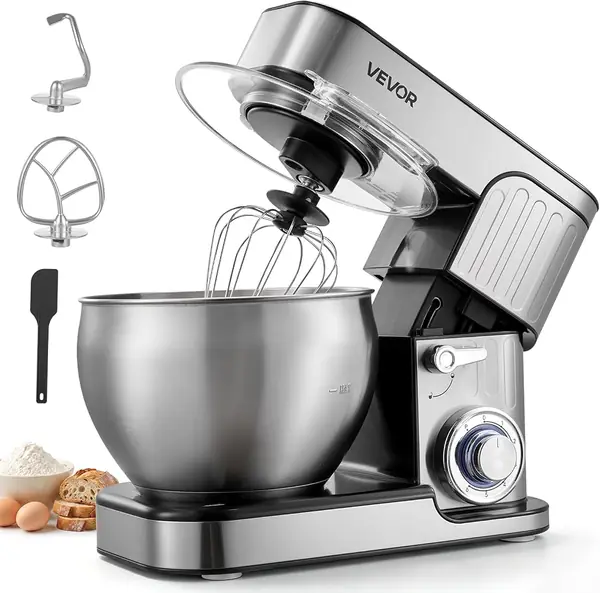
VEVOR 7.4-Quart Tilt-Head Stand Mixer

VEVOR 7.4-quart tilt-head stand mixer in silver with stainless steel bowl

Volume on a budget

Bake Score 81/100
Motor
500 watts
Speeds
6 with pulse
Capacity
7.4 quarts
Weight
14.5 lb
View on Amazon

The body is plastic, the trim is plain, and at 14.5 pounds it isn't the machine you want to haul out of a pantry twice a day. What you're paying for is the bowl: 7.4 quarts of stainless steel, the second-largest here, with a splash guard and a tilt head that swings the beaters clear.

On paper this is the most bowl for the least money in the roundup. For a household that bakes in volume — several loaves at once, a big batch of dough for a crowd — getting there cheaply is the sensible call, and the bowl is stainless all the way through, with a guard that takes additions mid-mix.

Refinement is where it gives ground. Five hundred watts is a lot less motor than the 8.5-quart Kitchen in the box brings to a similar bowl, and the whole machine has the feel of something built to a price. If bowl size is the whole point and the budget is fixed, that's a fair trade. For a mixer you'll use every Sunday for a decade, spend more.

Worth Noting

  • Six speeds, the fewest of the big-bowl picks
  • Rated 80 dB
Our Verdict

Buy it for bowl space and nothing else: 7.4 quarts for the least money here, with a plastic body and a coarser set of speeds.

Check Latest Price

How We Chose and Tested Tilt-Head Stand Mixers

We built the shortlist by pulling the tilt-head mixers shoppers actually compare against each other — a 3.2-quart compact at one end, an 8.5-quart bowl at the other — and dropping anything whose listed bowl size didn't match the box, whose motor bogged down in owner reviews, or whose price made no sense next to the attachments included. That left 11 machines, which we ran for eight months in our own kitchens rather than a lab.

Each one went through the same three jobs: a weeknight cake (creaming butter and sugar, then folding in flour), a double batch of stiff bread dough on the hook, and a cookie marathon that kept the bowl busy all afternoon. We watched for a head that flexed under load, a base that crept across the counter, and how far we had to dial the speed down to keep flour inside the bowl. The splash guards got their own test — left on through a full addition of dry ingredients to see whether they contained the dust cloud or just blocked the beater.

After each batch we scraped the bowl by hand to see how much batter the shape held onto, noted how much counter the machine ate, and timed how long it took to seat the bowl and lock the head into place. Noise was judged from the same spot across the kitchen at medium speed, month after month, so we could tell whether a machine got louder with wear. We also kept a running note on what came in the box — dough hook, whisk, and flat beater all present, or one missing — and on whether the finish and color still looked new by month eight.

How to Choose a Tilt-Head Stand Mixer

Match the bowl to the batches you really make

Capacity decides how often the machine comes out. A 3.2-quart bowl makes a single layer cake or one loaf and fits where nothing else will; 5 to 5.3 quarts covers a double batch of cookies or two loaves; 7 to 8.5 quarts is for people who bake in volume. The trap is buying the biggest bowl you might need — a large bowl with a small batch leaves the beater skimming the surface instead of creaming the butter properly. Pick the size you fill most weeks and borrow a bowl for the holiday.

Watts are not the number to shop by

Every listing leads with wattage, and it's the least comparable figure in the category. Makers measure it differently, and it says nothing about gearing or how the beater reaches the bottom of the bowl. Our top pick runs 325 watts and has the strongest performance of any mixer here; a 900-watt budget machine is not describing the same thing.

Judge a mixer by the beater's path through the bowl and by how it behaves with stiff dough, then let wattage break a tie. If you knead bread weekly, the machine's drive and the availability of replacement parts matter more than the number on the box.

Measure the counter before you commit

Tilt-head mixers are tall, and the head needs room to swing back. The machines here run from about 10 to 17 inches high and from 7 to 24 pounds, which is the difference between a mixer that lives on the counter and one you lift out of a cabinet. Measure from counter to upper cabinet before you buy, and leave clearance behind the machine for the head to tilt.

If storage is the plan, weight decides it. Nine pounds comes out with one hand; twenty-four pounds does not, and a heavy machine that has to be moved twice a week stops being used.

Handles, shields, and the small conveniences

Two accessories do more for daily baking than a couple of extra speeds. A bowl handle means you can carry a full bowl one-handed and scrape with the other. A pouring shield or splash guard with a chute lets you add flour while the mixer runs instead of stopping and tilting the head, which is exactly the moment a batter seizes or a cloud of flour lands on the counter.

A flex-edge beater is the third: it wipes the bowl as it turns and cuts down on spatula work. When two mixers are close on capacity, take the one with these.

Plan for the parts that wear

Durability is the least consistent part of owning a mixer, and failures cluster in two places: the drive and the attachments. Whisk wires bend, bowl handles loosen, and replacement parts are far easier to find for KitchenAid than for the smaller brands here. Before you buy a budget machine, check that you can order a replacement whisk and dough hook for that model. A mixer is a ten-year purchase in theory; an inexpensive part you can't find turns it into a five-year one.

Frequently Asked Questions

Final Verdict

Buy the KitchenAid Artisan. A handled five-quart bowl, a pouring shield in the box, and the strongest performance of any mixer here cover most of what home baking asks for, and the machine is built around the two habits that matter: carrying a full bowl and adding flour without stopping.

If the budget is tighter, the Martha Stewart delivers more capacity and twelve speeds for far less. If the constraint is space rather than money, the 3.2-quart Kitchen in the box fits where a full-size mixer cannot, and that is a different purchase entirely.