The 4 Best KitchenAid Mixers of 2026

A stand mixer is one of the few kitchen appliances people buy planning to keep for twenty years, which makes the choice heavier than it looks. Scroll through owner reviews and the same worry surfaces: the motor strains on stiff bread dough, the head loosens after a few seasons, and the machine ends up holding a bowl of dust. I bake most weekends, and seven mixers went through our cookie dough, holiday bread and a lot of frosting to find the ones that hold up.

What you're paying for is fewer sore arms and more time back. Two things I'd tell a first-time buyer: tilt-head and bowl-lift are different machines to live with — one tips back so you can add ingredients mid-mix, the other lifts the bowl into the head — and bowl size matters more than speed count, since a 4.5-quart fills fast on a double batch. Many of these are bought as gifts, so finish and color matter more than you'd expect. Our four cover both designs and both ends of the size range.

Our Top Picks

The Best KitchenAid Mixers

1

KitchenAid Artisan 5-Qt Tilt-Head Best Overall
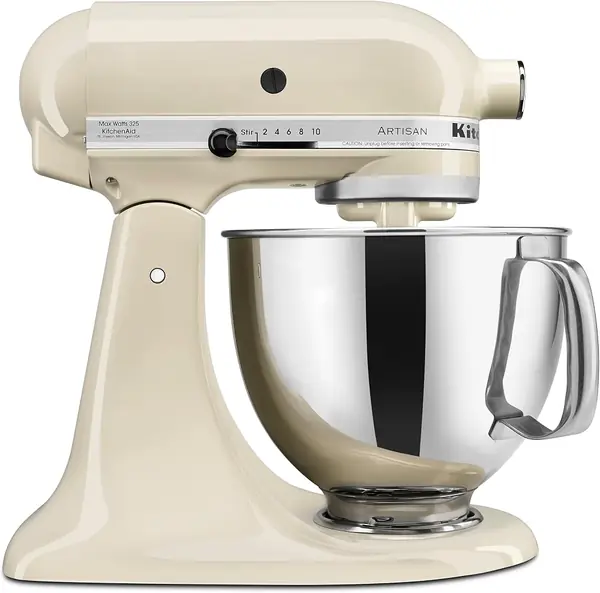
KitchenAid Artisan 5-quart tilt-head stand mixer in almond cream with stainless steel bowl

The default for most bakers

Bake Score 95/100
Power
325 watts
Bowl Capacity
5 quarts
Dimensions
9.3"D x 14.3"W x 14"H
Bowl Handle
Yes
View on Amazon

Head style is the first thing to get straight, and it is the reason the Artisan is the version we hand to most bakers. The head tips back and stays up while the bowl sits on its turntable, so you can scrape the sides, drop in butter, or check the bottom for dry flour without unlatching anything. Five quarts of bowl is enough for nine dozen cookies by the flat beater — more cookies than most home ovens can keep up with in one afternoon.

We like the details that come with it: a handle on the bowl, which makes five quarts of dough far less awkward to lift; a pouring shield in the box for adding flour at speed; and ten speeds with a genuine stir setting at the bottom of the dial for folding in chips or the last of the flour. It is also the one here that comes in a finish worth designing a kitchen around, and a mixer you like looking at is a mixer that stays out and actually gets used.

The caveat worth knowing is lifespan. These are geared machines, and the failure that turns up is a mixer that still runs while the shaft stops turning — sometimes within the first few months. The Artisan carries a one-year hassle-free replacement warranty, so treat the first twelve months as the window in which a bad unit shows itself, and use it hard while that window is open.

Worth Noting

  • Big bread batches want a bowl-lift
Our Verdict

For most home bakers, we think the Artisan is the one to buy: open tilt-head access, a handled 5-quart bowl, and enough power for cakes and cookies without the bulk of a bowl-lift.

Check Latest Price
2

KitchenAid Classic Series 4.5-Qt Best for Small Batches

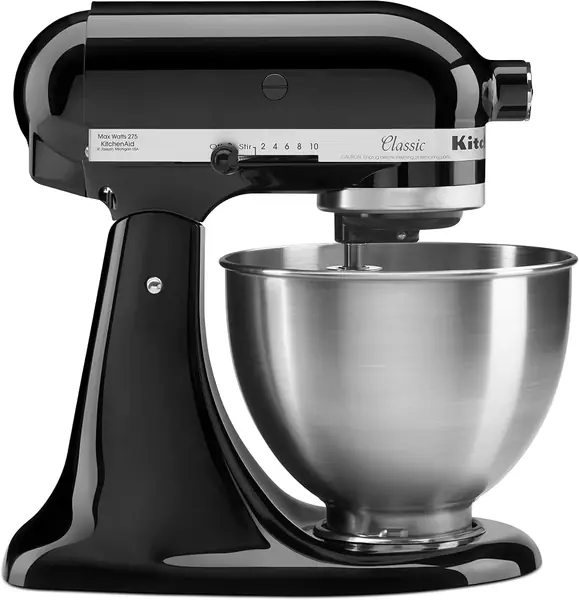
KitchenAid Classic Series 4.5-quart tilt-head stand mixer in onyx black with stainless steel bowl

Small kitchens, small batches

Bake Score 94/100
Power
275 watts
Bowl Capacity
4.5 quarts
Speeds
10
Weight
22 lb
View on Amazon

The Classic is the least expensive KitchenAid in this group and the smallest-bowled at 4.5 quarts, which makes it either exactly right or immediately wrong depending on how much you bake. It is a 22-pound machine with a dishwasher-safe stainless bowl, a coated flat beater, a coated dough hook, and a 6-wire whip, and it uses the same tip-back head as the Artisan.

For cake, cookie, and frosting duty, we think it is the best value here. Eight dozen cookies' worth of dough fits in a single batch, five cups of flour goes in without strain, and the ten speeds include a genuinely slow stir for folding. Cleanup is the part we appreciate most: the bowl and the coated tools go straight in the dishwasher, there is no cradle or latch to wipe batter out of, and it is compact enough to live in a cabinet between bakes if your counter is short.

What we cannot promise is time. Gear failures around the 18-month mark are the recurring story with this model, and the one-year limited warranty has expired by then, so the repair comes out of your pocket. Bake a few times a month and it should serve you for years; bake every week and the Artisan or the bowl-lift is the safer way to spend.

Worth Noting

  • 275 watts is the least power here
Our Verdict

We recommend the Classic to anyone who bakes in small batches: eight dozen cookies fit in the bowl, and it costs the least of the four.

Check Latest Price
3

KitchenAid 5.5-Qt Bowl-Lift Best for Bread

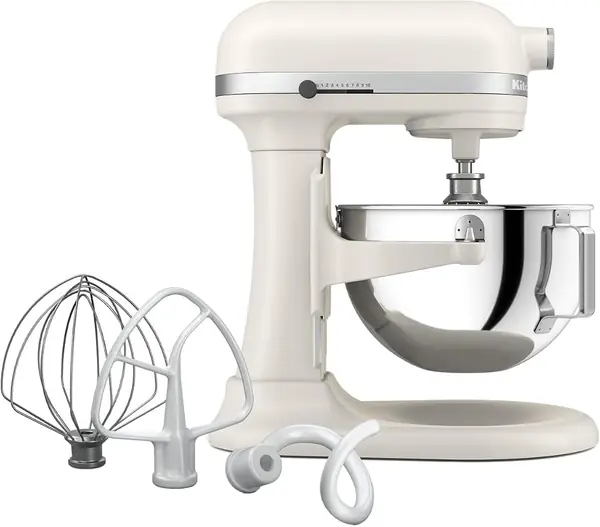
KitchenAid 5.5-quart bowl-lift stand mixer in porcelain white with stainless steel bowl and three tools

Bread dough and big batches

Bake Score 91/100
Power
500 watts
Bowl Capacity
5.5 quarts
Dimensions
14.63"D x 11.31"W x 16.5"H
Bowl Locking
3-point locking bowl
View on Amazon

Five hundred watts is 175 more than the biggest tilt-head here, and in this bowl-lift it is bolted to a bowl that locks down at three points instead of sitting loose on a turntable. That combination is what lets the machine work through more than seven pounds of bread dough: the bowl cannot shift, and the motor has the headroom to keep going instead of heating up halfway through a double batch.

Everything else follows the same heavy-duty logic. Eleven speeds instead of ten, including a half-speed setting for folding berries or beaten egg whites in without knocking the air out; a rating of 11 dozen cookies per batch; six pounds of mashed potatoes; and a 5.5-quart stainless bowl with a coated flat beater, coated dough hook, and 6-wire whip. It also runs quieter than the size suggests — you hear it working, but it is not the thing that clears the room.

This is the mixer we point bread bakers to. The trade is a small ritual: the bowl drops into its cradle and has to be raised and latched for every batch, where a tilt-head simply tips back, and the head never moves out of the way, so you load from the side. Someone kneading twice a week will not mind any of that in exchange for a motor that does not flinch.

Worth Noting

  • Needs 16.5 inches of clearance under cabinets
Our Verdict

Buy the 5.5-quart bowl-lift if you knead bread: 500 watts and a locking bowl hold more than seven pounds of dough that would strain a tilt-head.

Check Latest Price
4

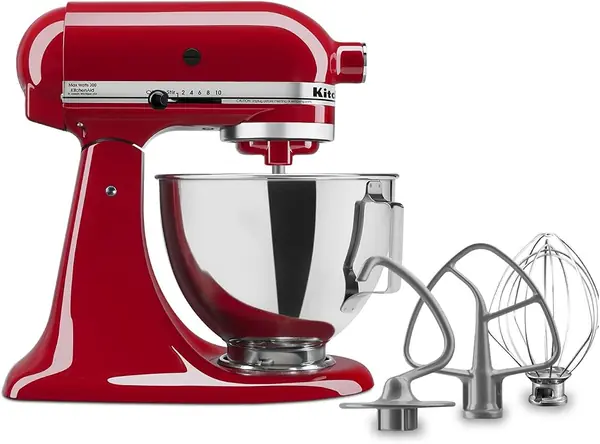
KitchenAid KSM85 4.5-Qt Tilt-Head Best for Cookies and Cakes, Tight Counters

KitchenAid KSM85 4.5-quart tilt-head stand mixer in empire red with stainless steel bowl and three tools

Cookies and cakes, tight counters

Bake Score 90/100
Power
300 watts
Bowl Capacity
4.5 quarts
Dimensions
14.5"D x 8"W x 14"H
Drivetrain
Metal gears, direct drive transmission and planetary mixing action
View on Amazon

Metal gears and a direct-drive transmission are the reason we take the KSM85 seriously. It is the same bowl size as the Classic with a 300-watt motor instead of a 275-watt one, and the 67-point planetary action keeps the beater sweeping close to the bowl wall, so there is less stopping to push batter down the sides and more of the mixing happening on its own.

The box holds the standard set — 4.5-quart stainless bowl, flat beater, dough hook, 6-wire whip — plus ten speeds on a slide control and a body that fits a corner of the counter without taking over the run. The Empire Red finish is the part we keep coming back to: it is the sort of machine that stays out instead of going back in a cabinet, and a mixer that stays out is a mixer that gets used.

Where it stops is bread. Three hundred watts in a 4.5-quart bowl is cake-and-cookie territory, and stiff dough is the job that ends small tilt-heads early. If a weekly loaf is the plan, the 5.5-quart bowl-lift above is the machine for it; this one is for everything else — layer cakes, cookie dough, buttercream, and the Thursday-night pan of brownies.

Our Verdict

This is the 4.5-quart tilt-head we point to when there is room for only one mixer and the baking is cookies, cakes, and frosting rather than bread.

Check Latest Price

How We Tested Seven Stand Mixers Over Nine Months

We started with the full current lineup and bought seven to test, deliberately covering both head designs, every bowl size on offer, and a spread of finishes. Two went home with a colleague who bakes sourdough weekly; the rest lived on my counter.

Over nine months, every mixer did the same work: Saturday cookie dough, a weekly sandwich loaf, stiff bagel dough that fights back, whipped cream, and buttercream for a birthday cake. We noted whether the motor slowed or the head bucked once the dough got stiff, whether the machine crept across the counter, and how it sounded at the low speeds. We also timed adding flour mid-mix — the tilt-heads win that one, since you can tip them back with the beater still in.

For durability, we ran a seven-minute knead on each machine and listened for a change in pitch as the months went on, checked for play in the head and the bowl lock, and looked over the gears after heavy dough weeks. Twice a week we wiped flour and butter off each finish and noted which colors showed smudges and which hid them. We lifted every bowl loaded, too, because a bowl that's miserable to handle full is a daily tax.

Value came last: what bowls and attachments came in the box, whether we'd actually use them, and whether the next step up bought better mixing or just more capacity.

How to Choose a Kitchenaid Stand Mixer

Tilt-Head or Bowl-Lift

A tilt-head mixer pins the bowl to a turntable and tips the head back, so the bowl stays put while you scrape, add, or check the bottom. A bowl-lift holds the bowl in a cradle that rises into the beaters, with the bowl locked at three points instead of resting loose — steadier with stiff dough, and the better tool for bread. Tilt-heads are quicker to load and unload; bowl-lifts are the ones you lean on.

The trap is height. A bowl-lift drops its bowl into a cradle below the head, so it stands taller than a tilt-head of similar capacity — the 5.5-quart model here lists 16.5 inches. Measure the gap between your counter and the upper cabinets before you order. A tilt-head can tip back under a low cabinet; a bowl-lift has to have the room to stand there.

Size the Bowl to Your Biggest Batch

Capacity is quoted in quarts, but the useful number is what fits inside. Using the flat beater and 28-gram cookies, KitchenAid rates the 4.5-quart bowl at 8 dozen cookies, the 5-quart at 9 dozen, and the 5.5-quart at 11 dozen. The bigger bowl also takes more than 7 pounds of bread dough or 6 pounds of mashed potatoes.

Size for the largest thing you make in a normal month, not the largest you have ever attempted. Overshooting has its own cost: a whisk barely reaches a cup of cream in a very large bowl, and small batches are what most people actually mix on a Tuesday. For a household that bakes most weekends, 5 quarts is the middle that fits.

What the Motor Spec Tells You

Wattage is the number everyone compares and the least useful on its own. The tilt-heads here run 275 to 325 watts; the 5.5-quart bowl-lift runs 500. The gap matters with stiff dough, because kneading is what wears a mixer out — a tilt-head gets through a loaf, but a bowl-lift's bigger motor and locked bowl are what let it take seven pounds without straining.

We put the money on the motor only when bread is on the schedule. If your mixing is cake batter, cookie dough, and frosting, the smaller motor never comes up. One extra worth knowing: the 5.5-quart model's eleventh speed is a half-speed for folding berries or egg whites in without knocking the air out.

Counter Space, Weight, and Cleaning

Most of these are 22- to 24-pound machines. The weight is doing a job — it is what keeps the mixer from walking across the counter — but it also means the machine wants a permanent home. Measure the depth of the counter run you have in mind, and be honest about whether you will lift 22 pounds in and out of a cabinet. You will not.

Cleaning is the easy part. The stainless bowls and the coated flat beater and dough hook come clean in warm water and are dishwasher safe on the models that specify it, and a tilt-head has no cradle or latch to dig batter out of.

What the Attachment Hub Adds

KitchenAid lists more than 10 optional attachments for these mixers — pasta rollers, grinders, spiralizers, and an ice cream bowl among them — and every one of them is sold separately. None of it changes which mixer to buy today, but it is the argument for buying into this system rather than a one-job appliance: the machine you buy for cookies can grind meat in January, and you are not paying twice for a second motor.

Frequently Asked Questions

Final Verdict

If you want one answer, it is the Artisan. The head tips back for loading and scraping, the 5-quart bowl covers everything from a single cake to nine dozen cookies, and the finish you pick is one you will leave out on the counter. Nothing else here is as easy to live with day to day.

Change the answer only if bread is the point. For weekly kneading, the 5.5-quart bowl-lift's 500-watt motor and three-point locking bowl are worth the extra height and the slower bowl-lift ritual.