The 8 Best Infrared Thermometers for Pizza Ovens of 2026

A pizza oven lies to you at exactly the wrong moment. The flame is rolling, the gauge on the door says it's ready, and the pie you slide in comes out pale and limp — because the air was hot and the stone underneath was nowhere near it. An infrared thermometer settles that in about a second: point, pull the trigger, and you're reading the deck itself instead of guessing.

That gap between air and stone is where most bad pizza comes from. We put 14 infrared thermometers through backyard pizza nights, Saturday griddle breakfasts, and cast iron searing, and the spread in performance is wider than the prices suggest. Distance-to-spot ratio and adjustable emissivity are the two specs that decide whether a number means anything.

A few add a backlight or a case, which matter more at dusk than you'd think. And none of them take a human temperature, whatever the product photos imply — every pick here is built for a hot deck, a flat-top, or a cast iron pan.

Our Top Picks

The Best Infrared Thermometers for Pizza Ovens

1

Etekcity Lasergrip 1080 Best Overall
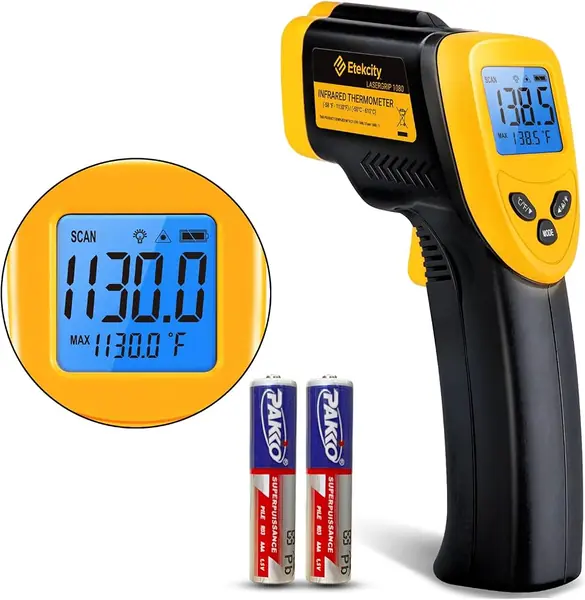
Etekcity Lasergrip 1080 yellow handheld infrared thermometer with backlit LCD display

High-heat pizza ovens

Bake Score 96/100
Emissivity
0.1–1.0 adjustable
Temperature Range
-58° to 1130°F
Response Time
0.5 seconds
Distance-to-spot
12:1
View on Amazon

The 1130°F ceiling is the first number we check on a pizza-oven thermometer, and it is why the Etekcity Lasergrip 1080 is our top pick. It leaves room for a hot stone, the dome, and the reflected heat around a wood-fired oven without running out of range. The 12:1 distance-to-spot ratio lets you stand back and still put the measurement area on the stone rather than your hand.

Adjustable emissivity from 0.1 to 1.0 is the feature that matters more than shoppers expect. Cordierite stone, a steel peel, and a blackened oven interior do not read the same, and being able to tune the setting keeps a reading useful as you move around the oven. The 0.5-second response is quick enough to sweep several spots on the stone and compare them before the oven recovers.

We also like the backlit LCD and the two-year warranty at this price. If you want a thermometer calibrated specifically for cordierite, the Ooni is the more specialized choice; if you want the widest range for the least fuss, this is the one. The included AAA batteries are standard, but the warranty is the notable extra.

Worth Noting

  • Light plastic body feels less rugged
Our Verdict

We recommend the Lasergrip 1080 as the default pizza-oven thermometer because its 1130°F ceiling and adjustable emissivity handle stone, dome, and steel without a premium price.

Check Latest Price
2

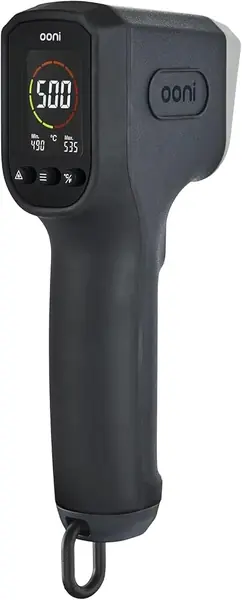
Ooni Digital Infrared Thermometer Best for Pizza Ovens

Ooni black digital infrared thermometer with color LCD and aluminum hang loop

Ooni stone ovens

Bake Score 95/100
Emissivity
Adjustable
Response Time
300 milliseconds
Max Temperature
999°F
Stone Calibration
Cordierite baking stones
View on Amazon

A thermometer from a pizza-oven maker invites suspicion: is the Ooni Digital Infrared Thermometer calibrated for its own ovens or just branded for them? The answer is the former. Ooni calibrates it for the cordierite baking stones used in its ovens, and adjustable emissivity still lets you read steel and other surfaces when you move off the stone.

That calibration is why we rank it as the best choice for Ooni owners and anyone cooking on a cordierite stone. The 999°F ceiling is enough for a hot Neapolitan bake, and the 300-millisecond response is the quickest in this group. The color LCD can show a numerical or color-coded reading, and scan mode lets you sweep the stone instead of taking one spot reading and hoping.

The laser is easy to place, and the hang loop is a small but useful touch for keeping the thermometer near the oven. The 2 AAA batteries are common and included. We treat the Ooni as a dedicated oven accessory rather than a general-purpose shop tool; if you also want to check grill grates, air vents, and engine parts, the broader Etekcity 1080 makes more sense.

Worth Noting

  • Premium price for a pizza-oven accessory
Our Verdict

We choose the Ooni thermometer for cordierite-stone ovens because its stone calibration, 300-millisecond response, and scan mode make a hot bake easier to read.

Check Latest Price
3

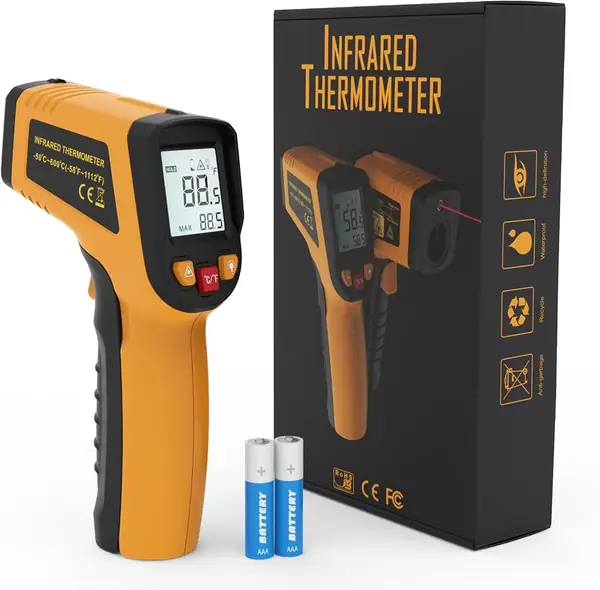
KNINE OUTDOORS Infrared Thermometer Gun Best Budget

KNINE OUTDOORS orange infrared thermometer gun with single laser and LCD screen

Budget high-heat checks

Bake Score 94/100
Emissivity
0.1–1.0 adjustable
Temperature Range
-58° to 1112°F
Targeting
Single laser
Distance-to-spot
12:1
View on Amazon

The KNINE OUTDOORS costs little enough to qualify as an impulse buy, but the specification sheet is not toy-grade. It reaches 1112°F, uses a 12:1 distance-to-spot ratio, and lets you adjust emissivity from 0.1 to 1.0. That is the same range of adjustment we look for on pricier tools, and it is the reason this one stays in the budget conversation rather than the novelty bin.

The single laser is clear, and the orange body is easy to find in a crowded outdoor kitchen. We like that the display is large and the unit switches between Fahrenheit and Celsius with a long press; those small conveniences matter when your hands are full and the oven is already hot. The 1112°F ceiling gives you headroom for a stone running hotter than the oven display suggests. The battery is included, so it works out of the box.

What keeps it out of the top spot is polish. The housing feels lighter than the Etekcity, and the controls are simpler than the dual-laser model's. At its price, that is a reasonable trade: it is the thermometer we hand someone who wants a capable temperature gun without spending much.

Worth Noting

  • Readings can run cool on some surfaces
Our Verdict

We recommend the KNINE OUTDOORS as the budget pick because it reaches 1112°F and adjusts emissivity, though we trust it more for relative readings than exact ones.

Check Latest Price
4

Etekcity Lasergrip 1025D Best for Precise Aiming

Etekcity Lasergrip 1025D yellow dual-laser infrared thermometer with 9V battery

Precise spot mapping

Bake Score 93/100
Emissivity
0.1–1.0 adjustable
Temperature Range
-58° to 1022°F
Response Time
500 milliseconds
Targeting
Dual laser
View on Amazon

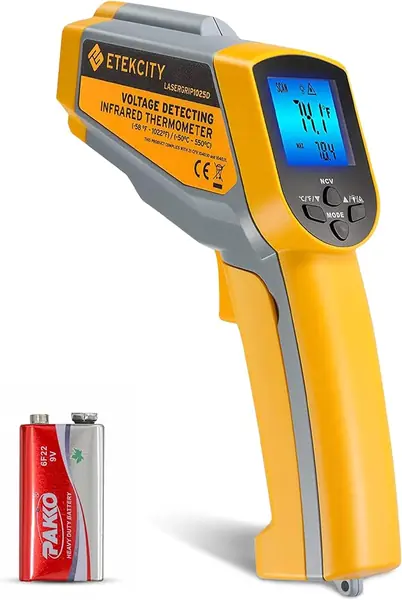
The dual laser on the Etekcity Lasergrip 1025D is the reason to look at this model instead of the cheaper Lasergrip 1080. Two dots bracket the measurement spot, so you can see the circle you are averaging over rather than guessing from a single point. On a stone with a hot center and cooler edges, that is a real advantage.

The rest of the package is professional-grade for home cooking: a 1022°F ceiling, a 12:1 distance-to-spot ratio, adjustable emissivity from 0.1 to 1.0, and a 500-millisecond response. It runs on a 9V battery and includes non-contact voltage detection, which is useful if the thermometer also lives in a toolbox.

We found the 1025D more deliberate in the hand than the 1080. The display is clear, but the layout takes a moment longer to learn if you are switching between emissivity, mode, and laser settings. That is not a problem for a tool you use often; it is less appealing if you want to pull it out of a drawer and point it without thinking.

Our verdict is that the 1025D earns its place as the precise-aiming pick, not the default. If you already know your oven runs unevenly and you want to map the stone, the dual laser is worth the extra bulk. If you just want a fast read before launching a pizza, the 1080 is simpler and just as capable at the temperatures that matter.

Worth Noting

  • 9V battery is less convenient than AAA
Our Verdict

We like the Lasergrip 1025D for cooks who want to see exactly where the reading is coming from, thanks to its dual laser and adjustable emissivity.

Check Latest Price
5

Gozney Infrared Thermometer Best Premium Design

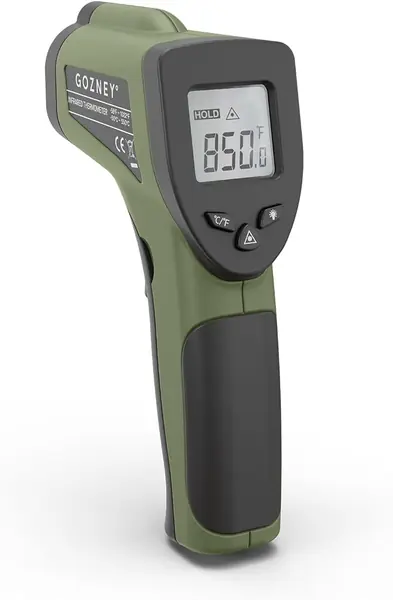
Gozney green infrared thermometer with built-in laser and backlit LED screen

Premium Gozney setups

Bake Score 92/100
Battery
1 9V included
Targeting
Built-in laser
Display
LED backlit
Max Temperature
550°C / 1022°F
View on Amazon

The Gozney Infrared Thermometer looks like it belongs next to a premium pizza oven: a green body, a built-in laser, and a simple LED screen rather than a cluster of buttons. That design-forward approach is not just vanity. A thermometer that stays visible and easy to grab is one you actually use before every bake.

We rank it as the premium choice for Gozney owners and anyone who wants a dedicated oven accessory. It reads up to 550°C / 1022°F, switches between Celsius and Fahrenheit, and offers single or continuous readings. The built-in laser makes placement straightforward, and the 9V battery is included. Continuous mode is the feature we appreciate most: you can sweep the stone and watch the number move instead of triggering a new reading every time.

The Gozney is not the most versatile thermometer here. It is built around pizza-oven duty rather than general-purpose shop work, and the controls are kept simple. For a Gozney owner who wants one good-looking tool for stone and dome checks, those are easy compromises. For someone who also wants to check a grill, a griddle, and HVAC vents, the broader Etekcity 1080 makes more sense.

Worth Noting

  • Premium price for a single-purpose tool
Our Verdict

We recommend the Gozney thermometer for Gozney owners who want a simple, good-looking tool that reads stone and dome temperatures without fuss.

Check Latest Price
6

TempPro TempScan Best Value All-Rounder

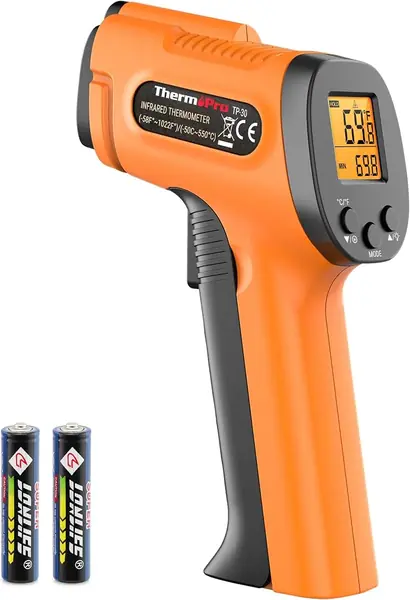
TempPro TempScan orange infrared thermometer gun with digital display and batteries

Everyday oven checks

Bake Score 91/100
Emissivity
Adjustable
Temperature Range
-58° to 1022°F
Response Time
Under 0.5 seconds
Distance-to-spot
12:1
View on Amazon

The TempPro TempScan's MAX/MIN/AVG memory is the detail that sold us on it as a value pick. A pizza stone is rarely one temperature, and being able to take a few readings and see the high, low, and average of the last scan makes it easier to judge whether the stone is ready or just hot in one spot. That is more useful to us than a single hold reading.

The rest of the specification is well judged for the money: a -58° to 1022°F range, a 12:1 distance-to-spot ratio, a response time under half a second, and adjustable emissivity. The orange body is easy to spot, and the included AAA batteries mean it works out of the box. We found the buttons straightforward, and the memory readout is easy to cycle through.

The TempPro earns its spot because the temperature range is high enough for a hot oven without stretching to a premium model, and the buttons are easy to work with one hand. It is the one we hand to someone who wants a straightforward value pick. The memory function is the reason it stays in the rotation.

Worth Noting

  • Display is not backlit for low light
Our Verdict

We recommend the TempPro TempScan as a value pick for cooks who want max/min/average memory and a high-enough range for pizza ovens.

Check Latest Price
7

Soonkoda GM50

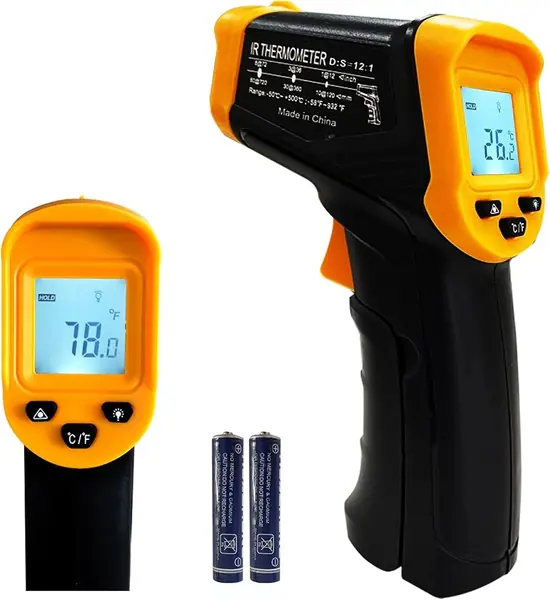
Soonkoda GM50 black infrared thermometer with backlit LCD and two AAA batteries

Low-cost backup

Bake Score 90/100
Emissivity
0.95 preset
Temperature Range
-58° to 932°F
Battery
2 AAA included
Display
Backlit LCD
View on Amazon

The Soonkoda GM50 sets its emissivity at 0.95 and leaves it there. That is a sensible default for most organic materials, painted surfaces, and the kind of dark stone a pizza oven uses, and it keeps the controls simple: point, pull the trigger, read the number.

It reaches 932°F, which is enough for many pizza ovens but not all. A high-heat Neapolitan oven can run past that, and the GM50 has no headroom to tell you how far past. The backlit LCD and data-hold function are useful, and the 2 AAA batteries are included. The response can feel slower than the half-second class, so it is not the one to choose if you want to sweep a stone quickly.

We rank the GM50 as a low-cost backup or a first thermometer for someone cooking at moderate pizza-oven temperatures. The 932°F ceiling is the main trade-off; it is not hidden, and it does not matter if your oven tops out below that. For a high-heat oven or a stone you want to map precisely, the Etekcity 1080 or Ooni is the better tool.

Worth Noting

  • Fixed 0.95 emissivity
Our Verdict

We see the Soonkoda GM50 as a cheap backup for moderate-heat pizza ovens, not a high-heat primary thermometer.

Check Latest Price
8

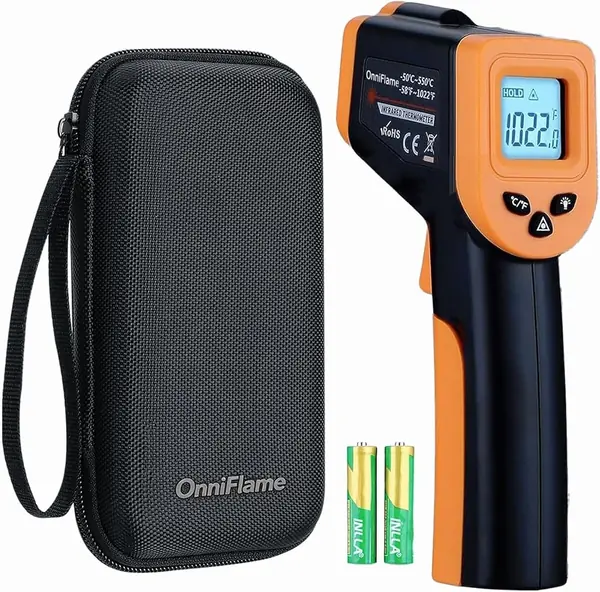
OnniFlame OF-100 Best for Protected Outdoor Storage

OnniFlame OF-100 black infrared thermometer with zippered carrying case and batteries

Protected outdoor storage

Bake Score 89/100
Temperature Range
-58° to 1022°F
Response Time
0.5 seconds
Battery
2 AAA included
Included Case
Zippered carrying case
View on Amazon

The OnniFlame OF-100 comes with a zippered carrying case, which sounds like a minor accessory until you have to keep a thermometer in a drawer with peelers and tongs. The case protects the lens and screen, and it makes the thermometer easier to leave in the outdoor kitchen without scratching it up.

The core numbers are competitive: -58° to 1022°F, a 0.5-second response, and a backlit screen. The battery cover opens a full 90 degrees, a small design change that makes changing the two AAA batteries less fiddly than on some guns. The black body is plain but clean, and the included batteries mean it is ready on arrival.

What we cannot do is pretend the case changes the temperature math: the OF-100 has the same 1022°F ceiling and 0.5-second response as several picks here, and its accuracy is in the same broad range. The difference is the ownership experience—the case, the wide battery door, the simple controls. That is enough to recommend it as an also-consider, especially if your thermometer lives outdoors.

The Etekcity 1080 is still the safer all-rounder if you want the broadest range of uses. The OnniFlame is for the outdoor kitchen where the thermometer lives near the oven, and the case is the reason it can stay there.

Our Verdict

We recommend the OnniFlame OF-100 for cooks who want a capable pizza-oven thermometer with a protective case and easy battery changes.

Check Latest Price

How We Tested Pizza Oven Infrared Thermometers

I started by reading listings and sorting on three things: the claimed temperature range, whether the maker published a distance-to-spot ratio, and whether emissivity could be adjusted. Anything that topped out below 900°F, or buried its specs in vague copy, didn't make the cut. That left 14 thermometers, which we lived with for five months — Friday pizza nights on a wood-fired stone and a countertop gas oven, Saturday flat-top breakfasts, and cast iron searing on the stove.

Accuracy got checked against something I trusted. I brought a cast iron skillet and a pizza stone up to a steady heat, confirmed both with a probe thermometer, then read them with each gun at the maker's recommended distance and again from across the oven mouth. I noted which ones landed within a few degrees, which drifted 50 or more, and which wandered while the trigger was held. Reading a shiny steel peel and a sheet of foil with the default setting versus an adjusted emissivity setting showed how far off a glossy surface can send a number.

Speed was timed with a pie already sitting on the peel — one hand on the gun, one hand holding dinner, counting until the number settled. For range, I pointed each one at a deck running hotter than its stated ceiling; some threw an error, and some quietly stopped climbing and let a 900°F stone pass for 750°F.

Build quality got tested the way it happens in a real kitchen: dropped from counter height onto a concrete patio, wiped with a floury thumb, and shoved in a drawer with the bottle opener. I kept notes on the small stuff too — whether the backlight survived dusk, whether the trigger worked one-handed, whether batteries and a case came in the box, and whether the extras justified what you pay.

How to Choose an Infrared Thermometer for Pizza Ovens

Start With the Temperature Ceiling

A high-heat pizza oven can push a stone past 900°F, so a thermometer that stops at 842°F leaves you guessing exactly when it matters. We look for at least 900°F of range, and we prefer 1000°F or more for Neapolitan-style baking and wood-fired ovens. Extra headroom also helps when you check the dome or the reflected heat near the back. If your oven is a lower-temperature gas or home-oven setup, a 932°F model can be enough, but it is a ceiling, not a suggestion.

Aim at the Right Spot

A single laser dot shows where you are pointing, not the full area the sensor averages. The distance-to-spot ratio tells you how wide that area grows: at 12:1, a foot away means about a one-inch circle, and farther back means a wider read. We prefer a 12:1 ratio for pizza ovens because it lets you stand clear of the heat and still place the measurement on the stone. Dual lasers cost more but bracket the circle, which helps when you map a stone with hot and cool zones.

Emissivity Is the Setting Most People Skip

Emissivity describes how a surface gives off infrared energy, and a fixed 0.95 setting covers a lot of pizza stones, cast iron, and painted metal. The trouble starts when you move to a shiny steel peel, aluminum, or a surface that does not match the preset. We prefer adjustable emissivity from 0.1 to 1.0 if the thermometer will do double duty. If it only ever reads a dark stone, a fixed setting can be fine and keeps the controls simple.

Response Time and a Readable Screen

A pizza oven changes quickly, and a thermometer that takes several seconds to settle makes it harder to compare one side of the stone with the other. We look for a response around half a second or faster, plus a display that stays readable in daylight. Continuous scan mode is more useful than a single beep-and-hold reading because you can sweep across the stone and watch the number move. A backlit screen helps at dusk; a color-coded display helps you read at a glance.

Build, Battery, and Storage

These are plastic tools, even the expensive ones, so treat the housing and screen as the parts most likely to age. A carrying case is worth having if the thermometer lives outdoors or rides in a grill drawer. Check the battery type before you buy: AAA cells are easy to keep on hand, while a 9V is fine if you already stock them. A wide battery door is a small thing until you are changing cells in a cold outdoor kitchen.

Frequently Asked Questions

Final Verdict

We recommend the Etekcity Lasergrip 1080 as the default because its 1130°F ceiling and adjustable emissivity cover the widest range of pizza ovens, stones, and cooking surfaces in this group. If you own an Ooni or another cordierite-stone oven and want the fastest, purpose-calibrated read, the Ooni thermometer is the better fit.

For a tight budget, the KNINE reaches high enough to be useful, provided you treat it as a relative-check tool rather than a precision instrument.