The 6 Best Ceramic Loaf Pans of 2026

A loaf pan has to do two jobs: bake a pound cake evenly from edge to center, then look good enough to carry to the table still in the pan. Ceramic does both better than metal — until a cheap one chips at the rim or cracks the first time a hot pan meets a cool counter, which has happened to me twice now. Ceramic bakeware is heavy, and weight is usually a fair warning about how the piece was made.

In the 14 ceramic and ceramic-coated loaf pans we baked in, the material turned out to matter more than the color. Stoneware and porcelain hold heat and brown gently; ceramic-coated steel is lighter in the hand and quicker to respond to oven temperature. Size is the other trap: a 1-pound loaf pan (8½ by 4½) holds noticeably less batter than a 9-by-5, though product descriptions often blur the two.

What surprised me was how little price predicted any of it — a couple of the least expensive pans released cleanly every single time, while one costly pan wore a meatloaf stain it never gave back.

Our Top Picks

The Best Ceramic Loaf Pans

1

Le Creuset Stoneware Heritage Loaf Pan Best Overall
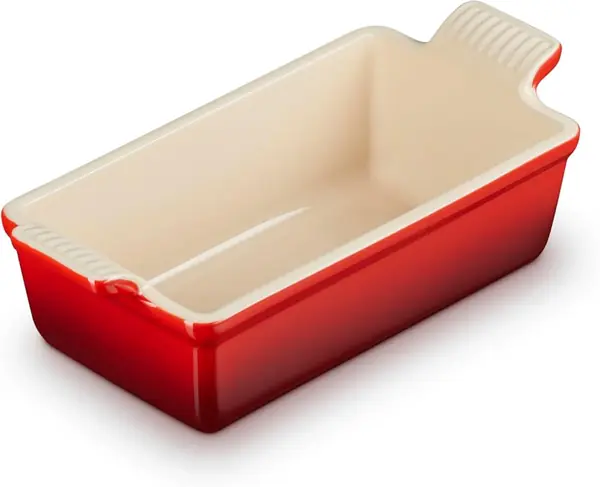
Le Creuset Stoneware Heritage Loaf Pan in cerise red, rectangular with side handles

Standard bread loaves

Bake Score 94/100
Material
Stoneware
Care
Dishwasher safe
Dimensions
9" x 5" x 3"
Capacity
1.5 quarts
View on Amazon

Stoneware heats slowly and then holds what it has, and that is the difference you taste in a loaf: the crust sets evenly from end to end instead of darkening at the corners while the middle catches up. The interior measures 9 by 5 by 3 inches and holds 1.5 quarts — the size most American loaf recipes assume — so banana bread, a sandwich loaf, and a pound cake all bake without scaling.

It is the only glazed stoneware pan in this group; everything else is metal under a ceramic coating, and the coating is the part that eventually fails. Here the enameled surface is nonporous, so it doesn't hold the flavor of last week's meatloaf, it resists staining and scratching, and it goes in the dishwasher. Le Creuset backs it with a limited lifetime warranty, and the pan is rated from -9°F to 500°F, which means freezer to oven works.

The trade-off is weight. Two pounds empty, and awkward one-handed once it's hot, so lifting it out takes both mitts and a steady grip. We minded that less than we expected, because the payoff is heat retention: bread stays warm in the pan through a second cup of coffee, and the dish goes straight to the table. It's also the most expensive pan here by a wide margin. Bake weekly and we think it earns that; bake a loaf a month and one of the coated pans will do the same job for less.

Worth Noting

  • Heavy and awkward to lift when hot
  • Highest price in this group
Our Verdict

Our pick for most bakers: real stoneware in the standard 9-by-5 size, with even browning, dishwasher cleanup, and no coating to peel.

Check Latest Price
2

Wisenvoy Porcelain Loaf Pan Best Value

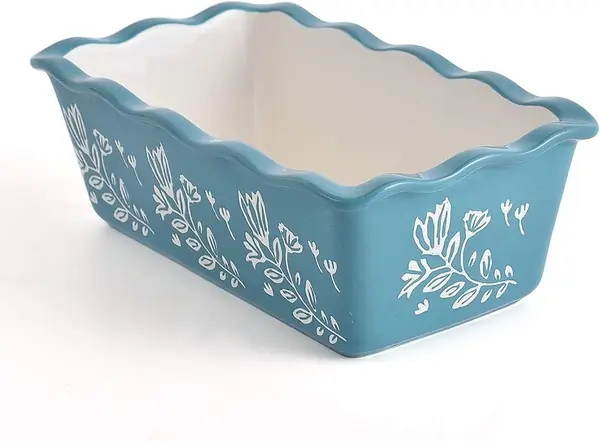
Wisenvoy porcelain loaf pan in blue green with a hand-painted pattern

Value porcelain bakes

Bake Score 93/100
Material
Porcelain
Care
Dishwasher safe
Dimensions
9.8" x 5.5" x 3.2"
Oven-Safe Max
400 °F
View on Amazon

Genuine glazed porcelain is usually the expensive answer. This pan is the exception: it is the only porcelain piece in this group, it sells for a fraction of our top pick, and we think it's the best value here for anyone who wants fired ceramic rather than a coating. The body is thick and heavy — close to three pounds before batter goes in — and the hand-painted pattern is far more cheerful than a baking pan strictly needs to be.

The limit is heat. Wisenvoy rates it to 400°F, which covers sandwich loaves and quick breads baked at 350°F to 375°F with room to spare, but leaves no margin for the 450°F start that no-knead and many artisan recipes call for. If your baking lives in that cooler range, you'll never think about it. If you like a hot oven, the stoneware pick and the coated steel pans here will serve you better.

It also runs a little larger than a standard pan at 9.8 by 5.5 inches, so a recipe written for 9-by-5 bakes a slightly lower loaf — a difference you notice in the crumb more than in the crust. The thick porcelain holds heat the way stoneware does, the smooth glaze releases bread cleanly, and it is dishwasher, freezer, and microwave safe, which is more versatility than most pans here offer.

Worth Noting

  • Heavy at nearly three pounds empty
  • Runs larger than a standard 9-by-5 pan
Our Verdict

For real porcelain without the premium price, this is the pan we point to — as long as your recipes stay at or below 400°F.

Check Latest Price
3

casaWare Ceramic Coated Loaf Pan Best for Toaster Ovens

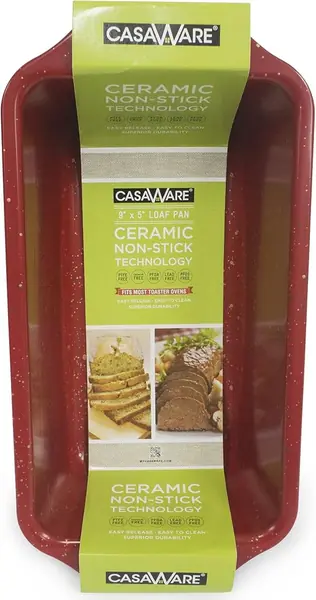
casaWare red granite ceramic-coated loaf pan, rectangular 9-by-5 size

Small ovens

Bake Score 92/100
Material
Ceramic-coated carbon steel
Care
Hand wash
Oven-Safe Max
536 °F
Interior Dimensions
9" x 5" x 2 3/4"
View on Amazon

Countertop ovens are where loaf pans quietly fail: they don't fit, or they fit with no room for air to move around them. casaWare builds this one to work in a toaster oven as well as a full-size range, at 11.25 inches long on the outside with a 9-by-5-by-2¾-inch interior that still turns out a full-size loaf.

That makes it the pan we recommend for an apartment range or a countertop oven. The red granite coating is genuinely slick — loaves release without parchment or a coat of grease — and the flecked surface browns evenly instead of leaving the pale ring a dark pan can produce along the edges. At 536°F it clears any bread bake, and only the Caraway pan here is rated higher.

The coating is the part that ages: hand wash it, keep metal utensils and knives out of the pan, and don't stack anything inside it, and the surface stays intact through years of weekly loaves. What you get in return is a light pan — 0.6mm carbon steel under that coating — that's easy to handle one-handed in a cramped oven, which matters more than it sounds when you're pulling a hot loaf out at an angle.

Worth Noting

  • Hand wash only, no dishwasher
  • Coating can thin at the corners
Our Verdict

A full-size loaf from a countertop oven, slick release, and a 536°F ceiling — our choice for small kitchens and hot bakes.

Check Latest Price
4

Tasty Ceramic Loaf Pan Set Best Two-Pan Set

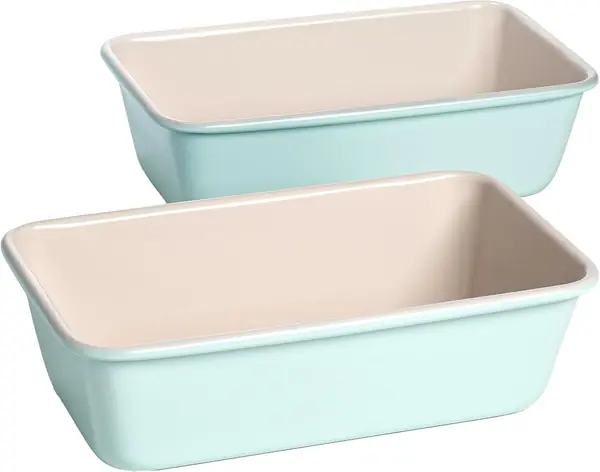
Tasty ceramic loaf pan set in aqua, two rectangular 9-by-5 pans

Two loaves at once

Bake Score 91/100
Material
Ceramic-coated aluminized steel
Dimensions
9" x 5"
Oven-Safe Max
425 °F
Pans Included
2
View on Amazon

Two 9-by-5 pans in one box is the pitch, and it's a good one: bake a sandwich loaf and a banana bread side by side, or keep one in the cupboard and hand the other to whoever keeps borrowing yours. The exterior measures 9.72 by 5.79 inches, close enough to standard that recipes behave the way the writer intended.

The ceramic nonstick is the real thing at this price — no PFAS or PFOA in the coating — and it releases cleanly. Aluminized steel underneath heats evenly, the aqua exterior is cheerier than another gray pan, and both pans are dishwasher safe, though hand washing is what keeps the coating at its best and metal utensils will scratch it. It's a coating on steel, not a fired ceramic pan, which is worth knowing if you were expecting stoneware heft.

Where this set lands depends on how you bake. One loaf at a time and a single pan will do; two loaves a week and the second pan earns its shelf space immediately, since you're not baking in two rounds. Against the other coated pans here it gives up some heat ceiling, and the finish won't outlast the stoneware. But for a household that bakes often and doesn't want to pay per pan, it's the sensible buy.

Worth Noting

  • Oven-safe only to 425°F
Our Verdict

Buy this set if you bake two loaves at a time: standard 9-by-5 pans, clean release, and dishwasher cleanup for about the price of one pan elsewhere here.

Check Latest Price
5

Caraway Ceramic-Coated Loaf Pan Best for Small Loaves

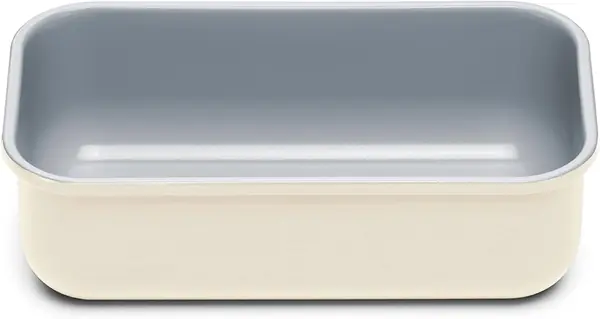
Caraway cream ceramic-coated loaf pan, rectangular one-pound size

Small one-pound loaves

Bake Score 90/100
Material
Ceramic-coated aluminum
Dimensions
8" x 4" x 2"
Oven-Safe Max
550 °F
Capacity
1 lb
View on Amazon

This is a one-pound pan, 8 by 4 by 2 inches, and it makes a one-pound loaf: compact, squared-off, the kind of bread that drops into a toaster slot without trimming. It's the right size for a small household's weekly sandwich loaf, a banana bread, or a pound cake, and the wrong size for a recipe written around a 9-by-5 pan — that batter is more than this one comfortably holds, so scale it down or expect a loaf that climbs the rim.

Where it earns its place is release. The ceramic coating over aluminum is among the slickest surfaces in this group; quick breads drop out with nothing more than a swipe of butter, and the crumb comes away intact. It's rated to 550°F, the highest here, so a hot bake is no concern at all, and the cream exterior looks good enough to leave on the counter between uses.

The price is the sticking point. It costs about what our top pick does, and our top pick holds noticeably more batter, which is hard arithmetic to ignore. Bake one-pound loaves every week and want them out of the pan ungreased, and the surface justifies it. Bake a standard loaf and a half-size pan will frustrate you by the second recipe.

Worth Noting

  • Hand wash only
Our Verdict

The best surface here for a one-pound loaf, with a 550°F ceiling to match, though a standard 9-by-5 recipe won't fit.

Check Latest Price
6

OXO Good Grips Ceramic Loaf Pan Best for Inexpensive Small Loaves

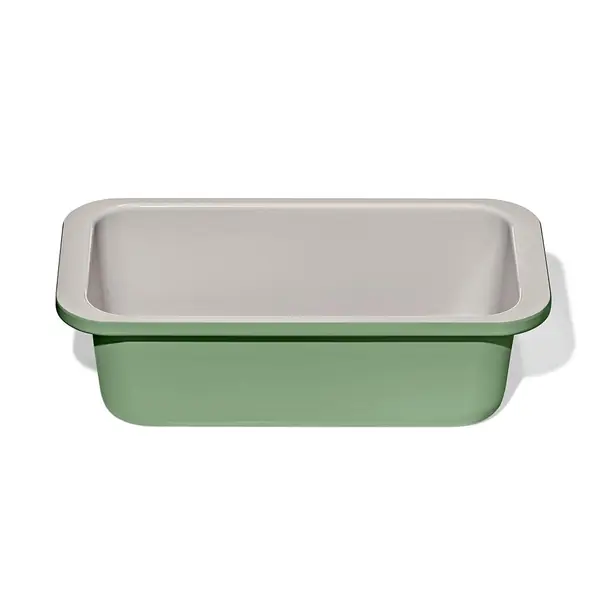
OXO Good Grips ceramic-coated loaf pan in basil green with rim handles

Inexpensive small loaves

Bake Score 89/100
Material
Ceramic-coated aluminized steel
Care
Hand wash
Capacity
16 oz
Handles
Expanded rim handles
View on Amazon

Cheapest pan here, and the one we recommend if you want a small loaf pan and don't want to think hard about it: it releases bread cleanly, browns it evenly, and the details are better considered than the price suggests. The expanded rim handles give your fingers somewhere to go when you pull a hot pan off the rack, and the size is marked on the top surface, so you can sort it from its siblings in a drawer without measuring.

The light-colored interior is doing real work. It spreads heat evenly and gives you a gold crust rather than the dark one a gray pan can produce, and the rounded interior corners leave no seam for dough to catch in. Capacity is 16 ounces — the same one-pound loaf as the Caraway — so recipes written for a 9-by-5 need scaling down.

Buy it knowing the coating is a coating. Hand wash the pan, keep metal utensils and the dishwasher out of the picture, and the surface stays slick; do that and replacing it every few years costs less than one of the stoneware pans here. That's the bargain — a light, inexpensive, well-designed pan you'll use hard rather than one you'll hand down.

Worth Noting

  • Coating can flake at the bottom
  • Only holds a one-pound loaf
Our Verdict

The inexpensive way into a small ceramic pan: solid release, thoughtful handles, and a coating that pays you back for hand washing.

Check Latest Price

How We Tested Ceramic Loaf Pans

We started with research, pulling every ceramic, porcelain, and ceramic-coated loaf pan we could find and narrowing by material, listed capacity, and whether the maker calls it dishwasher safe. We read through owner reviews for the complaints that repeat — chipped rims, coating that flakes off in sheets, loaves that start sticking after a month — and cut anything with a clear pattern of them. That left 14 pans, which we bought ourselves and baked in for eight months.

Testing happened in home kitchens on ordinary weekends and weeknights: pound cakes and quick breads on Saturday mornings, meatloaf on Tuesdays, sandwich loaves on Sundays, and a long run of zucchini bread in late summer. Before the first bake, we filled each pan with water to see how much batter it actually held, since two pans labeled 9 by 5 can differ by a full cup. Then we baked without rotating and noted how evenly the top and the corners browned — some crusts came out deep and glossy, others stayed stubbornly pale.

Release was the part we cared about most. We greased half the bakes and lined the other half with parchment, then noted whether a loaf slid out with a nudge or left its bottom half behind. After each bake we let the pan cool, soaked it five minutes, and scrubbed the corners with a sponge to see what lifted off; the dishwasher-safe ones went through cycle after cycle while we watched the rims. We also set hot pans down on a cool counter the way a distracted baker does, and marked any that cracked or crazed. At the end we weighed what each pan cost against how many bakes it turned out without a complaint.

How to Choose a Ceramic Loaf Pan

Fired Ceramic or a Ceramic Coating

A stoneware or porcelain pan is clay fired into a single piece. It heats slowly, holds that heat, and browns a loaf evenly from end to end; it also keeps bread warm at the table. A coated pan is metal with a thin ceramic layer on top — lighter, quicker to respond to oven heat, and usually less expensive, but that layer is a wear item. If you want one pan for the next decade, buy fired ceramic. If you want light and cheap and can replace it in a few years, a coated pan is a fair trade.

Size It to the Recipes You Bake

The standard American loaf pan is 9 by 5 by 3 inches and holds about 1.5 quarts, and most bread and quick-bread recipes are written for it. The 8-by-4-by-2 pans here hold a pound of batter, so a standard recipe climbs the rim instead of baking flat. A pan wider than 9 inches spreads the same batter shallower and browns it faster.

Check the pan your recipe names before you buy, and if you bake two loaves at once, a two-pan set saves you a second round in the oven.

Check the Oven-Safe Limit

Not every ceramic pan tolerates a hot oven. The pans in this group run from 400°F to 550°F, and the gap matters: sandwich loaves and quick breads bake at 350°F to 375°F, while no-knead and many artisan recipes start at 450°F or above. If your baking stays in the cooler range, a 400°F pan is fine and the savings are real. If you like a hot oven, pay for a pan rated to 500°F or more.

Care and How Long the Surface Lasts

Fired stoneware is dishwasher safe and forgiving. Coated pans want hand washing, and they last longer when metal utensils, knives, and stacked pans stay out of them — the coating is always the first thing to go. Either way, let a hot pan cool before it meets water, since a sudden temperature change is what cracks ceramic. When a coating thins or flakes, the pan is finished; no repair brings the surface back.

Frequently Asked Questions

Final Verdict

For most bakers, the Le Creuset Stoneware Heritage Loaf Pan is the one to buy. It is the only fired stoneware pan in this group, in the standard 9-by-5 size, so it browns evenly, goes in the dishwasher, and has no coating that can flake into your bread a few years in.

If that price is more than you want to spend on a loaf pan, the Wisenvoy gives you real porcelain for far less — just keep your bakes at 400°F or below. Baking one-pound loaves instead? Choose the Caraway for its surface or the OXO for its price.