The 8 Best Cast Iron Loaf Pans of 2026

The first time I pulled a sourdough loaf from a cast iron pan, it crackled as it cooled — a sound my old aluminum pan never made. Heavy iron holds heat and gives it back slowly, so the sides and corners brown at the same rate as the top. That's also why meatloaf slides out in one piece instead of collapsing into a pile.

The tradeoff is weight: a 9-by-5 pan with a lid can run eight pounds, and you feel every ounce of it when the pan is full of dough and sliding out of a hot oven. Lidded two-in-one designs also cost more than open pans, and it's fair to ask whether the lid earns its shelf space — for sourdough, it does. Baking in 12 of these, we found bigger differences in release, size and durability than we expected.

Most 9-by-5 pans are built for a 1.5-pound dough, and one that looks generous online can still send a risen loaf over the rim. Our picks include open pans for sandwich bread and lidded ones built to trap steam.

Our Top Picks

The Best Cast Iron Loaf Pans

1

Northriver Casting 9x5 Cast Iron Loaf Pan Set Best Overall
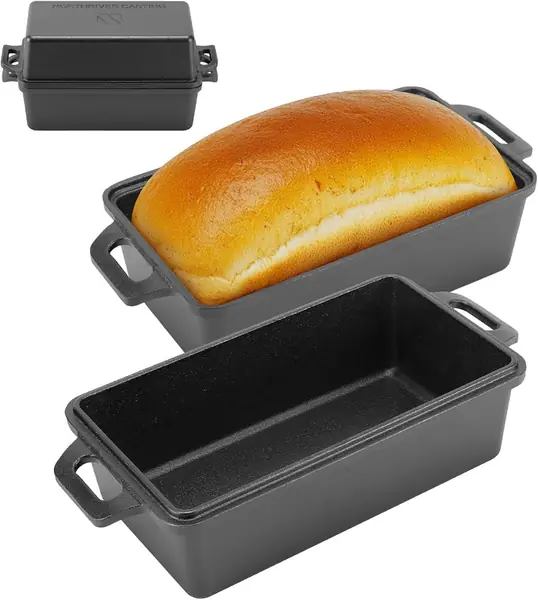
Northriver Casting two-piece black cast iron loaf pan set stacked with lid on

Loaves and sourdough

Bake Score 96/100
Weight
10 lb
Pan Size
9.1 x 5 x 2.75 in
Capacity
3.4 quarts
Configuration
Two stackable pans with lid
View on Amazon

Two 9-by-5 pans that clamp together into one lidded baker is the entire idea here, and it is why this is the set we recommend first. Baked open, they are a pair of standard loaf pans, so a double batch of banana bread goes in at once instead of in shifts. Clamped shut, the top half traps steam the way a Dutch oven does, and the loaf comes out rectangular, long enough to slice for sandwiches, with a thin glossy crust an open pan cannot give you.

Size is what settled it for us. American bread recipes are written for 9 by 5, and this pan matches that to within a tenth of an inch, so dough that fills a metal pan to the rim rises here instead of spilling over. The walls are thick enough to hold heat through the cold start of a sourdough bake, and the base and sides brown at the same rate, which is the whole reason to bake in cast iron rather than thin steel.

The trade-offs are the usual ones for bare iron plus one that comes with any lidded set. These arrive unoiled rather than factory-seasoned, so wash them, dry them on low heat and give them a coat of oil before the first loaf. Assembled, the set weighs 10 pounds, and seating the lid squarely on a hot pan takes two hands and dry mitts. The curved handles help, and the halves nest with the lid on top, taking barely more shelf space than a single pan.

Worth Noting

  • Lid takes two hands to seat hot
  • 10 pounds assembled, a chore to lift
Our Verdict

We recommend this set to anyone who bakes bread often: you get two standard 9-by-5 pans, a steam lid when you clamp them, and one compact stack to store.

Check Latest Price
2

Lodge Pre-Seasoned Cast Iron Loaf Pan Best Small-Batch Pan

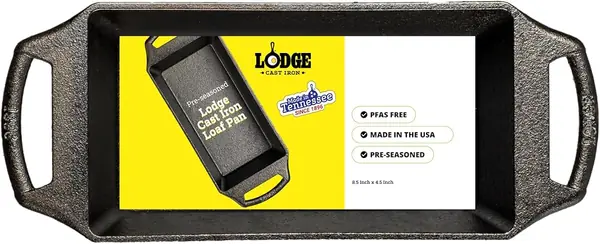
Lodge pre-seasoned black cast iron loaf pan with side handles, 8.5 inches long

Small-batch quick breads

Bake Score 95/100
Weight
3.8 lb
Pan Size
8.5 x 4.5 in
Capacity
6 cups
Seasoning
Pre-seasoned
View on Amazon

Eight and a half inches is the number that decides whether this pan suits you. It is shorter and narrower than the 9-by-5 standard most recipes assume, with six cups of capacity, so a full batch of dough bakes up taller and more domed than it would in metal. For banana bread, a pound cake or a sandwich loaf for two, that is not a compromise, it is the right size. For a recipe written to fill a 9-by-5, hold some batter back or slide a sheet pan underneath.

What the smaller size buys you is the least fussy pan in this guide. It arrives pre-seasoned, and quick breads have dropped out of it for us with a shake and a knife run around the edge. At 3.8 pounds it is light enough to handle with one mitt, the finish is iron and oil and nothing else, and it is made in the United States. No lid, no second pan, no learning curve beyond drying it properly.

The limitation is sourdough. Without a lid or a second half to serve as one, you bake open, and the crust comes out thinner and softer than a covered bake gives. The narrow width also means a firm dough climbs the sides instead of spreading. If your baking runs to sandwich loaves and quick breads, neither matters. If it runs to crackly sourdough, this is a second pan, not the first one you buy.

Worth Noting

  • Too narrow for a standard 9-by-5 recipe
  • No lid for steam baking
Our Verdict

We recommend the Lodge to small households and quick-bread bakers; it is the easiest cast iron loaf pan to live with, as long as you do not need a 9-by-5 loaf.

Check Latest Price
3

Camp Chef Seasoned Cast Iron Bread Pan Best for Long Loaves

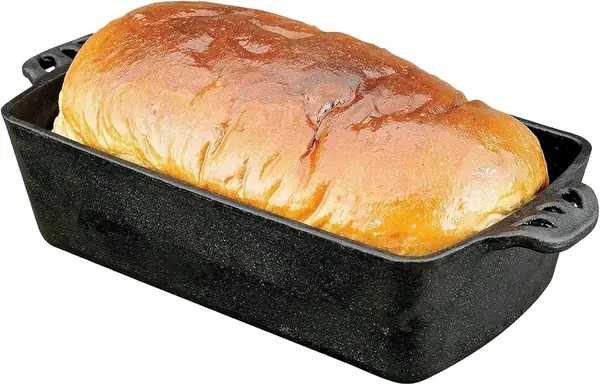
Camp Chef seasoned cast iron bread pan, long rectangular black pan with side handles

Long sandwich loaves

Bake Score 94/100
Weight
3 lb
Seasoning
Pre-seasoned
Warranty
Lifetime
Oven-safe To
500 °F
View on Amazon

Eleven inches of pan is a lot of loaf. This one runs roughly two inches longer than a standard bread pan, so a sandwich loaf comes out long and low, with more slices and a flatter profile, and a 9-by-5 recipe spreads out instead of climbing the walls. It weighs 3 pounds, which makes it the easiest pan in this guide to pull from a hot oven one-handed.

That weight is what we appreciated most. The lidded sets here run 10 to 12 pounds with the top on, and getting one out of a 450-degree oven is a two-handed negotiation; this one comes out on a folded towel and lands on the trivet. The interior arrives seasoned and ready, quick breads release with a quick greasing, and the lifetime warranty is the longest coverage in the group.

Buy it for what it is shaped to do: long loaves, meatloaf, a no-knead bread that fills the pan corner to corner. It is not a covered baker, so sourdough crusts will be softer, and it will not turn out the tall square loaf a 9-by-5 gives you. Neither is a fault. They are just the shape of the pan, and it is a shape that suits everyday baking better than most.

Worth Noting

  • Bakes a flatter loaf than a 9-by-5
  • One pan only, no double batches
Our Verdict

For weeknight sandwich bread and meatloaf, we think this long, light, pre-seasoned pan is the practical choice, and it costs about what the smaller Lodge does.

Check Latest Price
4

Articasting Enameled Cast Iron Loaf Pan with Lid Best Enameled with Lid

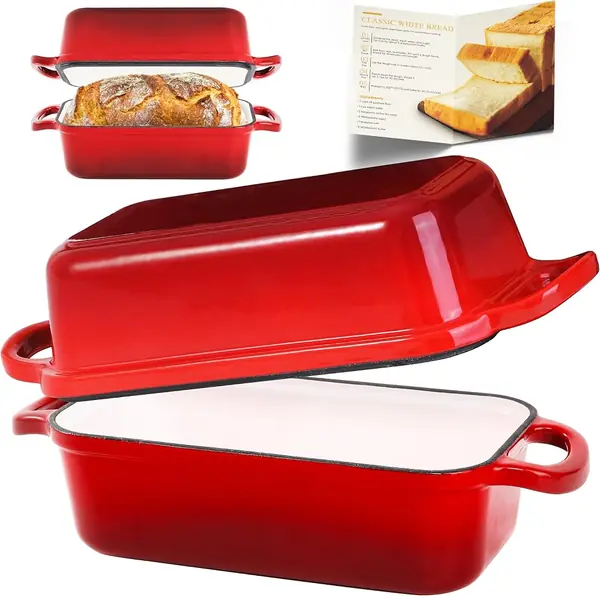
Articasting red enameled cast iron loaf pan with matching lid and gradient finish

Beginner sourdough bakers

Bake Score 93/100
Weight
10.9 lb
Pan Size
11.6 x 5 x 2.75 in
Capacity
3.8 quarts
Finish
Red enamel
View on Amazon

Enamel changes the deal. There is no seasoning ritual, no re-oiling after every wash, and no rust bloom if the pan sits damp in the rack. You wash it like a pot, dry it, and put it away. For anyone who wants cast iron results without cast iron maintenance, this red set is the most complete version of that idea here: two 9-by-5 pans, one of which becomes the lid.

It is a good steamer, too, and that is the part we care about most, since a lid is the whole reason to buy a two-piece set. Clamped together, the pans hold a full batch of sourdough and trap the steam that gives you a thin, blistered crust, and the enamel releases high-hydration dough with nothing more than a dusting of flour. The gradient red is the best-looking finish in this guide; it goes from oven to table without a serving plate, which is not something we say about most bakeware.

Two things keep it off the top spot. At nearly 11 pounds assembled it is the heaviest set here, and the lid has to be lined up and set down squarely while the pan is at 450 degrees. Because enamel never builds the seasoning layer bare iron does, very lean doughs still want a little flour or a strip of parchment for the first bakes.

Check the rims when the box arrives. A gift-boxed set of two heavy pans travels a long way, and a chip on a cooking surface is permanent in a way a worn spot on bare iron is not. Past that, this is the set we hand to anyone who has never baked in cast iron and does not want to start with a seasoning lesson.

Worth Noting

  • Nearly 11 pounds, the heaviest set here
  • Premium price tier of this group
Our Verdict

For beginners and anyone who resents seasoning, we recommend this enameled set: it delivers Dutch-oven crust, pot-easy cleanup, and a color worth putting on the table.

Check Latest Price
5

AILITOR Cast Iron Loaf Pan Set Best Two-Piece Value

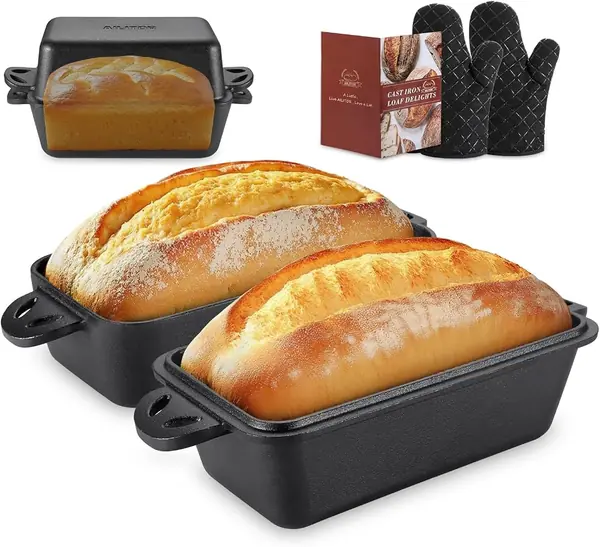
AILITOR two-piece black cast iron loaf pan set with lid and oven mitts

Gifting new bakers

Bake Score 92/100
Weight
10.4 lb
Pan Size
9 x 5 in
Capacity
4.3 quarts
Included
Oven mitts and recipe book
View on Amazon

Oven mitts and a recipe book come in the box, which sounds like filler until you are pulling 10 pounds of 450-degree iron out of the oven and your good mitt is in the wash. It is the kind of extra that suggests someone at the company actually bakes.

The pans are the value story. Each half is a standard 9-by-5 loaf pan, pre-seasoned with vegetable oil so it can go straight into the oven, and the pair clamps into a covered baker for steam. We baked sourdough closed and sandwich bread in the halves opened side by side, and both came out evenly colored top to bottom. Thick walls hold their heat through the long cold start of a sourdough bake, which is where thin metal pans fall behind.

Refinement is where it gives ground, slightly. The handles are chunky, the casting has a bit more texture than the Northriver set, and the footprint with those handles runs 12.6 inches, so check the shelf before you commit. None of it changes what comes out of the oven. If you want a covered cast iron loaf pan without paying enamel money, this is the set we point to first.

Worth Noting

  • Bare iron needs drying and re-oiling
Our Verdict

We recommend this set to anyone who wants two pans and a steam lid for the least money of the two-piece sets; the mitts and recipe book are a genuinely useful bonus.

Check Latest Price
6

GRMImosa Enameled Cast Iron Loaf Pan Best for Table-Worthy Enamel Baking

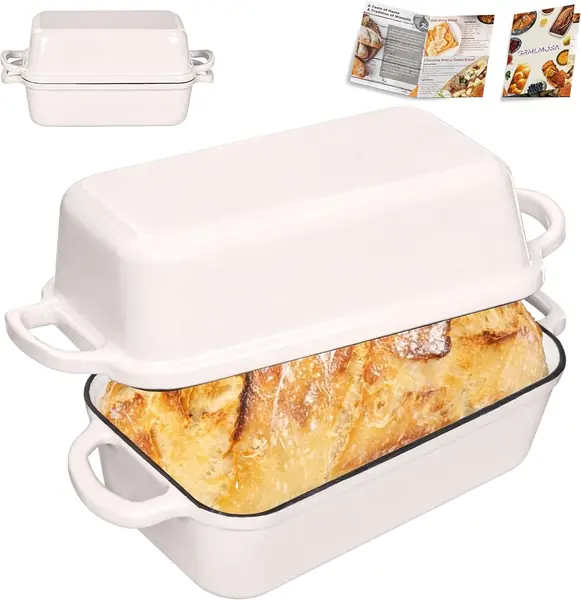
GRMImosa cream enameled cast iron loaf pan with matching lid, two pieces

Table-worthy enamel baking

Bake Score 91/100
Weight
11 lb
Pan Size
9.1 x 5 x 2.76 in
Finish
Cream enamel
Configuration
Two stackable pans with lid
View on Amazon

Nine by five is the headline, but on this pan those are outside measurements, so the cavity is smaller than the pan most bread recipes assume. Fill it with a full 9-by-5 batch and the dough climbs over the rim; hold back a little and you get a taller, narrower loaf that slices into neat, small pieces. Worth knowing before you buy, because the pan itself is lovely.

The cream enamel is the draw and it earns its keep. This is the set that goes from oven to table without a serving plate, and the surface wipes clean instead of needing a scrub and a re-oil. Clamped together the halves steam a sourdough loaf properly, and the top works as a second open pan when you want two quick breads at once. Even browning, no hot spots, and a lid that sits flat.

Our reservation is the enamel's edge. Chips at the rim and around the handles are the failure mode on enameled cast iron, and a chip on a baking surface is permanent in a way a worn spot on bare iron is not. Handle it like the pretty thing it is, with a cloth between pans when you stack them and no metal utensils in the pan, and it will outlast the novelty. For smaller loaves and a table-ready look, this is the one.

Worth Noting

  • Cavity is smaller than a standard 9-by-5
  • Enamel can chip at the rim and handles
Our Verdict

We recommend the cream GRMImosa to bakers who want a pan pretty enough for the table and do not mind a smaller loaf than a 9-by-5 recipe gives.

Check Latest Price
7

Wildone Enameled Cast Iron Bread Pan

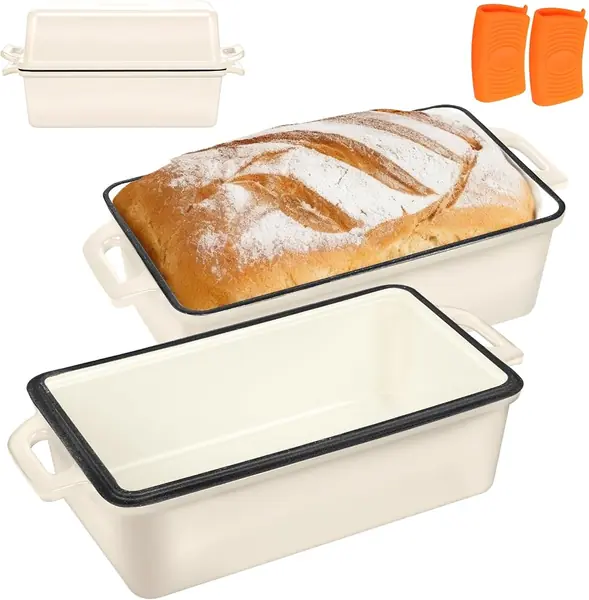
Wildone cream white enameled cast iron bread pan with lid and silicone handle covers

Handling a hot lid

Bake Score 90/100
Weight
11.7 lb
Pan Size
11.6 x 5 x 2.75 in
Capacity
3.4 quarts
Included
Silicone handle covers
View on Amazon

Silicone sleeves for the handles come in the box, and one bake with a lidded cast iron pan explains why. The handles are the part you grab, the part that is hottest, and on an enameled pan the part most likely to chip. Slide the covers on and a 12-pound set is genuinely easier to move.

The temperature rating is the detail that decides whether they get used. Those sleeves are rated to 240 degrees Celsius, about 465 degrees Fahrenheit, so they do not belong in a 500-degree oven. Put them on when the pan comes out, not before it goes in, and keep them where you can find them with oven mitts on.

The pan itself is a two-piece 9-by-5 set with a triple-layer enamel that releases bread cleanly and cleans up with a sponge. Cream white is the best-looking finish here if you like the light, French-country look, and we noticed it shows every dark crust mark and oil splash, which is the trade for the color.

Our real reservation is the coating's longevity. Enamel that lifts or flakes after a handful of bakes cannot be repaired, and this is not the set to buy if you bake three times a week and stack the halves in a drawer. Buy it for the look and the handle covers, treat it gently, and it bakes with anything else in this group.

Worth Noting

  • Cream enamel stains and shows crust marks
  • Coating can lift after repeated use
Our Verdict

We recommend this set to bakers who want cream enamel and handle covers and will treat the coating gently; heavy daily bakers are better off with bare iron.

Check Latest Price
8

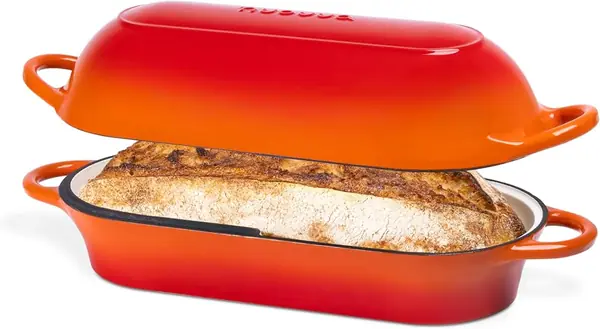
Nuovva Enameled Rectangular Bread Pot

Nuovva orange enameled rectangular cast iron bread pot with ridged lid

Batard-shaped sourdough

Bake Score 89/100
Pan Size
13.4 x 6.3 in
Capacity
1.8 liters
Finish
Orange enamel
Lid
Self-basting ridges
View on Amazon

This is not a loaf pan in the American sandwich sense. It is a rectangular bread pot, about 13 inches long and 6 wide, built to bake a batard, the long tapered loaf that slices into smaller pieces and fits a crowded cutting board. If you have been baking boules in a round Dutch oven and want the same crust in a more practical shape, this is the gap it fills.

The lid has self-basting ridges inside, which catch condensation and drip it back onto the crust instead of running down the walls, and the enamel means no seasoning to keep up with. It is rated to 500 degrees and works on induction, so it moves from oven to stovetop for a braise, which is more than most loaf pans can do.

Capacity is the constraint. At 1.8 liters it suits doughs in the three-to-four-cup-of-flour range, and a 900-gram sourdough fills it comfortably; a big sandwich loaf does not. The lid also wants a deliberate hand, since it seats on a hot pot with a bit of feel, and for the first couple of bakes we lined it up by eye.

For a small household baking one long sourdough a week, that is plenty, and the orange enamel is the most striking finish in this guide. For a family that goes through two sandwich loaves a week, buy a 9-by-5 set instead.

Worth Noting

  • 1.8-liter capacity limits dough size
  • Lid takes care to seat on a hot pot
Our Verdict

We recommend the Nuovva to sourdough bakers who want a batard shape and a lidded pot that also braises; its 1.8-liter capacity suits smaller doughs only.

Check Latest Price

How We Tested Cast Iron Loaf Pans

We started with listings and customer reviews, sorted the field by size, finish, and whether a lid was included, then narrowed it to 12 pans that covered the range: bare seasoned iron, enameled interiors, open pans, and two-piece sets. Price only broke ties — a pan that stuck or chipped was not worth saving a few dollars on.

Every pan got the same three jobs over six months: a weekly sandwich loaf, a sourdough baked with and without its lid, and a meatloaf. We compared the bottom crust and corners against the top, since uneven browning is the reason most people switch to cast iron in the first place, and noted whether loaves released cleanly or needed a knife run around the edge. On the lidded pans we watched whether the lid actually held steam through the first stretch of the bake, which is what drives oven spring and a thin, crisp crust.

We weighed each pan empty on a kitchen scale, then lifted it loaded, in an oven mitt, out of a 450-degree oven — that is where the eight-pound pans separated from the lighter ones and where I started reaching for one pan over another. After each bake we washed and dried them the way anyone would at home, and checked every few weeks for rust in the corners, flaking seasoning, and chipped enamel.

Size got its own test: we filled each pan with the same 1.5-pound dough to see whether it had room to rise or would spill over the rim. The pans that made the list did all of it without drama; the ones that didn't either stuck, chipped, or were heavy enough that I stopped wanting to use them.

How to Choose a Cast Iron Loaf Pan

Start With the Real Cavity Size

Most American bread and quick-bread recipes assume a 9-by-5 pan, and the difference between that and an 8½-inch pan is the difference between a loaf that fills the pan and one that domes over the rim. Watch how size is quoted: a pan listed at 9.1 inches across the top is measuring the outside of the walls, so the space your dough actually occupies is smaller and a full batch will crown hard.

If you bake for one or two, an 8½-inch pan like the Lodge is an advantage rather than a compromise. If you follow recipes as written, buy the 9-by-5 and save the small pan for banana bread.

Decide Whether You Want Steam

A covered bread pan traps the steam that keeps a crust thin and lets the loaf spring before the surface sets. Baked open, the same dough gives a softer, matte crust. That is the whole argument for a two-piece set, and it is why the lid is not wasted when you are not baking sourdough: it is a second pan.

If your baking runs to banana bread, pound cake and meatloaf, skip the lid and put the money into pan quality instead.

Bare Iron or Enamel

Bare cast iron is the more durable choice. It can be re-seasoned, so a scratched or worn surface is a temporary setback, and it darkens into a genuinely nonstick pan with use. It also asks for hand washing, thorough drying and a wipe of oil. Enamel skips all of that and releases sticky, high-sugar batters more easily, but the coating is the part that fails: a chip at the rim or a handle cannot be repaired.

Beginners and anyone who resents maintenance should pay for enamel. Frequent bakers who want one pan for life should stay with bare iron.

Weigh the Handling

The pans here run from 3 pounds to nearly 12, and that difference lands on your wrists at 450 degrees. A 10-pound set with a lid needs dry mitts and two hands; a 3-pound single pan comes out on a folded towel. Handles matter as much as the number, so look for a shape you can grip through cloth.

Check the shelf, too. Lidded sets are deep, and stacking is the one storage advantage a two-piece set has over a single pan.

What You Pay For

Prices run from budget to premium here, and most of the premium is enamel and lid engineering rather than better bread. A bare 9-by-5 pan bakes as well as an enameled one if you will season it, and it will outlast the coating.

Extras count for something: the AILITOR set throws in mitts and a recipe book for less than the enameled sets, which is a real reason to pick it over a plain pair. Pay for the finish you will actually maintain.

Frequently Asked Questions

Final Verdict

We recommend the Northriver Casting two-piece set as the default. It is a standard 9-by-5 pan, two of them for the price of one, and clamping the halves together turns it into a steam oven for sourdough, all in a package that stacks into a single shelf slot.

If enamel is what you want, the Articasting set does the same job without the seasoning lessons. For a household that bakes one small loaf at a time, the Lodge is the better fit, and the Camp Chef is the one to buy when your loaves are long.