The 8 Best Tart Pans of 2026

A tart pan has one job no other pan has to do: hold a shell together while it bakes, then let go of it cleanly. The removable bottom is what makes that possible — you set the ring on the base, press the dough into the flutes, and later push the finished tart up and off. The catch is fit. A base that sits loosely in its ring leaks butter onto the oven floor, and a non-stick coating that looks flawless in a product photo can still grab a soft custard on the way out.

I bake tarts often enough that I have opinions about which pan I reach for before guests arrive, and we worked through 14 tart pans — 4-inch minis sold in sets, standard 9-inchers, and a 14-inch rectangle — in every shape and finish we could get our hands on. The pattern held: the pans that released cleanly were the ones whose base seated snugly without needing force.

One thing worth knowing before you buy is that size and depth matter as much as coating, since a deep 9-inch pan and a shallow 11-inch one will bake the same dough very differently. The range runs from tartlets for a holiday spread to a big rectangle you can slice into bars.

Our Top Picks

The Best Tart Pans

1

Wilton Excelle Elite 9-Inch Tart Pan Best Overall
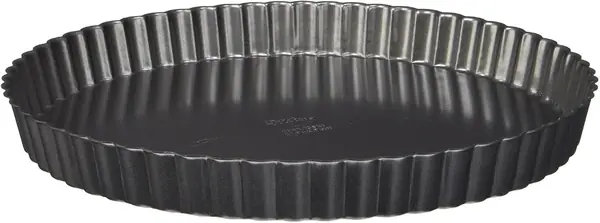
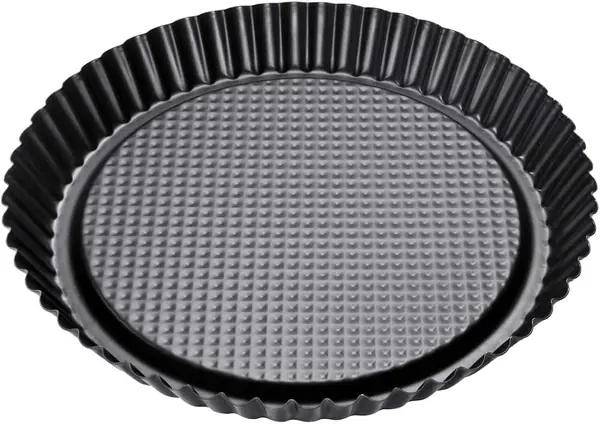
Wilton Excelle Elite 9-inch nonstick tart and quiche pan with fluted rim and removable bottom

Standard tart recipes

Bake Score 98/100
Depth
1 inch
Material
Nonstick steel
Diameter
9 inches
Oven-safe
Up to 450 °F
View on Amazon

Most tart and quiche recipes are written for a 9-inch ring, and the Wilton Excelle Elite is exactly that: 9 inches across the top, 1 inch deep, two pieces, nonstick steel. Nothing needs assembling and there is no learning curve — the base drops into the fluted ring and stays put until you push it from below.

We keep coming back to it because it does the unglamorous things well. A shortcrust shell releases without a fight, the base lifts out with a light push so a finished tart slides off in one piece, and the whole pan goes in the dishwasher, which matters more than it sounds on an afternoon when you are baking two. Wilton backs it with a 10-year warranty, generous for the money.

The build is plain but tidy: a smooth rolled rim that does not catch a dish towel, even heating that gave us evenly colored shells, and a 450 °F rating that clears any tart or quiche recipe we know of. The finish is dark, so pastry takes color a little faster than it does in bare steel; the first time you use it, start checking a few minutes before the recipe's time.

Against the Fox Run 9.5 and the CHEFMADE, it gives up a little width and a little heft, and what it keeps is the number that matters. Nine inches is the size your recipes were written for, so the filling depth and the bake time you get are the ones in the book rather than an estimate.

Worth Noting

  • 1-inch wall is shallow for deep-dish quiche
Our Verdict

The pan we recommend to almost everyone: a standard 9-inch ring, dependable nonstick release, and dishwasher cleanup at a midrange price.

Check Latest Price
2

Fox Run 9.5-Inch Tart Pan Best Value

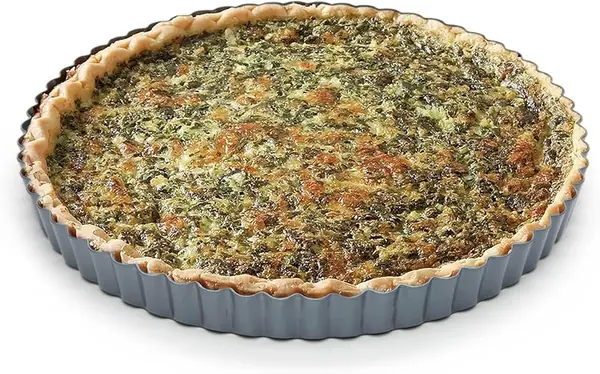
Fox Run 9.5-inch round nonstick carbon steel tart pan with fluted sides and loose bottom

Feeding a crowd

Bake Score 97/100
Depth
1 inch
Material
Nonstick carbon steel
Diameter
9.5 inches
Oven-safe
Up to 446 °F
View on Amazon

Half an inch is the whole story here. At 9.5 inches across, the Fox Run holds a tart that cuts into eight generous wedges instead of six careful ones, and it is the pan to reach for when dessert has to stretch to the end of a table.

It is a light pan — 6.4 ounces, less than half the CHEFMADE — and that lightness is the trade you are making. Carbon steel with a nonstick coating heats quickly and evenly; our shells came out crisp underneath and evenly browned at the rim, and a quiche released without tearing. The coating is slick enough that we have stopped flouring the ring, and the pan is dishwasher safe, though a rinse and a dry usually does the job.

What we appreciate most is that a bigger pan did not come with a bigger price or a heavier hand: it costs less than our top pick and handles the same recipes. Do make a full batch of pastry, since a 9.5-inch ring takes a little more dough than a 9-inch one — better a scrap left over than a patched shell.

Worth Noting

  • Thin gauge steel flexes more than heavier pans
Our Verdict

Buy this one when the tart has to stretch further: half an inch more diameter, a light pan, and a price below our top pick.

Check Latest Price
3

CHEFMADE 9.5-Inch Tart Pan Best Built

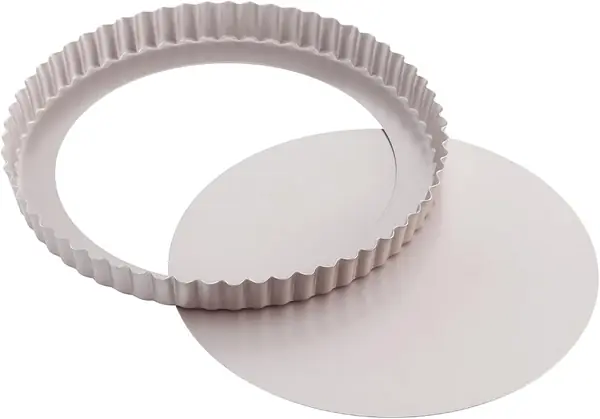
CHEFMADE 9.5-inch champagne gold nonstick carbon steel tart pan with fluted rim

Frequent bakers

Bake Score 96/100
Depth
0.9 inch
Diameter
9.5 inches
Coating
PTFE- and PFOA-free silicone
Thickness
0.8 mm carbon steel
View on Amazon

The CHEFMADE is the pan we bring out when the tart is the centerpiece. Champagne gold with crisp fluting, it looks like it belongs on a pastry shop shelf, and at 14.56 ounces it is more than twice the weight of the Fox Run — something you feel the moment you press firm dough into the corners.

That weight comes from 0.8 mm carbon steel, thicker than the other round pans here, with a reinforced edge made to resist warping. The coating is a food-grade silicone, free of PTFE and PFOA, and it released a blind-baked shell cleanly enough that we did not have to patch a single crack.

The thickness is what earns the extra money: the pan does not flex under a firm dough, and the base sits flat enough that a full tart does not rock on the counter. Keep a sheet of parchment between it and its neighbors in the drawer, and turn the tart onto a plate before slicing, so the finish stays as good as it looked on day one.

Worth Noting

  • 0.9-inch wall is shallow for deep quiche
Our Verdict

The pan to buy when the tart goes to the table: thick carbon steel, a champagne finish, and steady release from a 9.5-inch ring.

Check Latest Price
4

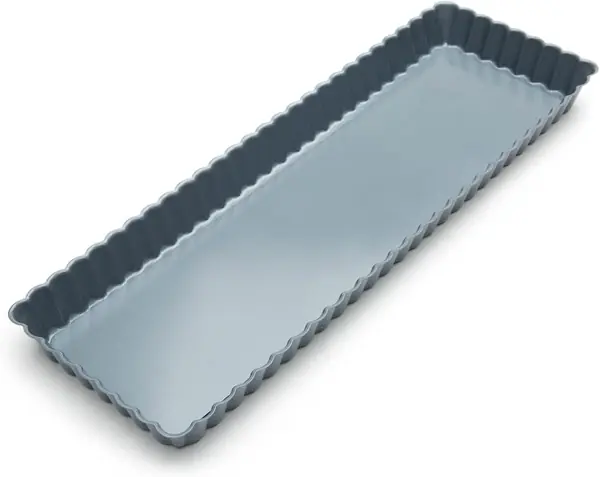
Fox Run 14-Inch Rectangular Tart Pan Best Rectangular

Fox Run 14-inch rectangular nonstick carbon steel tart pan with fluted sides and loose bottom

Rectangular tarts

Bake Score 95/100
Depth
1.7 inches
Material
Nonstick carbon steel
Oven-safe
Up to 446 °F
Dimensions
14.25 by 4.75 inches
View on Amazon

A rectangular tart is the shape to reach for when dessert is going on a buffet. Cut across the short side and every piece gets a fluted edge, nothing slumps into a wedge-shaped gap, and the whole thing looks deliberate on a platter.

We like it for the depth as much as the shape. At 1.7 inches it is the deepest pan here — it takes a quiche, or a tart piled with poached fruit, without threatening the rim — and 14.25 by 4.75 inches is a manageable footprint that sits on a half-sheet pan, which is where you want it whenever you move it.

The base lifts out the long way, so a finished tart slides onto a board in one piece, and the pan is dishwasher safe and rated to 446 °F. It is not the pan for a round birthday tart. For a dessert table or a brunch quiche cut into bars, it does something none of the round pans here can.

Worth Noting

  • Four corners need careful pressing
Our Verdict

For buffet desserts and square-cut quiche, this deep 14-inch rectangle does what no round pan in this group can.

Check Latest Price
5

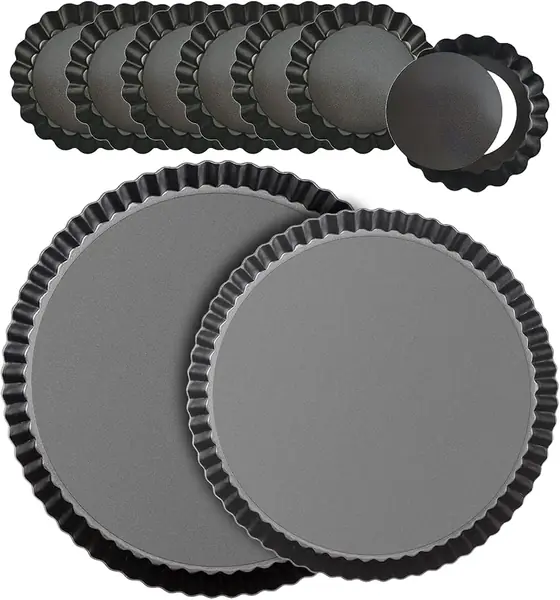
RICHSC-PAN Tart Pan Set Best Set

RICHSC-PAN tart pan set with 11-inch and 9-inch rings plus six 4-inch mini pans

Baking every size

Bake Score 94/100
Depth
1.2 inches on large pans
Material
Nonstick carbon steel
Oven-safe
Up to 445 °F
Includes
11-inch, 9.4-inch, and six 4-inch pans
View on Amazon

Eight pieces arrive in the RICHSC-PAN set: an 11-inch ring, a 9-inch ring, and six 4-inch tartlet pans, all nonstick carbon steel with loose bottoms. That is more shapes than any single pan here, and it is the reason to consider a set at all.

The 11-inch is the one we reach for first. Nothing else in this group goes that big, and a single wide tart is the easiest way to serve a dozen people from one shell — a fruit tart, a big quiche, or a crostata that is not fighting the rim.

The 9-inch pan measures 9.4 inches across the top with a 1.2-inch wall, deeper than our top pick, so quiche fillings get more room. The six 4-inch pans handle individual desserts, and everything is dishwasher safe and rated to 445 °F.

Here is where a set divides people. If you bake one tart a month, a single good 9-inch pan is the better buy and takes up less room. If you are the person who brings dessert to every gathering, the extra sizes earn their keep in the first season, and the minis stack into a corner of a drawer.

Worth Noting

  • Eleven-inch ring needs a wide shelf
Our Verdict

One order that covers a party tart and a tray of tartlets, and the only way to get an 11-inch ring in this group.

Check Latest Price
6

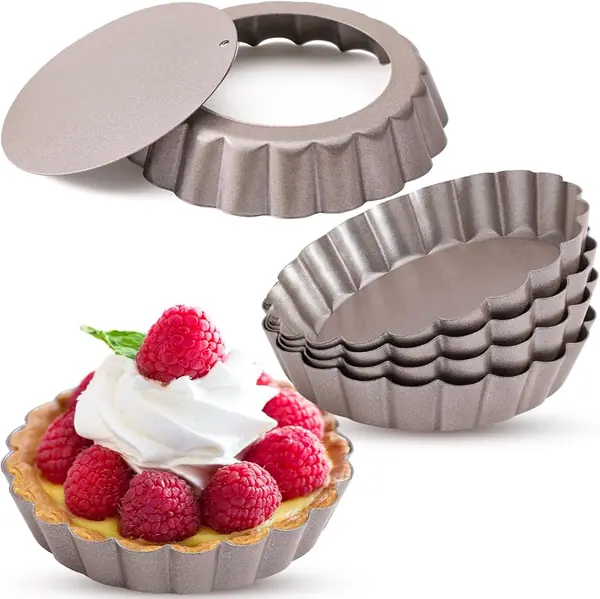
Webake 4-Inch Mini Tart Pan Set Best Mini Set

Webake set of six 4-inch mini nonstick tart pans with fluted sides and removable bottoms

Individual servings

Bake Score 93/100
Depth
0.75 inch
Material
0.6 mm carbon steel
Diameter
4 inches
Set Size
6 pans
View on Amazon

Six pans, four inches across, three-quarters of an inch deep: the Webake set exists for the moment when everyone at the table should get their own tart. We filled all six at once and they came out with clean fluted sides and no sticking at the corners, which is the whole job.

The one thing to know about a loose-bottom tartlet pan is the seam. A runny filling with no pastry underneath it will find the gap between base and ring, so line these even when a recipe says a bare pan is fine, and set them on a sheet pan before they go in the oven. Do that and the bases drop out cleanly, leaving shells you can pick up without a crack.

For individual desserts we prefer these to cutting a big tart into wedges: the portioning is done before the first guest arrives, and six pans stack into less drawer space than one 11-inch ring. They are dishwasher safe, the coating rinses clean with a wipe, and 0.6 mm steel keeps the set affordable without the pans feeling like toys.

Worth Noting

  • Shallow 0.75-inch wall limits filling depth
Our Verdict

Six small pans that make portioning a dessert course easy, as long as every one of them gets a pastry lining.

Check Latest Price
7

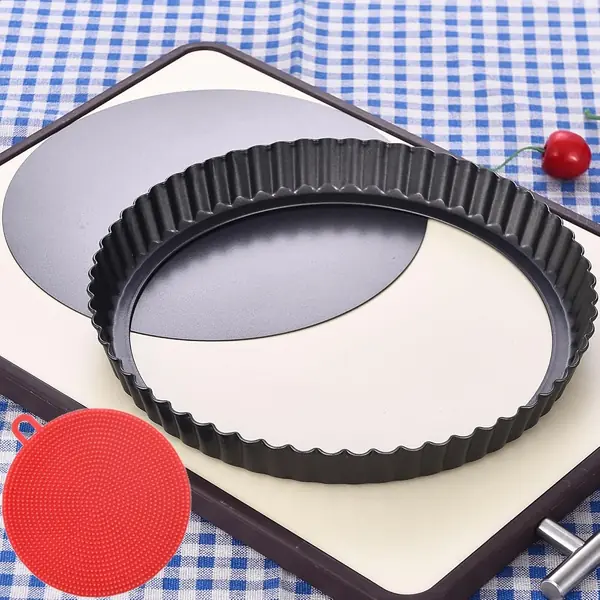
DATANYA 9-Inch Deep Tart Pan

DATANYA 9-inch black nonstick carbon steel tart pan with deep fluted walls and loose bottom

Deep-dish quiche

Bake Score 92/100
Depth
1.2 inches
Material
Nonstick carbon steel
Diameter
9.5 inches
Oven-safe
Up to 446 °F
View on Amazon

1.2 inches of wall does not sound like much more than 1 inch, but that fifth of an inch is what lets a quiche take a full custard recipe without cresting the rim. It is the deepest round pan in this group, and that is the reason to look at it.

The carbon steel is nonstick coated, rated to 446 °F, and dishwasher safe, and DATANYA throws in a small silicone scrubber — a quiet hint that the coating would rather not meet a scouring pad. The fluting is deep and sharply defined, which holds a pressed-in crust firmly while you work around the ring.

Think of it as the specialist. Where the Wilton is the pan you leave on the counter, this is the one you pull out for deep-dish quiche, a thick pumpkin tart, or any recipe that keeps asking for more filling than an inch will hold. As the least expensive pan in this guide, it is also the low-risk way to find out whether deep-dish is how you like to bake.

Worth Noting

  • Called 9-inch but measures 9.5 inches across the top
Our Verdict

The deep option: a 1.2-inch wall for quiche that needs more custard, at the lowest price in this guide.

Check Latest Price
8

Zenker 11-Inch Flan/Tart Pan Best for Flans and Tortes

Zenker 11-inch grey nonstick carbon steel flan and tart pan with shallow fluted well

Flans and tortes

Bake Score 91/100
Material
Nonstick steel
Diameter
11 inches
Care
Hand wash
Bottom
Fixed, does not remove
View on Amazon

There is no removable bottom on the Zenker, and that is not a flaw — it is what the pan is. Flans, strawberry shortcake bases, and German tortes come out by flipping the whole pan onto a plate, and a one-piece pan gives you an uninterrupted surface to flip from.

Eleven inches across and a little over an inch deep, it is the widest round pan here, with a nonstick coating that turns a baked sponge out in one motion and a PFOA-free finish. Flipped, the shallow recess becomes a well that holds whipped cream and fruit for a flan or a summer tart.

It is hand wash only, which is the one chore the pan adds, and the German build and 5-year warranty are what you get in return for the extra attention.

If your desserts get flipped, this is the pan we point to: it is the only one here built for it, and the extra width makes a party-sized flan that cuts into ten. A tart you want to lift out of its ring is a different pan and a different purchase.

Worth Noting

  • Most expensive pan in this group
Our Verdict

The one pan here made for flipping desserts out, not lifting tarts from a ring — buy it for flans and tortes and keep a loose-bottom pan for everything else.

Check Latest Price

How We Tested Tart Pans

We started by pulling in every tart pan we could find with a genuinely removable base rather than a push-up gimmick, then narrowed by size, shape, and material — carbon steel and steel, round and rectangular, mini and full-size. Reviews went into the pile as well, mainly to see which pans people said had leaked, warped, or flaked. That left 14 pans, and we spent five months baking with them.

Most of that baking happened on weekend mornings in my kitchen and in two colleagues' kitchens, plus a long run of mini tartlets before a family dinner. Every pan got the same treatment: I fitted the base into its ring and lifted the ring alone to see whether the base stayed put, pressed a standard sweet dough into the flutes and noted how much the corners fought back, and set each pan on a parchment-lined sheet tray before pouring a loose custard so that any leak would show up as a stain underneath.

For browning, we blind-baked each shell with weights and then finished it empty, watching whether the fluted sides darkened at the same rate as the base and whether the center stayed pale and damp. Non-stick was checked twice — on a first bake with no greasing beyond what the recipe called for, and again after a month of steady use. Cleaning meant soaking each pan for ten minutes, working the flutes with a small brush, and running a few through the dishwasher to see which came back dull or chalky.

What separated the good pans from the frustrating ones was rarely the coating. It came down to whether the base seated without force and released without a fight, which is the thing you only learn on the second or third tart.

How to Choose a Tart Pan

The Loose Bottom Is the Whole Point

For a tart you want to lift out of its ring, look for two pieces: a fluted ring with a separate base that pushes up from below, or a ring that drops away from the base. That is the mechanism that lets a whole shell move to a plate without flipping it. Fixed-bottom pans sold as tart pans only release by inversion, which is right for a flan and wrong for a fruit tart.

Because the base and ring are separate, the pan is not watertight at the seam, and a very loose filling can seep under the crust. Press the pastry firmly into the corner and the crust does the sealing. Set the pan on a sheet tray before it goes in the oven, too — carrying a two-piece pan by the ring alone can pop the base loose.

Size: Nine Inches Is What Recipes Assume

American tart and quiche recipes are mostly written around a 9-inch ring, so a 9 or 9.5-inch pan keeps the filling depth and bake time you are expecting. Moving up to 9.5 inches adds roughly a tenth more surface area, which means a slightly bigger batch of pastry and a slightly shorter bake — not a different recipe.

Go bigger only on purpose: an 11-inch ring for a party tart, a 14-inch rectangle for bars, 4-inch pans for individual servings. The trap is the label. Diameters are measured across the top, rim included, so a pan sold as 9 inches can measure 9.5 across the flutes. Check the stated diameter before you assume a recipe will fit.

Depth and Fluting Change How It Bakes

A standard tart pan runs about an inch deep, which holds a quiche custard comfortably and gives you a thin, crisp shell. Deep-dish quiche and heavy pumpkin or pecan fillings want 1.2 inches or more; going much deeper than the filling leaves the custard with further to set and the crust overexposed.

Fluting is not just decoration. The ridges give the pastry more surface to grip and firm up against, which is why a fluted shell stands up to a heavy filling without slumping. Straight walls, as on the rectangular pan here, are easier to line and give you cleaner bars when you slice.

Coating, Gauge, and How You'll Wash It

Carbon steel heats quickly and evenly, and gauge matters more than most listings admit: 0.8 mm steel resists warping and holds steady when you press firm dough into the flutes, while thinner 0.6 mm pans flex more. Every pan here is nonstick, so treat the coating as the part with a lifespan — no metal utensils, no slicing in the pan, and no bare stacking in the drawer.

A dark finish browns pastry a little faster than bare steel, so check early the first time you use a new pan. Dishwasher-safe matters if you bake often; hand washing protects a coating longer, and one pick here asks for it.

One Pan, a Set, or a Multi-Pack

Buy for the size you bake most. If tarts are a monthly thing, one good 9-inch loose-bottom pan covers nearly everything and lives in a drawer. Sets and multi-packs pay off when you regularly bake for a crowd or want individual desserts, since a set usually costs less than assembling the same sizes one at a time.

Storage decides more than people expect. Six 4-inch pans stacked take less room than a single 11-inch ring, but that 11-inch ring is the one that turns out a dessert for a dozen. Be honest about which of those two days happens more often in your kitchen.

Frequently Asked Questions

Final Verdict

Our default is the Wilton Excelle Elite. It is the size most recipes are written for, it releases a shell cleanly, and it goes in the dishwasher, which is what actually decides how often a pan gets used.

If you regularly feed eight or more, the Fox Run 9.5-inch pan does the same work with more surface for less money. Bakers who want a heavier pan and a finish worth carrying to the table should look at the CHEFMADE, and anyone who bakes a dozen individual tarts at a time gets more from the Webake set than from any single pan here.