The 7 Best Stand Mixers for Baking of 2026

A stand mixer takes up more counter than anything else you own, and the right one makes you forget it's there. Drop in butter and sugar, walk away, and come back to something that looks like it came from a bakery. The catch: two mixers with nearly identical specs can behave nothing alike once you load them with stiff bread dough.

We baked with 11 of them, tilt-head and bowl-lift, and the differences showed up fast: whether the head stayed put through a long knead, whether the controls worked one-handed with fingers covered in flour, and whether the finish matched the photos online. Color mattered more than I expected — some creams read warm in person, others went gray under kitchen light.

The spec sheet won't tell you this, but beater-to-bowl clearance decides more than bowl size or speed count; a beater that misses the bottom by a quarter inch leaves a stripe of unmixed butter in every batch.

Our Top Picks

The Best Stand Mixers for Baking

1

KitchenAid Artisan 5-Qt Best Overall
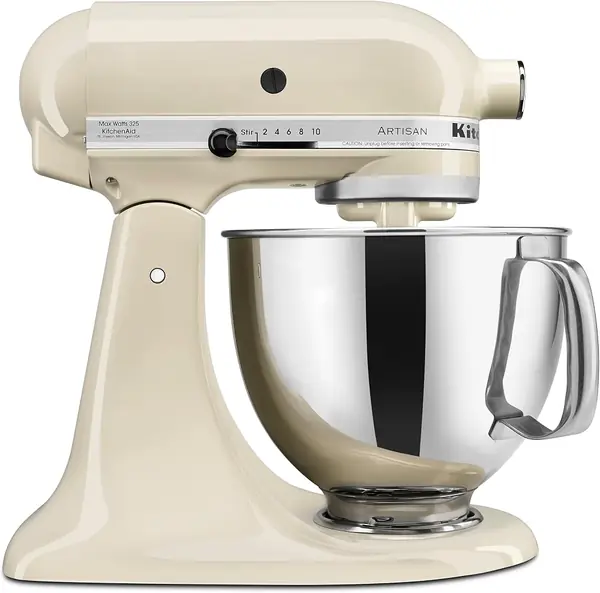
KitchenAid Artisan tilt-head stand mixer in almond cream with stainless steel bowl and pouring shield

Everyday all-purpose baking

Bake Score 95/100
Motor
325 watts
Speeds
10
Capacity
5 quarts
Included
Bowl, flat beater, dough hook, whip, and pouring shield
View on Amazon

Every mixer here got judged against this one, and none of them knocked it off the counter. The Artisan covers the whole baking arc — creaming butter and sugar, whipping cream at speed 8, kneading a batch of bread dough — with a 325-watt motor and a 5-quart bowl, and it does it without asking you to change how you work. It is the most expensive pick in this guide, and it is still the one we tell most bakers to buy.

The tilt head is why it stays on the counter. It hinges back far enough to put a spatula flat in the bottom corner, so scraping down mid-mix takes a second instead of a negotiation. Clip on the pouring shield that ships with this model and you can add flour through the chute with the motor running, which keeps the flour cloud in the bowl instead of on your counter.

Capacity is honest for a home kitchen: 9 dozen cookies in one batch with the flat beater, and a bowl wide enough that the dough actually turns instead of riding the beater. The handle earns its keep once the bowl is full. The front hub also takes the brand's pasta roller, grinder, and spiralizer if you want the machine to do more than bake.

Two things to know before you commit. Stiff, dense dough is where a tilt-head runs out of headroom, so if you knead whole-grain loaves every week, the 5.5-quart bowl-lift is the better tool. And the long-term record is the least even part of an otherwise excellent machine: shaft and motor failures show up inside the first year on some units, which is worth weighing against a one-year warranty.

Worth Noting

  • Shaft or motor failures show up within the first year
  • Tops out below a bowl-lift on stiff dough
Our Verdict

For most home bakers this is the mixer to buy: ten speeds, a tilt head you can scrape into, and enough power for cookies, frosting, and a batch of bread.

Check Latest Price
2

KitchenAid 5.5-Qt Bowl-Lift Best for Bread

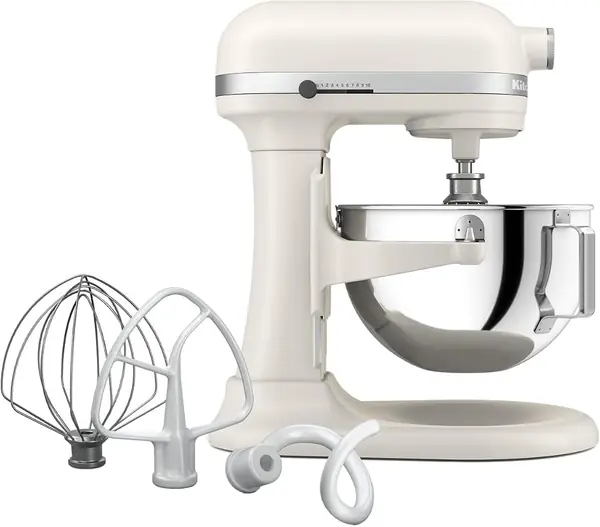
KitchenAid 5.5-quart bowl-lift stand mixer in porcelain white with stainless steel bowl and three attachments

Weekly bread baking

Bake Score 93/100
Motor
500 watts
Speeds
11
Capacity
5.5 quarts
Design
Bowl-lift with locking bowl
View on Amazon

The bowl on this KitchenAid twists and locks into two arms while the head stays where it is, and that mechanical difference is the whole argument for it. It is rated to knead over 7 pounds of bread dough, KitchenAid puts the peak power in the bowl at twice that of its tilt-head models, and it costs less than the Artisan does here. If bread is why you want a mixer, start here.

Eleven speeds sounds like a spec-sheet flourish until you use the half step below the lowest setting. That half speed folds blueberries, whipped egg whites, or chopped nuts into a batter without knocking the air back out, which is the one job a stand mixer usually does badly. The 5.5-quart bowl takes 11 dozen cookies or a double batch of dough without straining, and the bowl stays locked down while it happens.

The trade-off is access. There is no tilting head, so you scrape and add over the rim instead of into an open bowl, and the bowl has to be seated with both hands before you start. Check the 16.5-inch height against your upper cabinets before you give it a permanent spot, because this is not a machine that goes back in the cabinet between batches.

Worth Noting

  • 28 pounds, so it stays on the counter
Our Verdict

If bread is the reason you want a mixer, this is the one: a locked bowl, 500 watts, and a half speed that folds instead of deflating, for less than the Artisan.

Check Latest Price
3

Cuisinart SM-50NAS 5.5-Qt Best Warranty

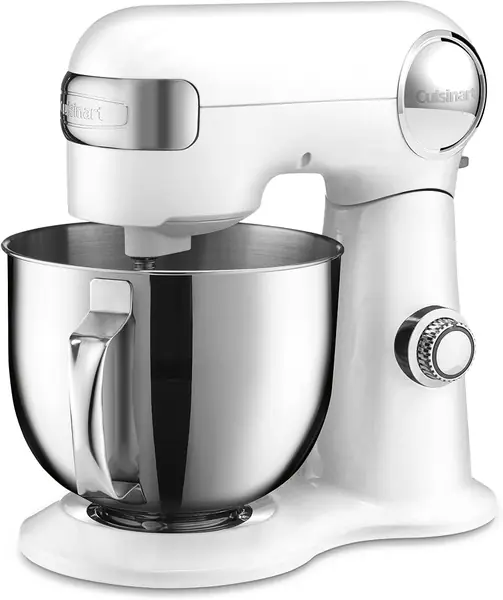
Cuisinart SM-50NAS tilt-back stand mixer in white linen with 5.5-quart stainless bowl and splash guard

Value and warranty

Bake Score 92/100
Motor
500 watts
Speeds
12
Capacity
5.5 quarts
Warranty
3 years limited
View on Amazon

Three years is the number that makes this Cuisinart worth a look: its limited warranty runs three times as long as the one-year coverage on either KitchenAid here. Add 500 watts, 12 speeds, and a die-cast metal body at the middle of the price range, and it is the value pick of the group.

We think it is the best buy here for anyone who wants one machine to handle everything and would rather not pay for the badge. It creams, whips, and kneads without complaint, the splash guard has a real pour spout instead of a token gap, and the tilt-back head gives the same open-bowl access we like on the Artisan. The 5.5-quart bowl is big enough for a double batch of cookie dough.

The bowl is also where it is least forgiving. It is wide at the bottom, so a single egg white or a small batch of buttercream sits below the beater and never quite gets picked up; scrape down more often than feels necessary, or make the full batch and freeze what you do not use. Thick cookie dough and bread dough are where it is happiest, with enough mass in the frame that it sits still while the hook works.

Our Verdict

Three years of warranty, 500 watts, and a 5.5-quart bowl make this the value pick of the group, provided you are mixing full batches rather than single egg whites.

Check Latest Price
4

Martha Stewart 5.3-Qt Best Budget

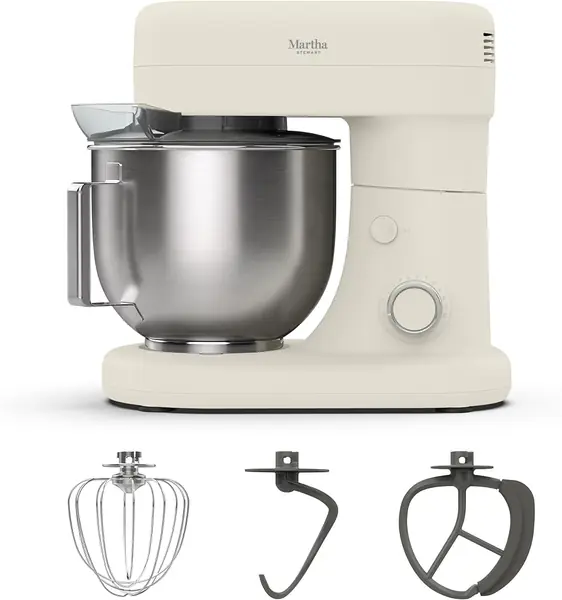
Martha Stewart tilt-head stand mixer in linen cream with 5.3-quart stainless bowl and splash shield

First-time bakers

Bake Score 90/100
Motor
660 watts
Speeds
12
Capacity
5.3 quarts
Weight
9 lb
View on Amazon

Six hundred and sixty watts at the budget end of this list is unusual, and it is why the Martha Stewart kept pace with machines costing several times as much on cake batter and cookie dough. Twelve speeds, a 5.3-quart stainless bowl, and a full set of attachments: a whisk, a dough hook, and a flat beater with a silicone edge.

That silicone edge is the detail that sold us. It wipes the bowl as it turns, so you are not stopping every thirty seconds to push batter back into the middle, and the removable splash shield gives you a chute to pour through. A bowl-scraping beater and a shield are the two things budget mixers usually skip, and this one includes both. We think it is the most useful machine here for the money.

Nine pounds means it comes out of the cabinet and goes back without a fuss, and that is most of the reason a small-kitchen mixer actually gets used. The 5.3-quart bowl handles up to 9 dozen cookies in a batch, and the attachments swap out without a fight when you move from whisk to hook.

Worth Noting

  • Light body rocks against stiff dough
Our Verdict

660 watts, a self-scraping beater, and a splash shield for budget money: the mixer we point new bakers to for cakes, cookies, and frosting.

Check Latest Price
5

VIVOHOME 6-Qt Best for Big Batches

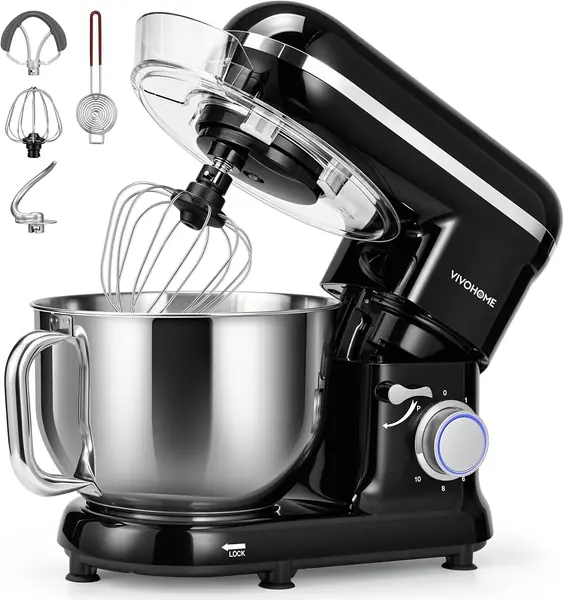
VIVOHOME 6-quart tilt-head stand mixer in black with stainless bowl, splash guard, and egg separator

Big batches

Bake Score 89/100
Motor
660 watts
Speeds
10 plus pulse
Capacity
6 quarts
Weight
11 lb
View on Amazon

Six quarts is more bowl than anything else in this guide, and it is the reason to look at this one. VIVOHOME rates the bowl at three loaves' worth of dough or 2.2 pounds of flour in a single batch, which puts it in holiday-cookie-marathon territory rather than Tuesday-night-cake territory.

There is real equipment around that bowl: 660 watts, 10 speeds plus a pulse button, suction feet, a splash guard you can pour through while the motor runs, and a flex-edge beater that scrapes the sides as it turns. The egg separator in the box is a small thing that is genuinely useful when you are separating a dozen eggs for a chiffon.

Two things to plan around. The beater leaves a ring of batter at the bottom of the bowl, so a spatula is part of the process, and the body is listed at 18.8 inches tall, so measure the gap under your upper cabinets before you claim counter space for it. Neither is a dealbreaker at this capacity, and you stop noticing the scraping by the second batch.

For big-batch baking on a budget, we think it is a lot of machine for the money, and the six-quart bowl does work nothing else here can match. Keep it on the lower speeds when the dough gets stiff and it will earn its counter space.

Worth Noting

  • Whisk and bowl handle are the failure points
  • Attachments are stiff to seat and release
Our Verdict

The most bowl for the money here, with 660 watts and a splash guard, for bakers who want big batches and accept that the trim is where the savings came from.

Check Latest Price
6

bella STIR 5.3-Qt Best for Small Kitchens

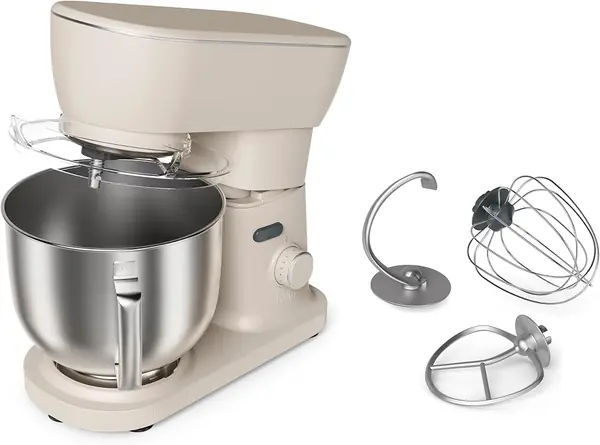
bella STIR 5.3-quart tilt-head stand mixer in oatmilk with stainless steel bowl and handle

Small kitchens

Bake Score 87/100
Motor
500 watts
Speeds
12
Capacity
5.3 quarts
Mixing
Planetary action
View on Amazon

A mixer you can carry with one hand and park in a cabinet is a different kind of useful than one that lives on the counter, and that is the case bella is making here. The body is built light, the 5.3-quart bowl has a handle, and nothing about it is pretending to be a KitchenAid.

Five hundred watts and 12 speeds put it level with the Martha Stewart on paper, and the soft-touch speed control is the part we appreciate: it eases up through the settings instead of jumping, so flour does not launch when you start on the wrong number. Planetary action carries the beater around the whole bowl instead of in a fixed circle, and the whisk, paddle, and dough hook all come in the box.

Light daily mixing is where this one makes sense: pancakes, a Tuesday cake, whipped cream for shortcakes. We think it is plenty of machine for that, and the money saved goes further spent on pans and good butter.

Worth Noting

  • No splash shield in the box
Our Verdict

A light, easy-to-store 5.3-quart mixer for everyday cakes, cookies, and whipped cream, and the one to pick when the mixer has to live in a cabinet.

Check Latest Price
7

Hamilton Beach Classic 4-Qt Best for Small-Batch Mixing

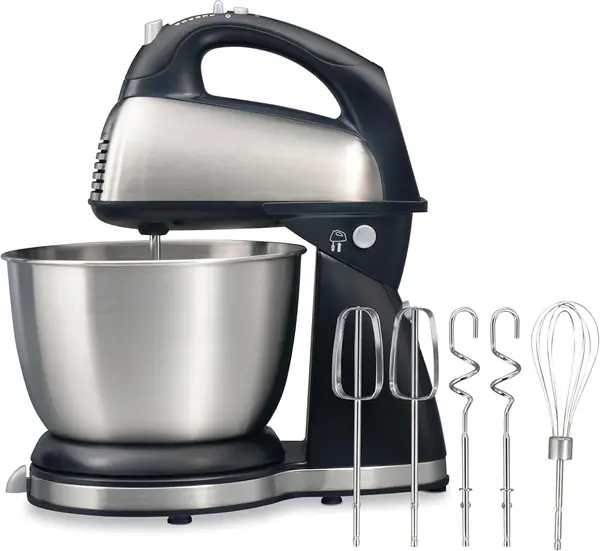
Hamilton Beach Classic convertible stand and hand mixer in black and stainless with 4-quart bowl

Small-batch mixing

Bake Score 86/100
Motor
290 watts
Speeds
6
Capacity
4 quarts
Type
Convertible hand and stand mixer
View on Amazon

The head lifts off the stand and becomes a hand mixer, which is the whole pitch: one appliance that holds its own bowl for hands-free creaming and comes out for mashing, whipping, or a quick batter in a pan.

The stand half is a 4-quart stainless bowl with a lever that shifts it side to side, so the beaters reach the edges instead of carving a ring in the middle. Six speeds plus a QuickBurst button, five attachments in the box — two beaters, two dough hooks, and a whisk — and 6.7 pounds of machine, light enough to move with one hand.

At 290 watts peak it is the least powerful mixer here, and that is the honest limit. Cake batter, cookie dough, frosting, and meringue are all within reach; stiff bread dough is not what this is for. It is the least expensive mixer here, and the hand mixer comes with it.

Worth Noting

  • You guide the bowl by hand the whole time
Our Verdict

Two mixers for the space and money of one: a 4-quart stand for hands-free creaming and a hand mixer for everything else, though neither half will knead bread.

Check Latest Price

How We Tested 11 Stand Mixers Over Eight Months

We built the shortlist from the mixers shoppers actually cross-shop: tilt-head and bowl-lift designs, bowls from 4 to 6 quarts, speed counts from six to twelve, and prices from budget to buy-it-for-life. Then we bought 11 at retail so no brand could send a hand-picked unit, and put them through eight months of ordinary baking rather than one afternoon of benchmarks.

That meant holiday cookie marathons, a weekly loaf of sandwich bread kneaded on the dough hook, birthday cakes creamed from cold butter, and more whipped cream than any household needs. They sat on real counters, including one cramped apartment kitchen where footprint decided whether the mixer stayed out or went back in the cabinet.

At each step we wrote down what happened. We weighed dough before and after kneading to see how much flour ended up on the counter, timed how long cold butter took to go pale, and watched whether the bowl shifted in its cradle when a stiff dough grabbed the hook. A heavy batch doubled as the sturdiness test: we noted whether the machine stayed planted or crept toward the counter's edge. We also checked beater clearance against the bowl bottom and poured batter through each splash guard to see how much escaped.

Noise got recorded with a decibel app at arm's length during a ten-minute knead, always early on a quiet weekend morning. Size came down to a tape measure: the footprint, plus the headroom a tilt-head needs to open under a cabinet. Durability was the eight months themselves — we looked for wobble in the head, loose bowl saddles, and finishes that scuffed or stained. We counted what came in the box, and we held every color up against its product photos in daylight and under kitchen LEDs, since a cream that photographs warm can arrive looking gray.

How to Choose a Stand Mixer for Baking

Tilt-head or bowl-lift

A tilt-head mixer hinges back so you can reach into the bowl with both hands; a bowl-lift keeps the head fixed and raises the bowl into the beater between two arms. Tilt-heads are quicker to scrape and add to, which is why we prefer one for cakes, cookies, and frosting. Bowl-lifts lock the bowl down, put more power at the beater, and take heavy dough without shifting — the KitchenAid 5.5-quart is rated for more than 7 pounds of bread dough.

Decide by what you knead, not by what looks sturdier. A bowl-lift's bowl seats with a twist and comes out with two hands, and the fixed head means you scrape over the rim. If bread is an occasional project, that is friction you do not need.

Match bowl size to batch size

A 5-quart bowl mixes about 9 dozen cookies with the flat beater, which is more than most households bake at once; 4 quarts is the compact end and 6 to 7 quarts is for doubling and holiday runs. Match the bowl to the batch you really make, since capacity you do not use is just a heavier machine to store.

The trap sits at the small end. A wide-bottomed bowl can leave one egg white or a single batch of buttercream under the beater's reach, and that is the most common way a big mixer disappoints. If most of your baking is single batches, a 5-quart machine mixes better than a 7-quart one.

What the wattage does and does not tell you

Wattage is not measured the same way by every brand, so treat it as a rough guide and compare machines within one list. What you feel in use is whether the motor holds speed as dough stiffens and whether the frame has enough mass to stay planted. A 300-watt kitchen mixer in a light plastic body and a 500-watt machine in a die-cast frame are different tools, not different numbers.

Look for a slow start and a genuinely low first speed. Those two keep flour in the bowl when you add it and let you fold berries or whipped whites into batter without deflating it — the half speed on the bowl-lift KitchenAid is the clearest version of that here.

Height, weight, and where it lives

Stand mixers are tall and they are heavy, and both facts decide whether you actually use yours. Check the height with the head up against the clearance under your cabinets — the VIVOHOME lists 18.8 inches — and check the weight if the machine lives in a cabinet. Twenty-eight pounds stays on the counter; 7 to 9 pounds comes out for a Tuesday cake.

Shields, attachments, and warranty

Every mixer here includes a wire whip, a flat beater, and a dough hook, so those are table stakes. The extras that change daily use are a splash shield with a pour chute and a beater with a flexible silicone edge that wipes the bowl as it turns. Both cut cleanup on every single batch.

Warranty is the other quiet difference: one year on the KitchenAids, three on the Cuisinart. If you bake often and expect to keep the machine a decade, that gap is worth more than a color choice.

Frequently Asked Questions

Final Verdict

For most bakers the KitchenAid Artisan is the end of the search: 10 speeds, a tilt head you can scrape into, and enough power for cookies, frosting, and a batch of bread. Knead stiff dough most weeks and the 5.5-quart bowl-lift does that job better for less money.

On a tight budget, the Martha Stewart 5.3-quart handles cakes and cookies without the KitchenAid price, and the Cuisinart is the one to take if a three-year warranty matters more to you than the badge on the front.