The 5 Best Silicone Bundt Pans of 2026

The hardest part of baking a bundt isn't the batter. It's the flip: the moment you invert the pan and wait to see whether the cake drops out clean or leaves half its fluted ridges behind. A good silicone bundt pan is supposed to take that fear out of the equation—it flexes just enough to coax the cake free—but only if the walls are sturdy enough to stand up in the oven and the surface releases without a wrestling match. That's the balance I went looking for.

I baked in 14 silicone bundt pans, from 7-inch molds to deep 9-inch designs, and compared how they handled the same pound cake, gelatin, and monkey bread recipes. I noted whether each pan held its shape when filled, how easily cakes released from the flutes, and whether the silicone stained or trapped crumbs. Size mattered, too: a pan that looks generous on the shelf can be awkward to store or too shallow for a tall cake. These made the flip boring.

Our Top Picks

The Best Silicone Bundt Pans

1

Kenond 9.5-Inch Fluted Cake Pan (2-Pack) Best Overall
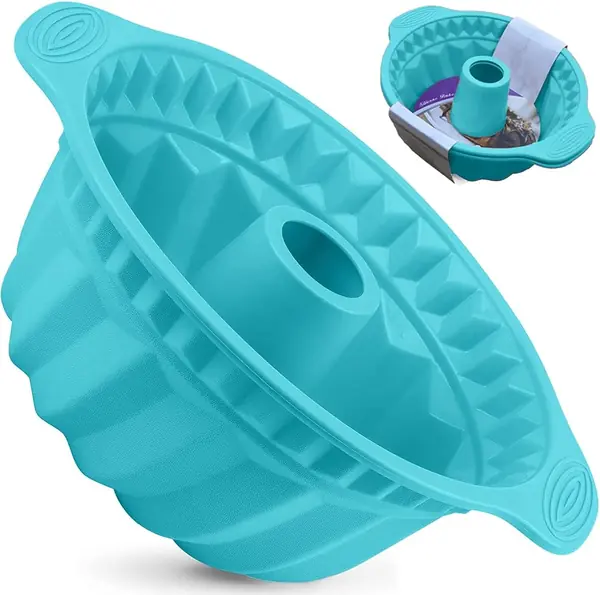
Kenond 9.5-inch silicone fluted cake pan in blue with two molded handles

Most bundt bakers

Bake Score 92/100
Max Oven Temp
446°F
Capacity
12 cups
Pack
2 pans
Handles
Molded silicone
View on Amazon

Every silicone bundt pan shares one weak point, and it shows up the moment you lift a full mold off the counter: the walls give, and batter slides toward the low side. Kenond's answer is a pair of molded handles at the rim, so you carry it the way you carry a mixing bowl, one hand on each side, and the batter stays level. Simple, but it is the first thing we check now when a new silicone pan arrives without them.

The size is the other reason it sits at the top. At 9.5 inches across and 12 cups, it holds a standard bundt recipe with room to spare instead of crowding the rim, and the flutes run deep enough that a lemon pound cake comes out with real definition rather than a vague suggestion of a pattern. Release has been the most consistent of the pans here: a light grease, a few minutes cooling on the counter, and the cake drops onto the rack in one piece.

Two pans arrive for roughly what one of the single molds here costs, which changes how you use them. One can hold a cake for the freezer while the other goes straight to the table, and neither has to be prised out of a cabinet — silicone folds, so they flatten into a drawer. The second pan also takes the jobs you would not risk your good bundt pan on: jello, a small monkey bread, a meatloaf.

Worth Noting

  • Sold only as a pair, never singly
Our Verdict

This is the pan we recommend first: full 12-cup capacity, handles that carry a loaded mold, and the cleanest release of the silicone pans we tested.

Check Latest Price
2

Aokinle 9.45-Inch Silicone Fluted Cake Pan Best Single Pan

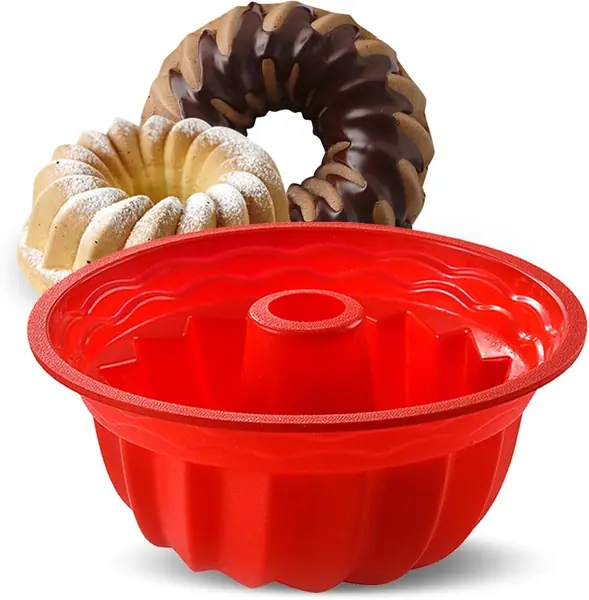
Aokinle red silicone fluted tube cake pan, 9.45 inches across with deep petal flutes

Single-pan kitchens

Bake Score 91/100
Max Oven Temp
446°F
Diameter
9.45 in
Depth
3.9 in
Silicone Grade
LFGB food-grade
View on Amazon

One pan is all a lot of people need, and this is the one we point them to. At 9.45 inches across and 3.9 inches deep, it takes a full bundt batter without coming near the rim, and the depth gives you a taller cake with flutes that stay sharp all the way up the sides instead of fading toward the top.

What we noticed in the oven is how even it bakes. The walls are a consistent thickness and cakes come out level rather than domed and pale on one side, which is the difference between a mold you reach for and one that sits in the drawer. The surface releases cleanly too: turn the cake out while it is still warm and the pattern holds.

The silicone is food-grade and BPA-free, made to the European LFGB standard, and rated to 446°F, so ordinary cake temperatures are comfortable with plenty of headroom. It is dishwasher safe, and what does not rinse off under the tap comes off in the cycle — often there is nothing to scrub but a film of butter.

Worth Noting

  • Floppy enough to bow when it's full
Our Verdict

This is our pick if one pan is all you want: deep 9.45-inch walls that bake evenly, a clean release, and no second mold to store.

Check Latest Price
3

Boxiki Kitchen Steel-Framed Silicone Bundt Pan Best for Sturdy Handling

Boxiki Kitchen red silicone bundt pan with a steel frame and metal handles

Steady, no-sag baking

Bake Score 90/100
Max Oven Temp
500°F
Capacity
12 cups
Size
9 x 9 x 4.6 in
Frame
Steel with handles
View on Amazon

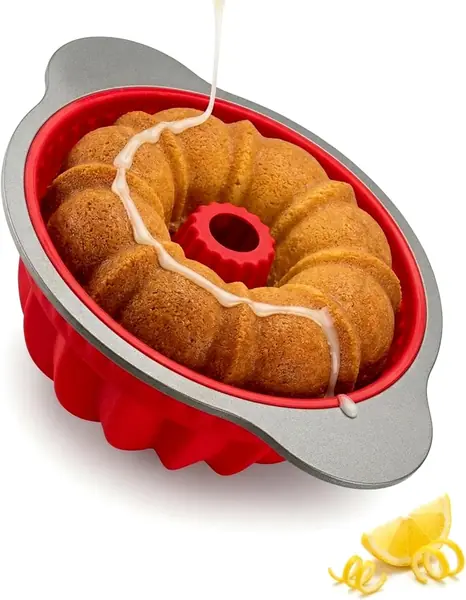
A steel frame inside a silicone pan sounds like it defeats the point, until you pick the thing up with 12 cups of batter in it. Boxiki's frame runs around the rim, so the pan behaves like a metal bundt with a silicone lining: it holds its shape without bowing, the handles are rigid enough to grip with a mitt, and you can turn the cake out without bracing the sides with your forearm.

Baking is where the frame pays off. The pan holds its shape through a long bake, cakes come out level, and the fluted pattern is deep enough to read clearly on an unglazed cake. The surface is textured rather than glassy, though, and that changes your technique: a rum cake or anything with a lot of sugar in the batter needs a proper grease and a dust of flour worked into the coves, or it will leave the top of the pattern behind.

One detail to know before you order: the warranty runs 90 days, against the ten years Lékué puts on its mold. That is a short promise for the most expensive pan here, and it is the one thing that gives us pause about a mold we otherwise like a great deal.

Worth Noting

  • Heaviest pan in this group
  • Won't fold down for storage
Our Verdict

The one we hand to anyone who has watched a silicone mold sag: a steel frame holds 12 cups of batter steady, and the handles work like real handles.

Check Latest Price
4

Lékué Deep Silicone Savarin Bundt Mold Best for Syrup-Soaked Savarins

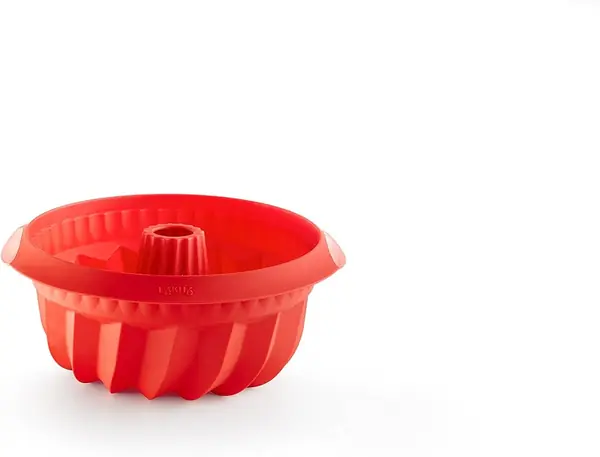
Lékué red silicone savarin bundt mold, a deep 2.5-quart ring about nine inches wide

Syrup-soaked savarins

Bake Score 89/100
Max Oven Temp
428°F
Capacity
2.5 quarts
Diameter
8.66 in
Warranty
10 years
View on Amazon

This is a savarin mold rather than a copy of an American bundt pan. The ring is deep and generously sized — 2.5 quarts, about nine inches across — with a rounded profile that suits a yeast cake built to drink up syrup rather than a dense pound cake that needs sharp flutes to look like anything at all.

Capacity is the number to check before you buy. At 2.5 quarts it holds about 10 cups, which is less than the 12-cup pans here, so a full-size bundt recipe will come right up to the rim and may need a cup held back. For a savarin, a rum baba, or a molded mousse cake, the size is exactly right, and the flexible walls let a set dessert slide out without a watermark.

What we appreciate most is how little fuss it takes. It weighs less than a coffee mug, rinses clean under the tap, and goes into the dishwasher and the freezer without complaint. The ten-year warranty is the longest promise on this page, and on a mold that costs about what the Kenond pair does, it makes a fair case for buying one good pan instead of two.

Worth Noting

  • No handles to steady a full mold
Our Verdict

We reach for this one for syrup-soaked savarins and big ring cakes: 2.5 quarts, dishwasher safe, and the only ten-year warranty in this group.

Check Latest Price
5

SILIVO 7-Inch Silicone Fluted Cake Pans (2-Pack) Best for Small Batches

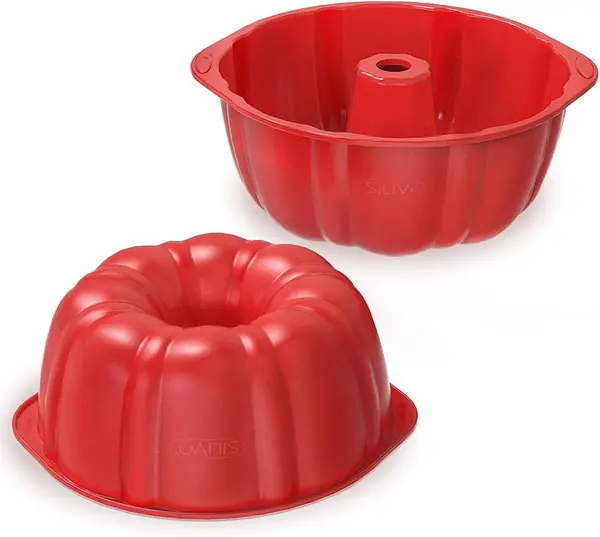
Two red SILIVO seven-inch silicone fluted cake pans with deep fluted sides

Small batches

Bake Score 88/100
Max Oven Temp
450°F
Capacity
7 cups
Pack
2 pans
Size
7 x 7 x 3.2 in
View on Amazon

Seven inches across and 3.2 inches deep, with about 7 cups of capacity each, these are small pans that make short work of a boxed mix. One mix divides neatly between the two, you get a pair of ring cakes instead of one, and the fluted shape still reads on a plate rather than looking like a plain round layer with a hole punched in it.

They release cleanly for such thin silicone: a light grease, a few minutes cooling, and the cake drops out with the pattern intact. They are dishwasher safe as well, so a morning of baking does not turn into an afternoon of scrubbing, and the size makes them handy for the jobs a big bundt pan is bad at — jello, a small monkey bread, a meatloaf for two.

The pair also solves a freezer problem. Two small cakes wrap and stack better than one big one, and you can thaw half of what you baked instead of committing to the whole ring. That is the case for owning them even if you already have a metal bundt pan in the cupboard.

Worth Noting

  • A standard recipe needs both pans
Our Verdict

We like these for small households and split mixes: two 7-inch pans that turn one boxed mix into a pair of tidy ring cakes.

Check Latest Price

How We Tested Silicone Bundt Pans

I built the shortlist by reading spec sheets and customer reviews for silicone bundt pans, then narrowing to 14 models across a range of prices, from small 7-inch molds to standard 9-inch fluted pans and deeper designs. I looked for clear material information, a reinforced rim or rigid frame, and a size that would fit a normal cabinet and sheet pan. Over four months, I baked the same pound cake, gelatin, and monkey bread in each one, always on a weekend morning when I could watch the whole process from batter to unmolding.

To judge sturdiness, I filled each pan and carried it from counter to oven, noting whether the sides bowed or the handle twisted under a full batter. I baked, cooled, and flipped every cake onto a wire rack, then checked whether the cakes browned evenly, how many crumbs stayed behind in the flutes, and whether the cake kept its shape. For cleaning, I rinsed each pan, washed the flutes by hand, and ran them through the dishwasher when the maker allowed it, then looked for staining, lingering grease, or a soapy film.

Size and function got their own checks: I measured how much batter each pan held, whether it fit in my cabinet stacked with others, and how the same recipes behaved in a shallow pan versus a deep one. I also used a couple of the pans for gelatin and monkey bread, since those tests expose whether the surface releases cleanly and whether the details of the mold survive. Durability showed up over time—after repeated washes, some pans stayed supple and clear, while others picked up a faint oily haze or lost their crisp edges.

How to Choose a Silicone Bundt Pan

Start with capacity, not diameter

A standard bundt recipe is written for 10 to 12 cups, so match the mold to that number rather than to the width on the box. The Kenond holds 12 cups and takes a full recipe in one go; a 7-cup pan like the SILIVO means splitting the batter between two molds. Diameter alone tells you very little, since a wide, shallow ring and a narrow, deep one can hold the same amount.

Depth is what gives you height and definition. A mold with 3.5 to 4 inches of wall produces a taller cake whose flutes hold their shape after unmolding, which is the difference between a bundt that looks like a bundt and one that looks like a donut with ambitions.

Decide how much structure you want

Every all-silicone fluted cake pan flexes; the question is whether it flexes while you're carrying it. Handles like the Kenond's give you a grip without stopping the walls from bowing, and a steel frame like the Boxiki's stops the bowing but can't be folded away. Whichever you buy, set the filled mold on a sheet pan before it goes anywhere — the sheet carries the weight and catches the spill.

The trap is the showroom feel. A pan that seems rigid when you unbox it can still bow once 12 cups of batter are in it, so judge the mold by its handles, its frame, or its wall thickness rather than by how stiff it feels empty.

Release is technique as much as coating

Silicone is slippery, but it isn't nonstick in the way a coated metal pan is, and the flutes are where a cake lets go last. Grease the mold properly — softened butter brushed into the coves, or a spray that contains flour — and fill it no more than three-quarters full so the batter has somewhere to climb.

Then wait. A few minutes of cooling lets the cake firm up enough to turn out in one piece; rush it and the warm cake tears at the center tube, leave it too long and condensation softens the crust. Turn it onto a rack, not a plate, so the pattern doesn't sit in its own steam.

Heat ratings, cleanup, and storage

The molds here are rated between 428°F and 500°F, comfortably above the 325°F to 375°F most cakes bake at, so the number matters mainly if you push higher for quick breads or a roast. All five are dishwasher safe. What stains silicone is batter baked onto the outside, and a paste of baking soda and water lifts it better than any scrubber.

Think about storage before you commit. An all-silicone pan folds flat into a drawer, a framed one takes a full shelf, and a pair of small pans nests together. In a small kitchen that difference decides which pan actually gets used.

Frequently Asked Questions

Final Verdict

Buy the Kenond if you bake bundt cakes more than a few times a year. Full 12-cup capacity, handles that make a loaded mold carryable, and the most consistent release of the pans here make it the one we recommend first, and the second pan in the box earns its shelf space rather than sitting in a cupboard.

If the sag of all-silicone bakeware is what has kept you away from silicone entirely, the Boxiki's steel frame fixes it, provided you can spare the shelf and don't mind the weight. And if you bake for two far more often than for eight, the SILIVO pair is the honest small-batch answer.