The 7 Best Sifters for Fresh Milled Flour

Fresh-milled flour doesn't behave like the stuff in the paper bag. It's heavy with bran and germ, it clumps into damp little pebbles, and it sits in your batter in stubborn pockets. Sifting breaks up those clumps, fluffs the flour, and catches the coarse bits so your bread rises evenly instead of squatting.

I've been milling my own grain for years, and the sifter I reach for keeps changing. We worked through 14 sifters and sieves: hand-crank models, round fine-mesh sieves, and matched sets. The real fork is crank versus sieve — a crank holds three to five cups and works as you turn the handle, while a round sieve rinses clean in seconds and doubles as a strainer.

Mesh count gets more attention than it deserves; 40 and 60 mesh both handle home-milled flour. What separates the good ones is whether the mesh stays taut after months of being pressed into a bowl, and whether the handle feels solid or flexes.

Our Top Picks

The Best Sifters for Fresh Milled Flour

1

Tiawudi 9-Inch Fine Mesh Sieve Best Overall
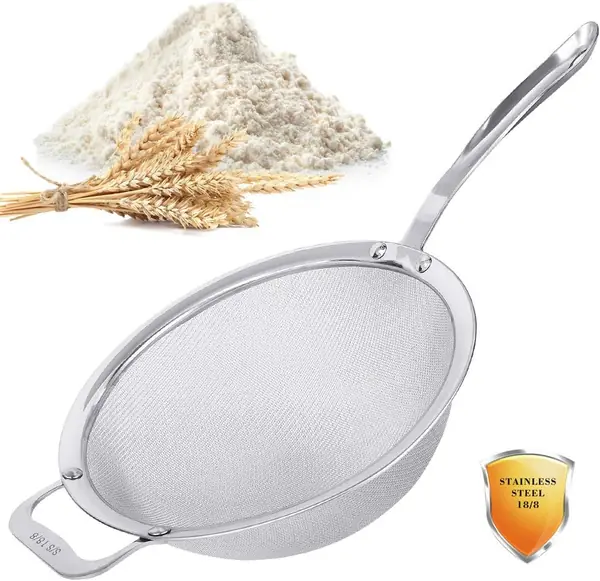
Tiawudi 9-inch stainless steel fine mesh sieve with wide riveted handle and hook

Everyday full batches

Bake Score 94/100
Mesh
30 mesh, double layer
Diameter
9 inches
Bowl Depth
3 inches
Handle
Riveted, wide hook
View on Amazon

Nine inches across and three inches deep is the number that decides this one. A home mill puts out flour by the cupful, and a sieve this wide takes the whole of a batch in a single pass instead of three. We set it over a stock pot, tipped in fresh-milled wheat, and worked straight through without stopping to empty it — that flow, more than any single spec, is why it's our top pick. The double layer of 30-mesh cloth passes flour quickly for something this fine.

The handle is the second good decision. It's riveted at two points and the hook is wide enough to catch the rim of a bowl or a pot, so it hangs steady while both hands work. Thirty mesh is the coarser end of flour-sifting fine: right for lumps and the big bran flakes, though it lets the fine bran dust through, which is why a 60-mesh screen still earns a place in a miller's kitchen. For everyday sifting straight off the mill, we take the speed.

Two things worth knowing. Lean on the handle and it bends before the rivets let go, so treat a bend as a warning rather than a failure. At 17.5 inches overall it is also not a drawer tool, so plan to hang it. We've rinsed quinoa and drained yogurt in it too, which is a bonus rather than the argument for buying.

Worth Noting

  • Handle bends before the rivets give
  • Long overall length eats drawer space
Our Verdict

We recommend it as the default because a nine-inch bowl swallows a whole batch of home-milled flour and the double mesh still holds the coarse bran back.

Check Latest Price
2

PUHETO 40/60 Mesh Sieve Set Best for Sifting Out Bran

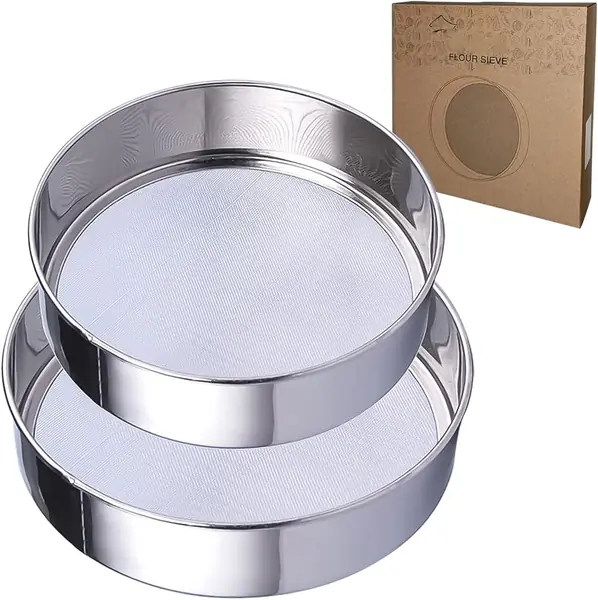
PUHETO two-piece round stainless steel flour sieve set in 6- and 8-inch sizes

Separating bran

Bake Score 93/100
Material
304 stainless steel
Mesh
60 and 40 mesh
Sizes
6 inches and 8 inches
Pieces
2 sieves
View on Amazon

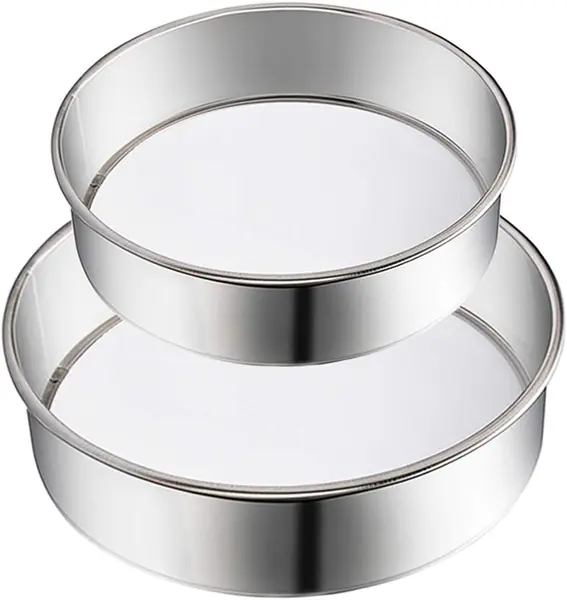
Forty and sixty are the numbers to read on this pair. The eight-inch sieve is woven at 40 mesh and the six-inch at 60, and that second screen is the one that matters when you mill your own wheat. Its openings run about 0.15 millimeters, fine enough to sit above bran flakes and let the flour through. That is separation rather than aeration, and it is a different job from what a crank sifter does.

This is the pair we reach for when the goal is flour character rather than lumps. Run whole wheat through the 40 first to lift the coarse flakes, then push it through the 60 for a lighter, higher-extraction flour. The two-stage pass is the trick, and it is what makes a set of two more useful here than any single screen. If you have been disappointed by how much bran a rotary sifter leaves sitting in the bowl, this is the correction.

Both are plain round sieves with a rim and no handle, so you shake and tap them over a bowl or work the flour through with a scraper. That is arm work with a full batch, and it is the honest trade for mesh this fine. They rinse clean in seconds and nest together, so even a small kitchen can keep both within reach.

Worth Noting

  • Shake-only, so a big batch takes arm work
Our Verdict

Buy this pair if bran is what you're chasing, because the 40- and 60-mesh screens take out what a crank sifter pushes straight through.

Check Latest Price
3

Bellemain Hand-Crank Sifter Best Hand-Crank Sifter

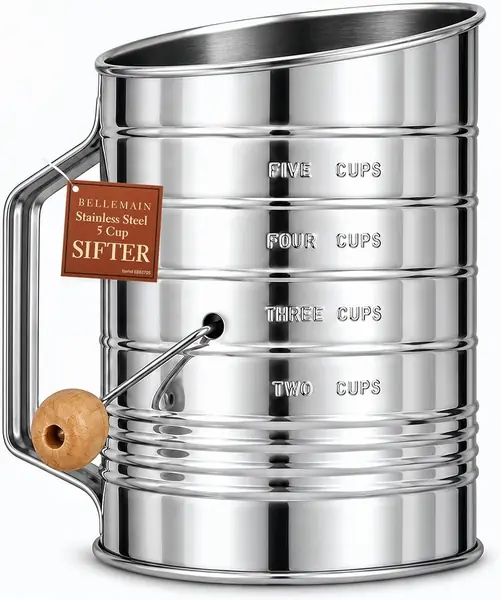
Bellemain stainless steel hand-crank flour sifter with wire agitator and side crank

Low-effort cranking

Bake Score 92/100
Material
Stainless steel
Mesh
Single layer
Agitator
Double wire loop
Type
Hand crank
View on Amazon

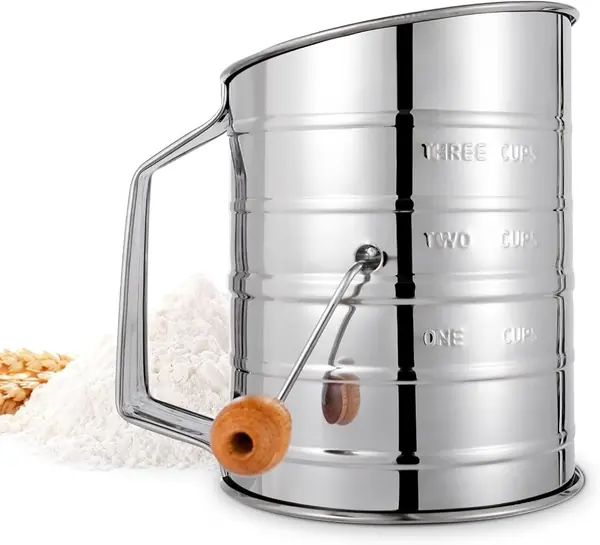
A crank beats a squeeze handle after the first cup or two, and this is the crank sifter we hand people first. The effort moves from your grip to your wrist, which is the difference between finishing a batch and stopping halfway. We noticed the single mesh clears faster than expected because the twin wire loop travels the screen as you turn, scraping flour off the cloth instead of letting it cake in the middle.

Fill it, crank, refill: a batch of bread flour is two rounds, and that is the trade for a sifter that tucks into a drawer. The all-stainless body wipes out with a dry cloth, and a quick tap on the side knocks the last of the flour loose before it goes back on the shelf.

The crank is the part to watch. Ours has been fine, but the mechanism is where these sifters eventually give up, so buy it as a tool you expect to replace rather than an heirloom. Keep the drum dry between bakes, and store it with the crank facing up so the wire loop is not resting its weight on the screen.

Worth Noting

  • Crank assembly is the wear point
Our Verdict

Our pick if you want your arm to last through a batch, since cranking is easier than squeezing and the twin wire loop keeps the screen clear.

Check Latest Price
4

Winco 10-Inch Commercial Sieve Best for Very Large Batches

Winco 10-inch stainless steel commercial sieve with deep bowl and polished rim

Very large batches

Bake Score 91/100
Material
Stainless steel
Diameter
10 inches
Bowl Depth
3 inches
Mesh Opening
0.84 millimeters
View on Amazon

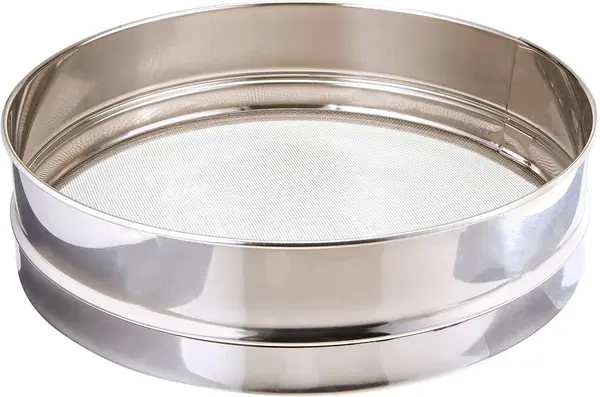
Ten inches of sieve is a different scale of tool. Set over a stock pot, the rim spans it completely, so you can sift onto a wide surface and let the flour fall where it wants. Surface area is what speeds up a big batch: more mesh under the flour at once, less shaking for every cup that goes through.

The openings measure 0.84 millimeters, which is coarse for our purposes. Read this as a pre-sieve. It takes out chaff, big flakes, and clumps, and it lets fine bran straight through, so follow it with a 60-mesh screen and you have the two-stage setup a lot of home millers end up at anyway.

It is built like restaurant equipment. The ring is heavy and the mesh is secured to the frame with no give, even when you press cooked potato or custard through it. Flour does lodge in the narrow seam where mesh meets rim, so rinse it right after use and work that seam with a brush; leave it dirty and the flour sets like paste.

Buy this one if you sift in volume, or if you want a single wide sieve that strains and purees as readily as it sifts. If stripping bran out of fresh milled flour is the whole point of the purchase, a finer screen will do more for you and this one will mostly get in the way of that expectation.

Worth Noting

  • Flour lodges where mesh meets the rim
  • 0.84 mm openings are coarse for bran
Our Verdict

Worth it if you sift by the gallon, because the ten-inch bowl and rigid ring handle big batches and it strains custard just as readily.

Check Latest Price
5

Meirrnyyu 60-Mesh Sieve 2-Pack Best Budget

Meirrnyyu two-pack 60-mesh stainless steel round flour sieves in 6 and 8 inches

Budget bran sifting

Bake Score 90/100
Material
Stainless steel
Mesh
60 mesh
Sizes
6 inches and 8 inches
Pieces
2 sieves
View on Amazon

Two fine sieves for less than most single crank sifters here, which makes this the low-risk way to find out whether sifting your own flour is a habit you'll keep. The pair covers both jobs a home mill creates: a six-inch for a small batch or a quick dusting, an eight-inch for a loaf's worth of wheat.

Both screens are 60 mesh, the fine end of what we cover. That's the mesh that pulls the coarser bran out of whole-grain flour and leaves you with something closer to high-extraction, and it is fine enough to double as a powdered sugar sieve when a recipe wants an even dusting. If you've been put off by how much bran a rotary sifter leaves in the bowl, this pair is the cheap test of whether finer sifting changes your bread.

The cost of that fineness is speed. Sixty mesh is slow, and a cup of coarse home-milled flour takes patience, so you'll get through a batch faster tapping steadily than shaking hard. Rinse them and stand them on edge to dry, because a wet screen is a slow screen.

Worth Noting

  • Fine mesh sifts slowly on big batches
Our Verdict

The cheapest route to two fine sieves, and the pair we point to when you are still deciding how fine you want your flour to be.

Check Latest Price
6

Norpro 3-Cup Rotary Sifter Best for Measured Sifting

Norpro 3-cup stainless steel rotary flour sifter with hand crank and wire agitator

Measured sifting

Bake Score 89/100
Material
Stainless steel
Agitator
Two-wire
Capacity
3 cups / 24 oz
Markings
Inside and outside
View on Amazon

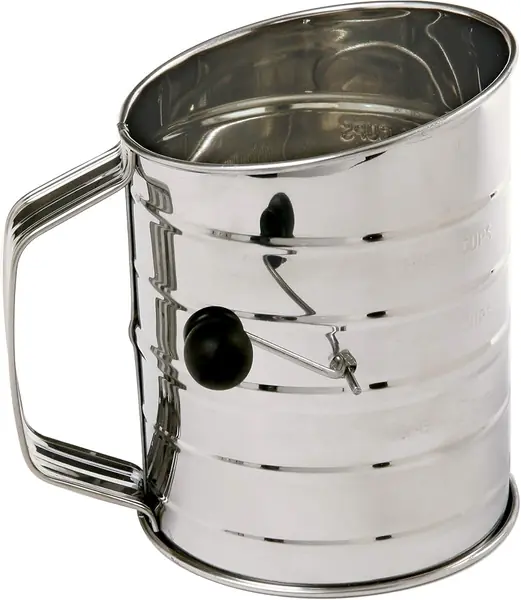
The wire loop inside this sifter sweeps a circle, so it leaves a ring of flour at the edge of the screen that never quite reaches the mesh. The last half cup needs help: tip the sifter, tap the rim, and the rest drops through. That's the one habit it asks for, and once you have it the cranking itself is smooth and quiet.

What it does better than most is measure. The cup marks are stamped on the inside and the outside of the drum, so you can read them with the flour already in and top up without setting down the bag. Three cups fit comfortably, which is one layer cake or a batch of biscuits, and the two-wire agitator turns easily even when the drum is full.

For a baker who measures straight into the sifter and sifts onto the counter, this is a sensible pick, because the marks earn their place every time you bake. The mechanism is also simple enough to hand to a kid who wants to help. Keep it out of the dishwasher; steam works into the seams and the steel stops looking after itself.

Worth Noting

  • Stamped body flexes and dents
Our Verdict

A sensible buy if you want measurement marks and a classic crank, as long as you treat the body gently and keep it out of the dishwasher.

Check Latest Price
7

Toresano 3-Cup Hand-Crank Sifter Best for Small Kitchens

Toresano 3-cup stainless steel hand-crank flour sifter with stamped measurement marks

Small kitchens

Bake Score 88/100
Material
Stainless steel
Agitator
Double loop
Capacity
3 cups
Dimensions
5.5 x 5.8 x 5.1 inches
View on Amazon

At roughly five and a half inches square it sits flat on a shelf or on its side in a drawer, which is the reason it stays in reach in a kitchen where a ten-inch sieve would be a nuisance. Small footprint, full-size crank, and a drum that holds enough for a cake or a single loaf.

The measurements are stamped into the metal rather than printed on, so they survive years of washing and stay readable in a dim kitchen at seven in the morning. Two wire loops travel the screen as you crank, and the mesh is fine enough for whole wheat straight off the mill as well as for cocoa when you're dusting the top of a cake.

Two people baking a loaf or a cake at a time don't need more sifter than this, and it costs less than the larger cranks on this list while taking up half the cabinet space. It is a single-batch tool, though, so don't plan to work through a week's flour in it on a Sunday afternoon.

Worth Noting

  • Crank can drag and scrape the screen
Our Verdict

We like it for a small kitchen that still wants a crank sifter, since it stores on any shelf and handles a single batch without fuss.

Check Latest Price

How We Chose and Tested These Sifters

We started by pulling every sifter and sieve a home baker would realistically consider — hand-crank canisters, round fine-mesh sieves, and matched two-piece sets — then filtered by mesh rating, cup capacity, and whether the listing described real stainless rather than a coated stand-in. Anything that looked likely to flex or shed its finish got cut. That left 14 sifters and sieves, which we used for four months.

Every batch began with whole grain going through a countertop mill: hard red wheat for bread, rye for sandwich loaves, soft wheat for cakes. We weighed out a pound of fresh-milled flour each time and sifted it into a bowl, noting how many passes it took to clear the bran, whether the flour came out light and separate or still gritty, and how much fine dust landed on the counter instead of in the bowl.

Crank models got turned one-handed while the other hand steadied the canister over the bowl; we watched whether the agitator swept the full bottom or left a ring of flour around the rim, and whether the handle turned smoothly or caught and skipped on the bran. Round sieves were tapped, shaken, then rinsed and reused the same morning as quinoa strainers and cocoa dusters. Each one went through the dishwasher at least a dozen times, and we checked the mesh for sag, the rim for wobble, and the handle joint for play — all while weighing whether the extra mechanism on a crank earns its keep next to a plain sieve that rinses clean in seconds.

How to Choose a Sifter for Fresh Milled Flour

Mesh size decides what ends up in your bowl

Mesh count is the number of openings per inch, so higher means finer: 40 and 60 mesh hold bran back, while 30 mesh mostly breaks up clumps and lets the fine bran dust straight through. Look for a mesh count or an opening size before anything else on the listing.

The trap is the rotary crank sifter. Its wire agitator is built to push flour through the screen, which is exactly what you want for a light cake crumb and exactly wrong for stripping bran out of whole wheat. If you mill your own grain, own at least one screen at 40 mesh or finer.

Width, depth, and something to hang it on

A wide, deep sieve is easier to live with than a small one, because a home mill produces flour in batches. Nine or ten inches across and about three inches deep takes most of a batch at once, and a hooked handle lets the sieve hang on a bowl so both hands stay free for the flour.

Watch for the shallow multi-size sets sold for draining pasta and rinsing rice. Those are colanders, and a cup of flour disappears into one. Depth is the measurement nobody puts on the front of the package, so check the bowl spec rather than the diameter alone.

Cranking, shaking, or squeezing

A hand crank moves the work to your wrist and off your grip, which is the better choice for arthritic hands or a long batch. A round sieve has no mechanism to break, but you supply the motion, and a 60-mesh screen under a full batch is genuine arm work.

Squeeze-handle sifters belong to dusting rather than to sifting a batch of bread flour; the trigger wears out and the mesh is usually the coarse kind. Match the mechanism to the volume you actually sift in a week, not to the one batch you sift at holidays.

Cleaning, drying, and where it lives

Flour finds the seam where mesh meets rim, and once it gets damp in there it stays. Rinse a sieve as soon as you're done, work the seam with a brush, and stand it to dry instead of leaving it flat on the counter.

Skip the dishwasher for stamped-steel sifters and anything riveted; steam works into the joints and the finish stops being a finish. Long sieves want a hook on the wall, small cranks want a shelf, and both want to be dry before they go there.

Frequently Asked Questions

Final Verdict

For most people milling flour at home, we point to the Tiawudi sieve: nine inches wide, three inches deep, and fine enough at 30 mesh to break up lumps while holding the coarse bran back. It takes a full batch without a refill, which is the difference between sifting as a habit and sifting as a chore.

If bran is the thing you're chasing, the PUHETO pair does more: run the flour through the 40-mesh screen, then the 60, and you land closer to a high-extraction flour than any single tool here gets you. And if cranking suits your hands better than shaking, the Bellemain is the crank we hand people first.