The 8 Best Proofing Baskets for Sourdough

The first time a fully proofed boule refuses to leave the basket, you find out what a banneton actually does for you. It holds the shape you spent ten minutes building, wicks moisture off the surface so a skin forms, and stamps in those spiral rings that make a loaf look bakery-made. The wrong one — too small, shedding splinters, lined with a cloth the dough grips like Velcro — undoes all of that at the exact moment you can't fix it.

I've baked sourdough long enough to be picky, and 14 proofing baskets went through our weekly bakes, from bare rattan rounds to full kits with a liner, lame, scraper, and whisk. Size is where beginners get caught — a 9-inch round takes roughly a 1 kg boule, and the 10-inch ovals are built for batards — but construction is where cheap baskets give themselves away: loose coils that grab dough, splintery rims, liners that pill after three washes.

Our Top Picks

The Best Proofing Baskets for Sourdough

1

KooK Banneton Proofing Baskets Best Overall
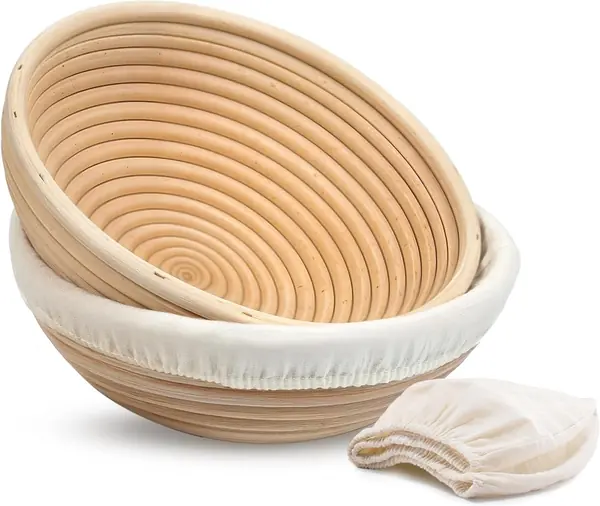
KooK two round rattan proofing baskets with washable liners

Everyday round boules

Bake Score 97/100
Material
Natural rattan
Set Contents
2 baskets, 2 washable liners
Basket Size
9 x 9 x 3.4 inches
Dough Capacity
2 lb
View on Amazon

Two 9-inch baskets, two washable liners, and no gimmicks: that is the whole case for the KooK set. We like that it treats the banneton as a tool rather than a starter kit, because most bakers already have a scraper, a lame, or a favorite bowl. The 9-inch round is the size we reach for first: it suits a standard boule, fits most Dutch ovens, and leaves enough room for a 2-pound dough to rise without climbing the rim. The pair is the practical part. Sourdough usually happens in batches, and having a second basket means one loaf can cold-proof while the first one bakes.

The liner is the detail that makes this one easy to live with. Use it for wetter doughs, for a softer crust, or when you want to spend less time scrubbing flour out of rattan. We also appreciate that both liners are washable, because a liner that cannot be cleaned is just a flour trap. Without the liner, the rattan rings leave the familiar spiral, and the natural cane has enough texture to hold a shaped loaf. The listed 2-pound capacity is generous for a 9-inch basket, though a very slack, high-hydration dough will still spread if you do not build tension before it goes in.

The only real limitation is shape. This is a round basket, so it is not the one for long batards or sandwich loaves; the DOYOLLA oval pair covers that ground. But for the baker who makes boules most weekends, the KooK set is the simplest answer here: two baskets, two liners, and a size that works with the pots and schedules most of us already have. We keep coming back to it because it does not make proofing feel like a project.

Worth Noting

  • Round shape only
Our Verdict

We recommend the KooK set as the default because two 9-inch baskets and washable liners cover most sourdough routines without extra gadgets.

Check Latest Price
2

Superbaking Sourdough Banneton Set Best Set for Beginners

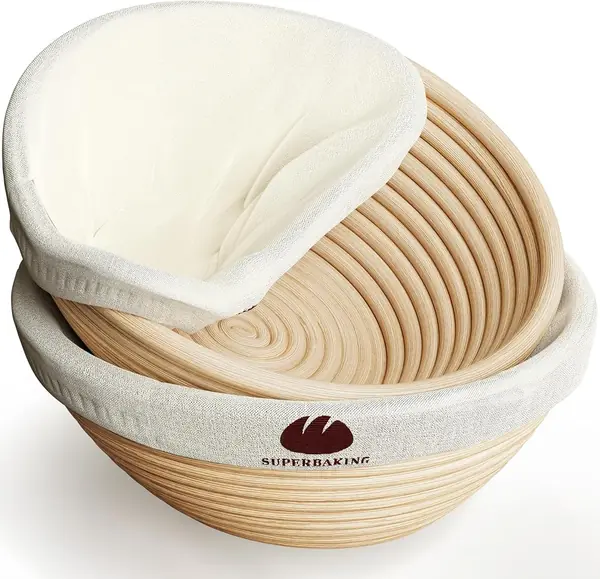
Superbaking two 9-inch round rattan proofing baskets with liners

Beginner two-loaf setup

Bake Score 96/100
Material
Indonesian rattan
Set Contents
2 baskets, 2 liners
Basket Size
9 inches round
Extras
Recipes and manual
View on Amazon

Superbaking's packaging reads like a starter kit, but the useful part is simpler: two 9-inch round rattan baskets, two liners, and a recipe booklet. That combination makes sense for someone who is still deciding whether sourdough will become a habit. The second basket is the practical advantage—you can proof two boules at once, or keep one dough in the fridge while the other bakes, without buying another product. The guidance is there for the first few loaves, when the process still feels like a lot of steps.

The polished rattan is meant to be splinter-free, and the basket has the shallow, ridged profile that gives a boule its spiral. We appreciate that the liners are included rather than sold separately, because the liner is what makes a new basket forgiving: flour it well, and a wet dough is less likely to weld itself to the cane. The recipe booklet and app access are nice extras, but we do not think anyone should buy this set for the app. The baskets are the reason it earns a place.

Durability is the caveat. Natural rattan is variable, and some baskets arrive rough or develop splits with use, so run a hand around the inside and check the rim before the first proof. That is not enough to knock the set out of contention, especially for a beginner who wants two baskets and some hand-holding in one purchase. Just treat it as a working basket, not an heirloom, and keep it dry between bakes.

Worth Noting

  • Rattan can arrive rough or split
Our Verdict

We steer new bakers to this set for two baskets, liners, and recipe guidance in one box, provided they inspect the rattan on arrival.

Check Latest Price
3

EWFEN Sourdough Proofing Basket Gift Set Best Round-And-Oval Set

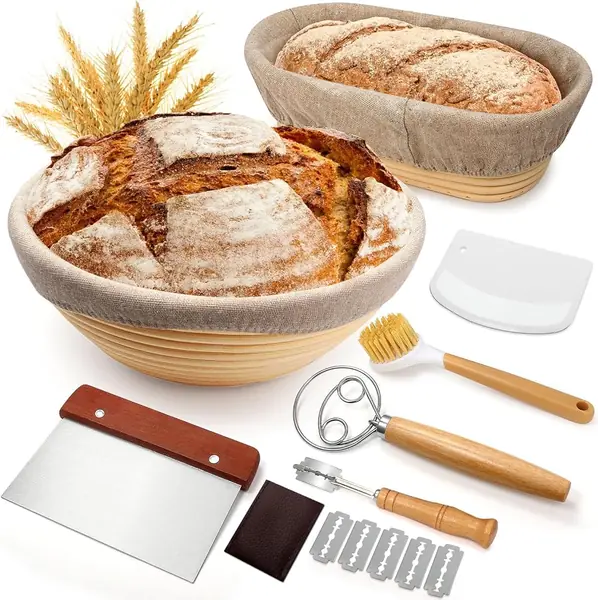
EWFEN round and oval rattan proofing baskets with baking tools

Round and oval

Bake Score 95/100
Material
Indonesian rattan
Set Contents
9 pieces including 2 liners
Basket Sizes
9-inch round, 10-inch oval
Included Tools
Lame, whisk, scrapers, brush
View on Amazon

The round-and-oval pairing is what makes the EWFEN set worth a look. A 9-inch round handles a classic boule; a 10-inch oval is the better shape for batards, sandwich loaves, and any dough that wants to stretch rather than sit up. We like having both in one purchase because buying a second shape later often means buying another pair, another set of liners, and another box to store. The two liners are included, and the oval basket is the harder one to find a liner for on its own.

The rest of the nine-piece kit is a mixed bag. The lame, Danish whisk, bowl scraper, sourdough scraper, and cleaning brush make this a ready-made gift, and a new baker can use all of them. But the tools are the part we trust least: they feel like starter accessories, and the whisk and blades are the pieces most likely to disappoint. We treat them as a bonus, not a reason to choose the set. The rattan baskets themselves are the durable core, with a smooth finish and enough structure to hold a shaped dough.

Size is the other thing to check. The round is standard, but the oval is a moderate 10-inch length, so it suits a normal batard rather than a very long one. If you already have a round basket and only need an oval, buy an oval pair. If you are starting from nothing, this set covers both shapes and gives you a few tools to grow into. That breadth is why it stays on our list.

Worth Noting

  • Included tools feel entry-level
Our Verdict

We like this set for bakers who want both a round and an oval basket, with basic tools included as a convenience rather than the main event.

Check Latest Price
4

DOYOLLA Oval Proofing Baskets Best for Oval Loaves

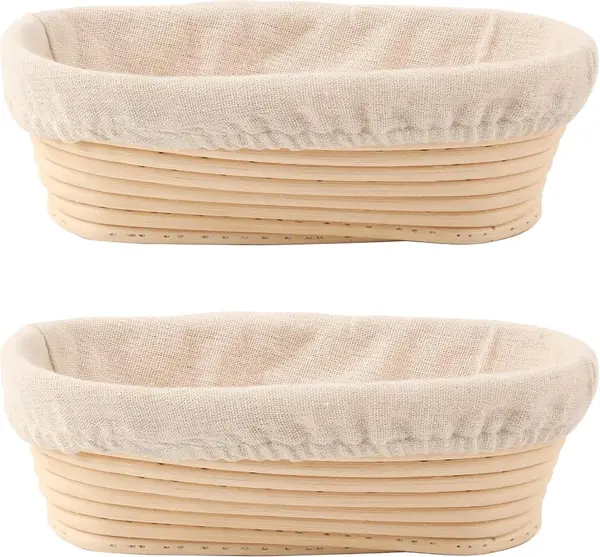
DOYOLLA two oval rattan proofing baskets with cloth liners

Long oval loaves

Bake Score 94/100
Material
Natural rattan
Set Contents
2 baskets, 2 liners
Basket Size
10 x 6 x 3 inches
Shape
Oval
View on Amazon

An oval basket changes the loaf before it ever reaches the oven. DOYOLLA's pair is 10 inches long and 6 inches wide, which is the right ballpark for a batard that will fit a standard oval Dutch oven. The longer footprint suits sandwich loaves and sourdough that you plan to slice across the middle rather than cut into wedges. Two baskets also mean you can proof a pair, bake one, and hold the other in the fridge without reusing a basket that is still damp.

The baskets are natural rattan with the usual ringed interior, and the liners are included. We prefer the bare basket when we want the diagonal flour pattern, and the liner when the dough is wet enough to worry about sticking. The liner is also the weak point: it can sit loosely in the oval, and some liners tear at the seams after washing. Fit it carefully, hand-wash it, and do not expect it to stay pristine. The basket itself is the sturdier part.

The size deserves a tape measure. A 10-inch oval is a moderate batard basket, not a giant one, and a very large dough will fill it quickly. Check the interior of your Dutch oven and the length of the loaves you usually bake. If you make round boules, this is the wrong shape; if you make long loaves and want two baskets, it is a focused choice. We reach for it when the loaf is meant to be sliced, not torn.

Worth Noting

  • Liners can fit loosely or tear
  • Moderate size limits very long loaves
Our Verdict

We choose the DOYOLLA oval pair when the loaf is a batard, not a boule, and we accept the fussier liner for the shape.

Check Latest Price
5

Saint Germain Round Banneton Best Budget Single Basket

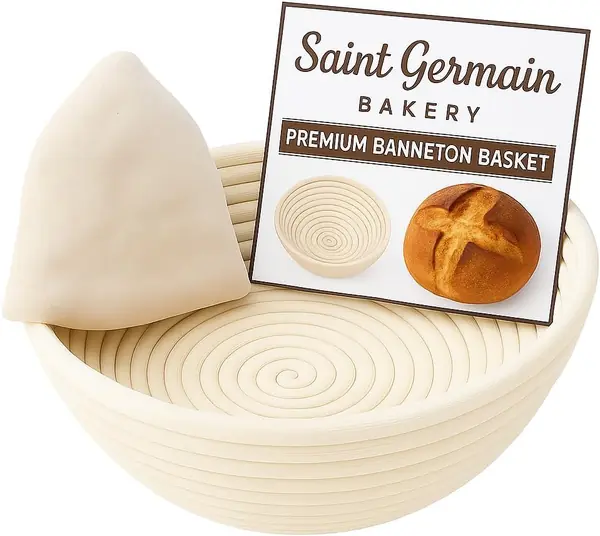
Saint Germain single round rattan proofing basket with liner

First single basket

Bake Score 93/100
Material
Natural rattan
Set Contents
1 basket, 1 liner
Basket Size
9 inches round
Finish
Nonstick
View on Amazon

A single basket is a sensible first purchase if you are not sure how often you will bake. Saint Germain's 9-inch round is the standard size for a medium to large boule, and it comes with a cloth liner, so you can start without buying anything else. It takes up less shelf space than a pair, and it costs less than most sets here. For someone who makes one loaf a week, that is enough.

The basket is natural rattan with a nonstick finish, and the liner gives you a softer crust and an easier release. Use the liner for wet dough or for a smoother surface; use the bare basket when you want the spiral. The 9-inch diameter fits most Dutch ovens, and the shallow walls support a shaped dough without burying it. It keeps the decision simple: one basket, one liner, one loaf at a time.

The obvious trade-off is capacity. If you bake two loaves a week, a single basket leaves you waiting for one to finish proofing before you start the next. We also want to see the rim before the first use, because natural rattan can arrive rough or splintered. Those are reasons to check the basket, not reasons to avoid it. As a low-cost entry point, it does the job without extra clutter, and it is the easiest way here to find out whether you enjoy the proofing routine.

Worth Noting

  • Single basket limits batch baking
  • Rattan can arrive rough or splintered
Our Verdict

We point first-time bakers to this single basket when they want to try sourdough without buying a pair.

Check Latest Price
6

SnailDigit Banneton Set Best for Smaller Boules

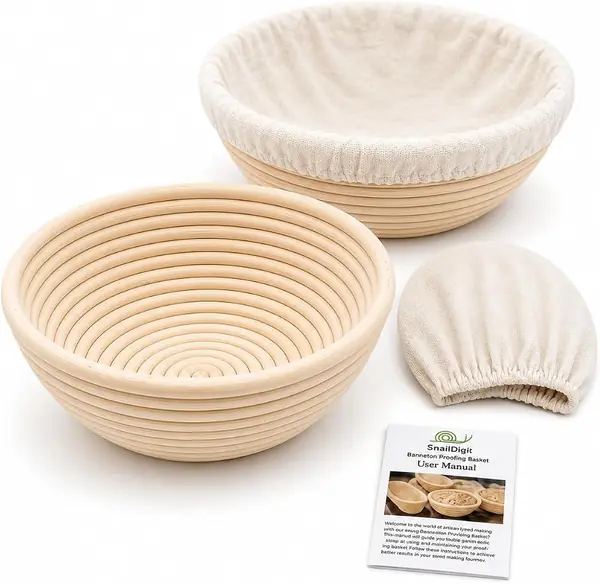
SnailDigit two round rattan proofing baskets with cotton liners

Smaller boules

Bake Score 92/100
Material
Indonesian rattan
Set Contents
2 baskets, 2 cotton liners
Basket Size
9 x 9 x 3.14 inches
Dough Capacity
1.5 lb
View on Amazon

A 1.5-pound dough capacity sounds limiting until you match it to the pot you actually own. SnailDigit's pair is 9 inches across and about 3 inches deep, which suits the 4- to 4.5-quart Dutch ovens many home bakers use. The baskets come with cotton liners, and the polished rattan is meant to release cleanly with a flour dusting. The size is right for everyday boules: a loaf that fits a smaller pot is easier to handle and bakes through without a long, stressful finish.

The cotton liners are a step up from the thin cloth on some cheaper sets. They hold flour well, wash simply, and give the dough a smooth surface if you prefer a softer crust. The baskets themselves have the standard ringed pattern, so you can proof bare when you want the spiral. The 9-inch diameter is narrow enough to feel secure in a smaller Dutch oven, while still leaving room for a normal boule to rise. The polished finish feels smoother than the rougher cane on budget baskets.

What we do not like is the ceiling. If your standard dough is closer to 2 pounds, this basket will feel cramped and the loaf can climb rather than hold a wide shape. Natural rattan can also splinter with use, so keep an eye on the rim. Buy it for moderate loaves and smaller ovens, not for giant bakery-style boules. For that buyer, it is a sensible match.

Worth Noting

  • Capacity tops out at 1.5 pounds
  • Rattan may splinter over time
Our Verdict

We recommend this pair for moderate 1.5-pound boules that fit smaller Dutch ovens, not for oversized bakery loaves.

Check Latest Price
7

KneadAce Cotton Rope Banneton Set Best Space-Saving Design

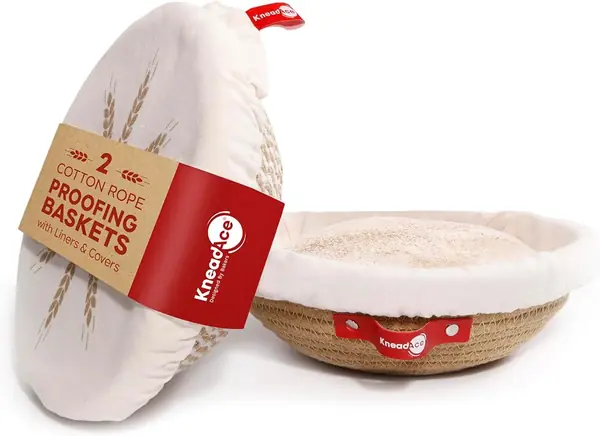
KneadAce two cotton rope proofing baskets with liners and covers

Small kitchens

Bake Score 91/100
Material
Cotton rope
Set Contents
2 baskets, 2 liners, 2 covers
Basket Size
9 inches round
Care
Machine washable
View on Amazon

Cotton rope is a different animal from rattan. It is softer, foldable, and machine washable, which makes the KneadAce pair the easiest basket here to store in a small kitchen. The baskets come with liners and double-layered covers, so you can proof in the fridge without hunting for a shower cap or a plate that fits. The covers turn the basket into a self-contained proofing setup, which is more useful than it sounds.

The round shape is a standard 9-inch, and the cotton rope has enough structure to hold a shaped dough without collapsing when you move it. The fabric releases the dough with a light dusting of rice flour, and the liners add another layer of insurance for wet dough. Because the whole set is machine washable, it is also the one here that does not demand the same dry-storage ritual as rattan. That is a real convenience if your kitchen runs humid or your baking gear lives in a cupboard.

The trade-off is the imprint. If you bake sourdough for the spiral, the cotton rope will not give you the crisp rings that a cane basket does. It is better for a soft, even surface and for bakers who care more about release and cleanup than about the pattern. The seams are also the weak point, so wash on a gentle cycle and air-dry. A torn seam is not a safety issue, but it does shorten the set's life.

We recommend this pair when storage is the constraint. It folds flat, hangs from its attached loop, and goes into the wash after a messy proof. For a small apartment or a fridge that is already full, that is worth more than a traditional look. Just do not buy it expecting the same crust detail as rattan.

Worth Noting

  • Softer imprint than rattan
  • Seams can fail with washing
Our Verdict

We keep this cotton-rope pair for small kitchens and fridge space, not for bakers who want a sharp rattan spiral.

Check Latest Price
8

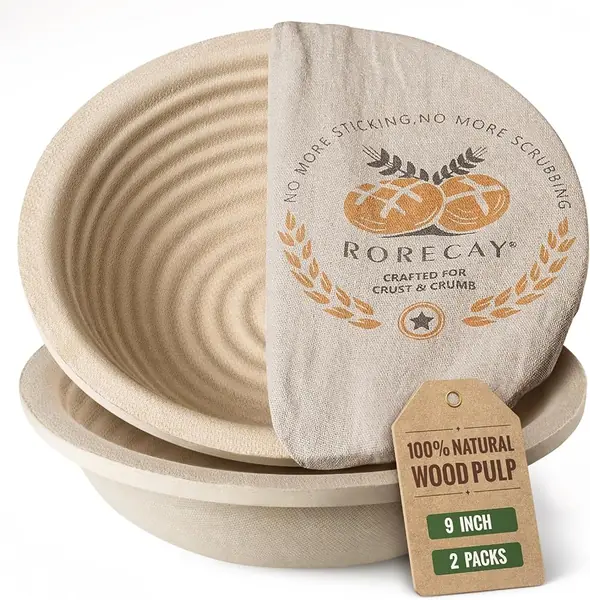
rorecay Wood Pulp Banneton Set Best for No-Liner Proofing

rorecay two round wood pulp proofing baskets with linen covers

No-liner proofing

Bake Score 90/100
Material
Wood pulp
Set Contents
2 baskets, 2 linen covers
Basket Size
9 x 9 x 2.2 inches
Dough Capacity
2.2 lb
View on Amazon

Rorecay's baskets are made from wood pulp, not rattan, and that changes the way they work. The material is porous and thick-walled, designed to pull moisture away from the dough and hold a steadier temperature; the basket also needs no cloth liner, just a flour dusting. The 2.2-pound capacity gives a larger boule room to spread, and the two linen covers are useful for the fridge.

The wood pulp has a matte, almost papery surface that will appeal to bakers who do not want to fuss with cane. It is also biodegradable, which is a nice bonus if that matters to you. The basket can be used bare, because a liner is one more thing to wash, dry, and lose. The covers are the useful extra here: they keep the dough from drying out without plastic wrap.

The trade-off is the hand-feel. Wood pulp is not going to look or behave like a woven cane basket, and the rim can be more vulnerable to chipping if it is knocked around. It also has a shallower 2.2-inch wall than the rattan baskets here, so a very tall dough may dome above the rim. Those are real limits, but they matter most if you bake oversized loaves or treat your gear roughly.

We reach for this pair when we want a large boule and a no-liner proof. It is not the classic choice, and it will not give the same crisp spiral as rattan, but it is the easiest basket here to wipe clean and the one that needs the least seasoning. If you already have a rattan basket for show loaves, this is a practical second set for everyday baking.

Worth Noting

  • Can chip or crack if knocked
  • Shallower wall than rattan baskets
Our Verdict

We recommend this wood-pulp pair for large, no-liner boules and for bakers who prefer a low-fuss proofing routine.

Check Latest Price

How We Tested 14 Proofing Baskets

We started by reading through listings and long review threads to see which baskets sourdough bakers keep coming back to, then filtered by the things that actually change a bake: 9-inch round versus 10-inch oval, rattan versus cotton rope versus wood pulp, how tightly the coils were wound, and whether a liner, lame, scraper, and whisk came in the box. Fourteen baskets made the cut, and we baked with them for four months.

Every basket got the same treatment: a 78-percent-hydration dough, an overnight retard in the fridge, and a turn-out onto parchment the next morning. We weighed the dough before and after the flip to see how much stayed stuck to the coils, and noted whether the spiral pattern came out crisp or smeared. We also checked that a 1 kg boule genuinely fit a 9-inch round without climbing the rim, and that batard-shaped dough ran the length of the ovals instead of pooling in the middle.

After each bake we brushed and aired the baskets, washed the liners, and stacked the sets in a cabinet to see how much shelf space a pair eats. Across four months we watched for splinters, loose staples, and coils that sagged or split, and checked liners for shrinkage, pilling, and frayed seams. On arrival day we counted every piece in each box against its listing, since a kit missing its scraper isn't the bargain it looked like online. Price only counted once a basket had survived all of that.

How to Choose Sourdough Proofing Baskets

Start With the Loaf, Not the Diameter

A banneton's job is to support a shaped dough while it ferments, so the basket should be slightly wider than the loaf you want. A 9-inch round is the default for a 1.5- to 2-pound boule; an 8.5-inch basket suits smaller loaves, and a 2.2-pound capacity gives a large dough room to spread. If the basket is too small, the dough climbs and the baked loaf turns tall and tight. If it is too wide, the dough spreads flat and loses height.

Check the interior dimensions, not the package size. A basket listed as 9 inches may measure across the rim, and the usable base is smaller. Set a ruler across the top and compare it with the base of your Dutch oven. That is the quickest way to avoid a basket that fits the shelf but not the loaf.

Round or Oval? Match the Shape You Slice

Round baskets make boules, the classic high-domed loaf. Oval baskets make batards, which slice into more even pieces and fit oval Dutch ovens. If you bake sandwich bread or long sourdough, an oval is the more useful shape; if you want the classic spiral-topped boule, choose round. The EWFEN set covers both shapes, while the DOYOLLA pair is the focused oval choice.

Do not assume two baskets of the same nominal size are identical. An oval's length and width matter more than its diagonal, and a 10-inch oval is a moderate loaf, not a giant one. Match the outside of the basket to the inside of your pot, and match the inside to the dough weight you mix most often.

Liners Are a Tool, Not a Requirement

A cloth liner gives you a smoother crust and a more forgiving release, especially with wet dough. A bare rattan basket gives you the spiral pattern and a slightly drier surface. You can use either, but flour the liner as carefully as the basket; a liner that is damp or under-floured will stick. We prefer washable liners for beginners because they make the first few bakes less stressful.

Rice flour is the better choice for dusting because it does not absorb into the dough as readily as wheat flour. If you use the bare basket, build up a light coating over the first few uses and never soak the rattan. Follow the maker's care instructions; some liners are machine washable, while rattan should stay dry.

Rattan, Wood Pulp, or Cotton Rope

Rattan is the traditional choice: it is rigid, breathable, and leaves the crispest spiral. It also needs dry storage and can arrive rough. Wood pulp is thicker and more porous, designed to manage moisture without a liner, but it can chip and has a shallower wall. Cotton rope is the most flexible and washable, though it leaves a softer imprint. Choose rattan for the classic look, wood pulp for low-fuss moisture control, and cotton rope for small kitchens.

The material affects care more than it affects the basic proof. Any basket holds a shaped dough; the difference is how much flour, washing, and storage it demands. That is why the KneadAce set folds flat and the rorecay pair can be used without a liner, while a rattan basket rewards a dry cupboard and a brush.

Inspect the Finish and Plan for Storage

Before the first proof, run a finger around the inside of a rattan basket and check for splinters, loose staples, or gaps. A rough spot can end up in your dough, so return a basket that feels unsafe. After each bake, shake out the flour and let the basket air-dry completely before stacking it. Trapped moisture is the main enemy of any natural basket.

Storage is part of the purchase. Round baskets stack, oval baskets take more shelf length, and cotton rope folds flat. If your kitchen is short on space, the KneadAce set collapses; if you have a dry cupboard, a stack of rattan is easy to live with. Measure the shelf before you fall for a pair.

Frequently Asked Questions

Final Verdict

KooK is our default because two 9-inch baskets and washable liners cover the most common sourdough routine without extra gadgets. If you bake batards, the DOYOLLA oval pair is the better shape; if you want one inexpensive basket to test the habit, Saint Germain is the low-risk entry. For a small kitchen or a humid cupboard, the KneadAce set folds flat and goes into the wash. Start with the shape and capacity you actually bake, and the rest of the choice gets simple.