The 4 Best Offset Bread Knives of 2026

A serrated bread knife doesn't slice so much as saw, and that's the point: the teeth bite into the crust and break through it before the soft crumb underneath has a chance to squash. The offset handle is the other half of the trick — it drops the blade below your knuckles so you can bear down on a tall boule without scraping your hand across the top. The catch is that a knife which glides through a bagel can mangle brioche, and one that feels razor-sharp in week one may be dragging by spring.

We cut crackly sourdough, supermarket sponge cake and everything in between with 12 offset bread knives. The gaps showed up fast — in how cleanly each knife finished a slice, how the handle felt after a dozen cuts, and whether the edge still bit by the time the loaf was gone. One thing worth knowing before you shop: serrated edges don't respond to a honing steel the way a chef's knife does, so a blade you can touch up yourself is a genuine advantage.

Our Top Picks

The Best Offset Bread Knives

1

Mercer Culinary Millennia Offset Bread Knife Best Overall
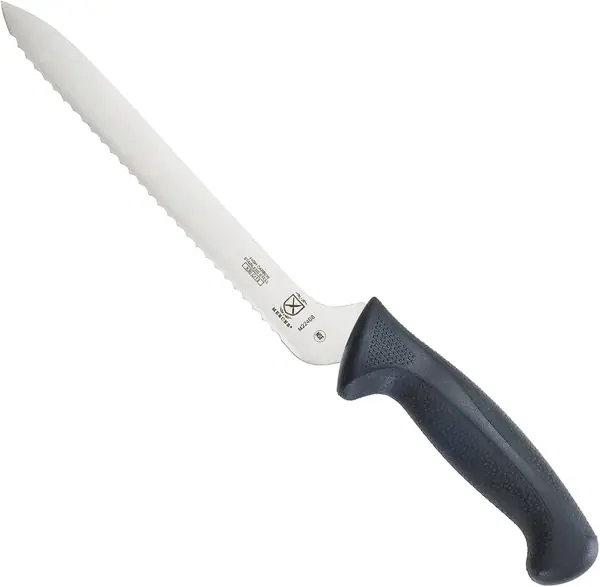
Mercer Culinary Millennia 8-inch offset bread knife with black textured Santoprene handle and wavy serrated blade

Everyday loaves

Bake Score 95/100
Blade Length
8 inches
Handle
Textured Santoprene
Weight
5.3 oz
Edge
Serrated, wavy
View on Amazon

The offset is the whole reason this knife exists, and the Millennia uses it properly. The handle sits high enough that our knuckles pass over the cutting board when the blade reaches the bottom crust, so we finish the slice instead of stopping short and leaving a hinge of uncut bread. On a round boule that is the difference between a clean slice and a torn one.

The 8-inch wavy edge handles everything from a soft sandwich loaf to a hard-crusted sourdough without levering the crumb apart, and the teeth are fine enough that we do not switch knives for tomatoes or angel food cake. Eight inches is also the length most home bakers actually need, since anything longer starts to feel like a commitment on a small board. Lean hard into a very dense crust and you can feel a little flex in the blade. It is a 5.3-ounce stamped knife, and that lightness is what makes the last inch of a loaf easy to control.

The Santoprene handle has textured finger points, and that texture earns its keep once your hands are floured: the grip does not slide the way a polished handle does. It is also light enough that a second loaf going into the oven does not feel like a chore to slice.

Mercer covers defects in materials and workmanship for normal kitchen use, which is about the right promise for a knife built to be used daily and washed by hand.

Worth Noting

  • Needs hand washing and prompt drying
Our Verdict

We hand the Millennia to anyone who bakes weekly: the raised handle clears the board and the wavy edge cuts crust without crushing the crumb.

Check Latest Price
2

PAUDIN 10-Inch Offset Bread Knife Best for Wide Boules

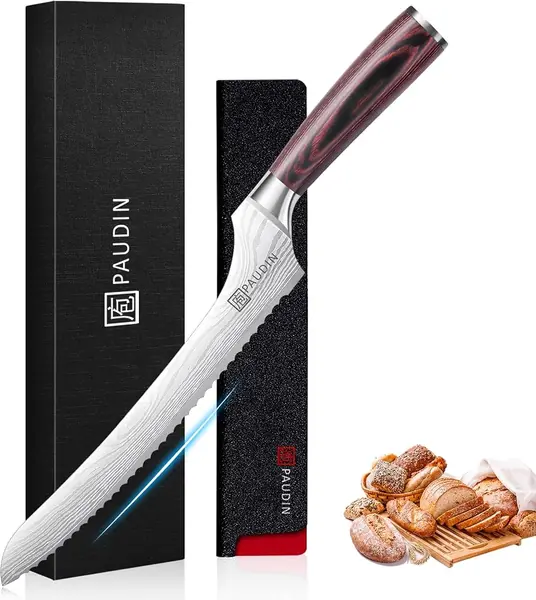
PAUDIN 10-inch offset sourdough bread knife with high-carbon steel blade, scabbard, and gift box

Wide sourdough boules

Bake Score 92/100
Blade Length
10 inches
Weight
8 oz
Includes
Knife and scabbard
Construction
Forged
View on Amazon

Ten inches of blade is the entire personality of this sourdough knife. Across a wide, dense boule it crosses in one draw where an 8-inch blade needs three, and the forged spine does not wander when the crumb is studded with walnuts or cranberries. On a baguette or a small round, that same length is more knife than the job needs, and you will feel the extra steel hanging off the end.

The offset handle does what the marketing promises: your hand rides clear of the board, and the grip stays secure when your palms are sticky with dough. It arrives in a gift box with a scabbard, which makes it the easiest of these to wrap for a baker and the safest to keep in a drawer.

PAUDIN calls it dishwasher safe, and we still wash ours by hand, because a serrated edge that knocks against a rack loses its points faster than one that is rinsed and dried. What we did not expect from a knife this size is how balanced it sits: the weight lands near the bolster, so the long blade does not feel like a reach at the end of a loaf.

Worth Noting

  • Heaviest knife in this group at 8 ounces
Our Verdict

We reach for the PAUDIN when the loaf is wide and the crust is serious: a long forged blade that takes a boule in one stroke.

Check Latest Price
3

SYOKAMI 10.5-Inch Offset Bread Knife

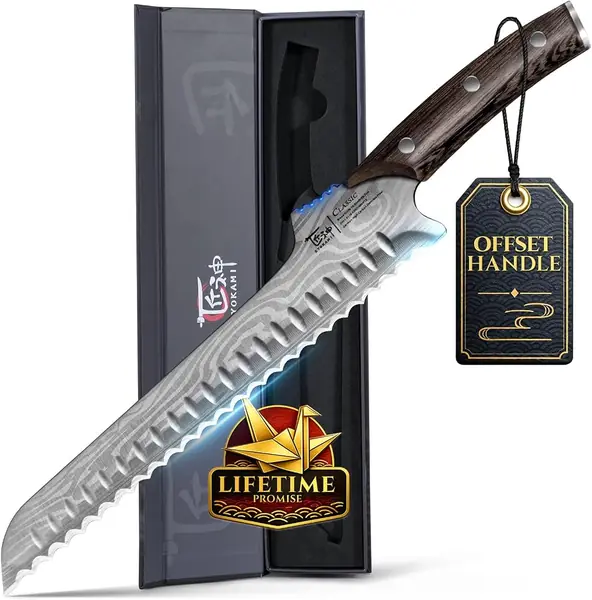
SYOKAMI 10.5-inch offset bread knife with forged serrated blade and wenge wood handle

Keeping it sharp

Bake Score 91/100
Blade Length
10.5 inches
Handle
Wenge wood
Construction
Forged, full tang
Serrations
10.5 mm spacing, resharpenable
View on Amazon

Most serrated knives are disposable in slow motion. Once the points dull, a steel skates across the tops of the teeth and never reaches the gaps between them, which is why so many bread knives get retired while the rest of the drawer keeps working. SYOKAMI's answer is spacing: the teeth sit 10.5 mm apart, wide enough for a standard honing rod to drop into each gap.

That is the most useful thing about this knife, and it is not the only thing. The blade is forged, full tang, and triple riveted, and at 10.5 inches it clears a wide sourdough boule in a single pass. The wenge handle is the grippiest of the four once your hands are covered in flour, and the wavy finish on the blade is the best-looking of this group.

What we did not anticipate is how much the handle changes the feel of a long blade: the wood absorbs a little moisture and stays steady where a slick handle would shift. It wants drying rather than soaking, a small habit to build for a knife you intend to keep.

Worth Noting

  • Longest blade here needs a full-size board
Our Verdict

The SYOKAMI is the one to buy if you plan to keep a bread knife for a decade: those spaced teeth can be honed back to sharp, and the forged blade is planted in the cut.

Check Latest Price
4

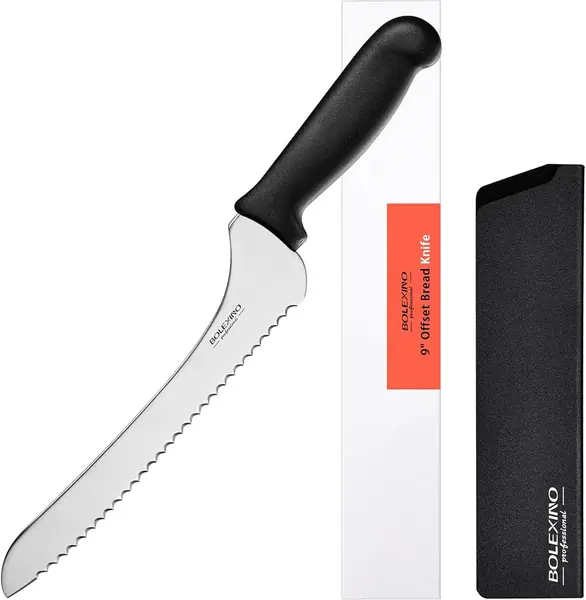
BOLEXINO 9-Inch Offset Bread Knife Best Budget

BOLEXINO 9-inch offset bread knife with black polypropylene handle and included sheath

Tight budgets

Bake Score 89/100
Blade Length
9 inches
Handle
Polypropylene
Weight
5.92 oz
Includes
Knife and sheath
View on Amazon

This is one of the least expensive knives in the group, and it does not behave like a compromise. It is stamped from high-carbon stainless steel and weighs 5.92 ounces, but the handle is shaped rather than just molded, with a curve that sits in the palm instead of under it.

Nine inches turns out to be a sensible middle for a home kitchen: long enough to cross a standard loaf in one stroke, short enough to steer on a bagel. The offset handle does its job, with the blade finishing the bottom crust while your fingers stay clear, and the included sheath is why this is the one we do not think twice about dropping in a drawer.

Where the price shows is rigidity. A thin stamped blade flexes when you lean into a genuinely hard crust, and you feel the difference next to the forged picks. On sandwich loaves, bagels, and the occasional tomato you never notice it, and that is most of what a home baker cuts.

Worth Noting

  • Nine-inch blade runs short on wide boules
Our Verdict

If you want knuckle clearance without spending much, the BOLEXINO is the pick: sharp out of the box, light in hand, and it comes with a sheath.

Check Latest Price

How We Tested the Offset Bread Knives

We built the shortlist by gathering every offset serrated knife we could find — from names we already trust in a busy kitchen and from small brands we'd never handled — then filtering for blade length, handle shape, and how the steel was described. That left 12 knives spanning budget to high-end, and we cooked with them for four months.

Testing happened in our own kitchens, mostly on weekends when the bread actually comes out of the oven, plus weeknight sandwiches and a run of bagel mornings. Each knife went through the same loaf of sourdough: we watched whether the crust shattered cleanly or crushed, whether slices came out even from end to end, and whether the tip could slip under the bottom crust without tearing the crumb. We specifically checked knuckle clearance on a tall boule — the entire reason for an offset handle — and noted which handles turned slick once things got floury.

Sharpness was tracked across the full four months rather than measured once at the start; we logged the point where a knife needed two passes on a tomato or started sawing instead of gliding through a bagel. Every knife was hand-washed and left to air-dry, and we checked the rivets and edge for spotting or rust. We also tried touching up the serrations at home with a round file to see which edges were actually serviceable. Value came down to how the inexpensive knives held against the pricier ones on day one and again on day 120.

How to Choose an Offset Bread Knife

What the Offset Really Buys You

An offset handle lifts your hand above the plane of the blade, so the knife can finish the bottom crust without your knuckles dragging across the board. That is the entire case for the shape. Before you commit, set the knife flat and look at how much room your fingers have underneath: a shallow rise still leaves you stopping short on a dense loaf and sawing sideways to break the last hinge of bread, which is exactly the slice you were trying to avoid.

Rise is not the same as blade depth. A deep blade with a modest offset can put your knuckles closer to the counter than a shallower blade with a tall handle, so judge the gap, not the height of the handle. All four picks here give you real clearance; a decorative bend that barely lifts the grip does not.

Match the Blade to the Loaf You Bake

Longer blades cross wide boules in fewer strokes and stay straight while they do it, which is why the 10- and 10.5-inch knives here suit bakers whose standard loaf is a big round. Length costs you control, though. On a baguette, a bagel, or a small round, an 8- or 9-inch blade is easier to steer and leaves less unused steel hanging past the end of the bread.

Buy for the shape you bake most weeks rather than the occasional showpiece. If you slice sandwich loaves and the odd sourdough, the shorter blade is the one you will reach for; if a wide, high-hydration boule is your regular bake, the extra inches earn their keep.

Plan for a Dull Edge

A serrated edge has to be sharpened from the side that is not there: a rod or stone needs to reach into the gullets between the teeth, and most bread knives are set too closely for that. That is why so many of them get retired while the rest of the drawer keeps working. Wavy, closely set teeth slice cake and tomatoes gently; wider, more pointed teeth grab hard crust.

If you want a knife you keep, look at the spacing. The SYOKAMI's teeth sit far enough apart for a standard honing rod to drop into each gap, which turns a disposable tool into a maintainable one. Everything else here is a knife you use well and eventually replace.

Handles, Weight, and Floured Hands

Weight runs from a little over 5 ounces to 8 ounces across these picks, and it changes how the knife behaves. A heavier forged blade drives through dense dough with less effort; a light stamped one is easier to control on the last inch of a sandwich loaf and less tiring across a long bake.

Handle material matters most when your hands are wet. Textured Santoprene and polypropylene stay put under a floury grip, wood feels warmer and grips well but wants drying afterward, and a smooth polished handle is the one to avoid if you bake with sticky dough.

Frequently Asked Questions

Final Verdict

For most kitchens, the Mercer Culinary Millennia is the offset bread knife to buy. The handle lifts your hand far enough to finish the bottom crust, the 8-inch wavy edge handles a sandwich loaf and a sourdough boule in the same week, and the textured grip holds when your hands are covered in dough.

If your standard bake is a wide, dense boule, the PAUDIN's extra blade length and forged rigidity justify the weight. And if you plan to keep one bread knife for a decade, buy the SYOKAMI: those widely spaced teeth are the difference between a knife you resharpen and a knife you replace.