The 5 Best Jelly Roll Pans of 2026

I've been baking on jelly roll pans for years, and I still think they're the most underrated pan in the kitchen. They're shallow enough for a thin sponge cake, big enough for a weeknight sheet-pan dinner, and easy to haul out for a batch of cookies. The problem is that a poorly made one warps the second it hits a hot oven, sticks to a delicate cake, or feels flimsy when you lift it loaded with vegetables.

We baked through 14 jelly roll pans — singles, pairs, nonstick and bare metal — to see which ones stayed flat, released cleanly, and felt worth the cabinet space. What I care about most is simple: a pan should fit a standard oven rack, clean up without a soak, and still sit flat after a season of Sunday baking. Our five held up in the oven, and in the dishwasher when the maker said it was safe.

Our Top Picks

The Best Jelly Roll Pans

1

Nordic Ware Naturals Jelly Roll Pan Best Overall
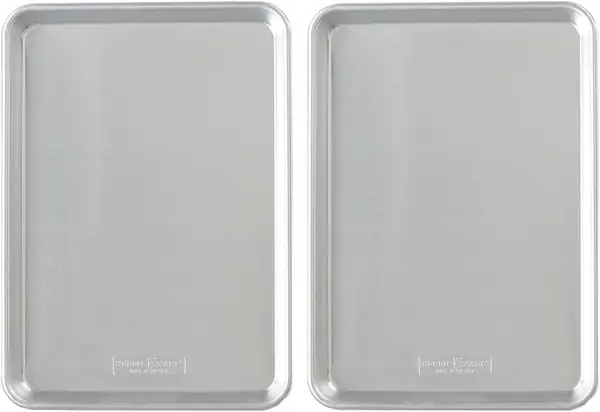
Two Nordic Ware natural aluminum jelly roll pans with rolled rims, stacked

Jelly rolls and cookies

Bake Score 96/100
Material
Pure aluminum, uncoated
Exterior Dimensions
11.3 x 15.8 x 1 inches
Care
Hand wash
Cooking Surface
10.5 x 15 inches
View on Amazon

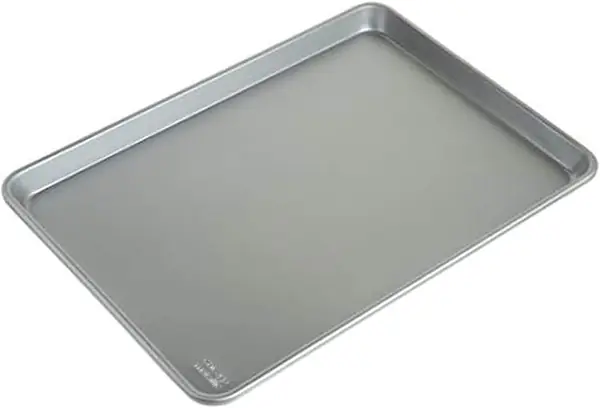
Bare aluminum with nothing sprayed or baked onto it is the whole argument for the Nordic Ware Naturals pan, and it is why this one sits at the top of our list. Aluminum moves heat faster and more evenly than the steel blends under most nonstick coatings, so a thin sponge sets at the same rate in the middle as it does at the corners. The cooking surface measures 10.5 by 15 inches, the standard jelly roll footprint, inside an exterior of 11.3 by 15.8 by 1 inch that also slides into a European-size or countertop oven.

The rim is a steel band encapsulated in the aluminum, and you can feel why that matters when you lift a corner with a full batter in the pan: it stays flat instead of oil-canning. We line ours with parchment for sponges mainly because the overhang gives you handles to lift the cake out, and the bare surface takes a smear of butter for cookies without any fuss.

What you give up is convenience. There is no nonstick layer, so nothing releases on its own, and the pan is hand wash only, because the dishwasher leaves the aluminum chalky and dark. It also stains: cocoa, tomato, and lemon all leave their mark, though the marks don't change how it bakes. The two-pack costs more than one coated pan here, and it's worth it, both for the second pan when you bake rolls in sequence and for the fact that there is no coating that can start lifting at the rim.

Worth Noting

  • Hand wash only; dishwasher dulls the finish
  • Nothing releases on its own without a liner
Our Verdict

Our top pick: two bare-aluminum pans that bake evenly, take parchment happily, and have no coating to chip, for bakers who prefer lining a pan to replacing one.

Check Latest Price
2

USA Pan Jelly Roll Pan Best Nonstick

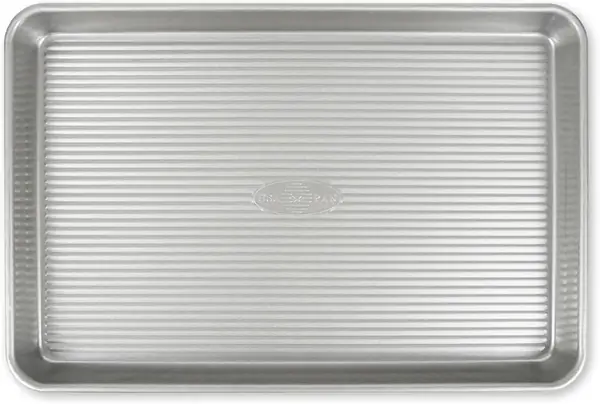
USA Pan aluminized steel jelly roll pan with corrugated nonstick surface and rolled edges

Easy-release baking

Bake Score 95/100
Material
Aluminized steel, silicone nonstick
Exterior Dimensions
14.25 x 9.88 x 1 inches
Weight
1.9 lb
Oven Safe
450°F
View on Amazon

Where the Nordic Ware pans want a liner, the USA Pan jelly roll pan is the one we grab when we want a cake to let go on its own. The corrugation is doing quiet work: those wavy channels hold the baking floor slightly off the base, air moves underneath, and the silicone nonstick coating releases a warm sponge with a flex of the pan. It is aluminized steel, oven safe to 450°F, and light enough at 1.9 pounds to pull out of the oven one-handed.

The release is what sold us. A sponge comes away with clean edges instead of the torn corners you get when a surface grabs, and cleanup is a rinse and a wipe rather than a soak. We also ended up using it more than we expected for roasted vegetables and wings, where the channels keep food up out of its own juices.

Two things to know. The pan measures 14.25 by 9.88 inches, a touch smaller than the 15-by-10 that most jelly roll recipes assume, so a cake baked here comes out slightly thicker and wants another minute or two. That smaller size is also why it's the one here that slides into a countertop oven. And like any nonstick, the coating is the part that ages, so keep metal tools and sharp cutters off it; a scored surface is a surface that starts lifting at the edge.

Worth Noting

  • Can flex at 350°F and above
Our Verdict

Our pick for easy release: the corrugated nonstick surface lets a warm sponge lift cleanly, and it's the pan we reach for when we don't feel like cutting parchment.

Check Latest Price
3

Chicago Metallic Jelly Roll Pan Set Best for Big Batches

Two Chicago Metallic aluminized steel jelly roll pans with wire-rod reinforced rims

Big-batch baking

Bake Score 94/100
Material
Aluminized steel, uncoated
Exterior Dimensions
17.75 x 13 x 1 inches
Oven Safe
450°F
Interior Dimensions
16.75 x 12 x 1 inches
View on Amazon

At 16.75 by 12 inches of interior, Chicago Metallic's pan is the biggest jelly roll pan here, close enough to a half sheet that one tray takes a full batch of cookies, a slab pie, or a roulade for a crowd. That capacity is why we keep a pair of them: two pans on one rack cover nearly anything a home oven can do, and the wire-rod reinforced rims are what keep them flat when a recipe runs at 450°F.

It is uncoated aluminized steel, which is the right call if you bake hot and often. There is no layer to score or lift, and it browns the bottom of a sponge deeply and evenly; focaccia, bread, and roasted vegetables come out with more color than they get on a coated pan. It's also heavy, in the way that a pan that resists buckling needs to be, and the rolled edges give you a real grip with a mitt.

The catch is the footprint. The exterior measures 17.75 by 13 inches, so measure your oven before you commit: it fills a standard rack and won't go anywhere near a countertop or toaster oven. If your oven is small, or you bake rolls one at a time, a 15-by-10 pan suits you better; if you bake in volume, this is the set that keeps up, and the second pan means a batch is always ready to go in.

Worth Noting

  • Uncoated surface needs greasing and stains
Our Verdict

We recommend it to anyone who bakes in volume: nearly half-sheet capacity, rims that stay flat at 450°F, and no coating to lift, in a pan that asks for a full-size oven.

Check Latest Price
4

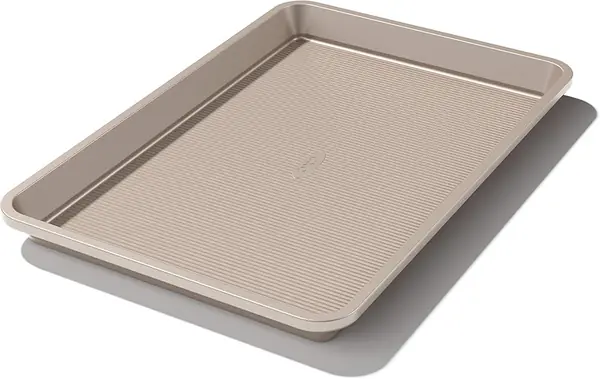
OXO Good Grips Non-Stick Pro Jelly Roll Best for Small-Batch Rolls

OXO Good Grips nonstick jelly roll pan with micro-textured surface and square rolled edges

Small-batch rolls

Bake Score 93/100
Material
Aluminized steel
Care
Dishwasher safe
Coating
2-layer ceramic-reinforced nonstick
Listed Size
10 x 15 inches
View on Amazon

The name says 10 by 15, and the flat floor inside the pan says otherwise. OXO's sloped sides pull the usable surface in noticeably, so a standard jelly roll recipe spreads thicker here than it does on the Nordic Ware pan and needs a little longer in the oven. Measure the interior before you plan a rolled cake around a specific recipe, or expect a shorter, fatter roll.

What we came around on is the surface. The micro-textured pattern keeps a delicate sponge from sealing to the metal, and the two-layer ceramic-reinforced coating releases a warm cake with a gentle flex, so the texture is doing as much work as the chemistry. Square rolled edges give you something to hold with a mitt, which matters more than it sounds when you're pulling a pan of liquid batter out level.

It's also the pan here we're happiest to put in the dishwasher, which is a real convenience in a category that mostly asks for hand washing. Bars, small rolls, a weeknight tray of vegetables: this is a good pan for small-batch baking, especially in a kitchen where the sink fills up fast.

Worth Noting

  • Coating can peel under heavy use
Our Verdict

A good small-batch pan whose textured surface genuinely helps a sponge release, and the easiest one here to clean if you have a dishwasher.

Check Latest Price
5

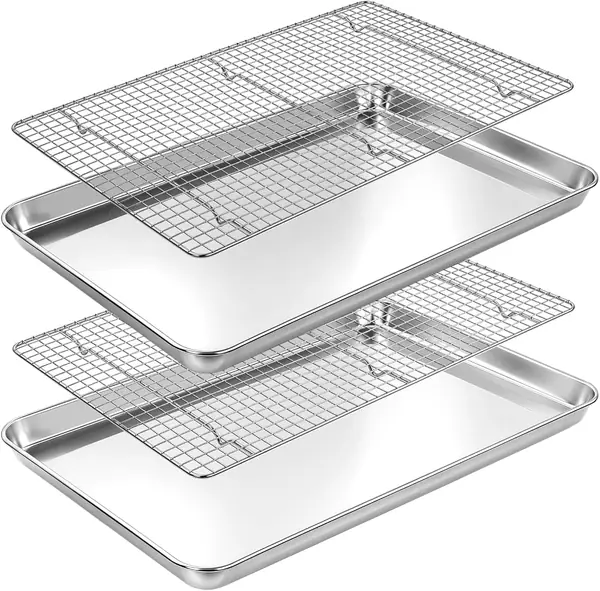
CEKEE Jelly Roll Pan Set Best for Baking with Racks

CEKEE stainless steel jelly roll pan set with two pans and two wire racks

Baking with racks

Bake Score 92/100
Material
Stainless steel, uncoated
Weight
4.5 lb
Pan Size
15.94 x 12 x 1 inches
Set Contents
2 pans, 2 racks
View on Amazon

Four pieces arrive: two 15.94-by-12-inch stainless pans and two fitted wire racks. The pans are uncoated commercial-grade stainless with a mirror polish, the racks sit down into the pan so they don't skate around, and the whole set weighs 4.5 pounds. Both parts are dishwasher safe, which is rare enough in this group to be worth pointing out.

The racks are what earn the shelf space. They cool cookies without steaming the bottoms, they lift a roast out of its fat, and they turn a pan into a broiler tray for bacon and wings. The pans themselves run wider than a classic jelly roll at 12 inches, so check your rack width first: two fit side by side in a standard oven, but neither fits a toaster oven.

The pans can flex and pop above 350°F, which lands right in jelly roll territory, so we treat this as sheet-pan and cooling gear rather than the set we trust with a sponge cake that has to look clean. We've stopped reaching for it when a cake is the point and started reaching for it for everything else, and the racks alone justify the cabinet space.

Worth Noting

  • Pans can warp above 350°F
  • Wider 12-inch footprint than a standard pan
Our Verdict

We recommend this set for roasting, bacon, and cooling rather than rolled cakes, since the pans can flex at the temperatures a sponge needs.

Check Latest Price

How We Tested Jelly Roll Pans

We started with bakeware lines known for aluminized and stainless steel, compared listed dimensions, rim construction, and price, and cut anything that looked too shallow or too fussy for a standard home oven. That left 14 pans—singles, pairs, nonstick and bare metal—which we used for six months.

During those six months, the pans stayed in a home kitchen rather than a lab. We baked jelly rolls and sponge cakes, roasted vegetables at 425°F, made sheet-pan chicken with a sticky glaze, and baked cookies. When a cake came out, we rolled it while still warm to see whether the surface grabbed the crumb; after dinner, we cleaned pans with hot soapy water and a soft sponge, and sent them through the dishwasher only when the maker allowed it.

Quality showed up in the details: how rigid the rim felt, whether the coating went on evenly, and whether the corners were finished. To judge sturdiness, we loaded each pan with root vegetables and lifted it one-handed from the oven; pans that flexed or bowed got marked down. For warping and durability, we checked every pan against a straightedge before first use and after high-heat cycles, listened for the pop that means a pan has buckled, and tracked scratches, coating wear, and rough edges over repeated washes. Size was measured inside and out, then checked against parchment and a standard oven rack. For nonstick, we noted whether a delicate cake released without parchment and whether baked-on glaze needed a soak. Value came last: we compared what each pan cost against how it performed after six months, not just what it looked like on day one.

How to Choose a Jelly Roll Pan

Measure the Inside, Not the Name

Nearly every pan in this shape is sold as a 15-by-10, and almost none of them give you 15 by 10 of flat baking surface. Sloped sides eat into the floor, and some pans taper harder than others, which is why a batter that fills one pan to a quarter inch can bake up half again as thick in another. Measure the flat interior before you commit.

If your pan comes in short, scale the recipe down or plan on a few extra minutes in the oven. Nordic Ware states its cooking surface at 10.5 by 15 inches; the OXO's sloped sides pull its flat area well inside its label, which changes what a standard recipe does in it.

Coated or Bare Metal

The real choice comes down to how you feel about parchment. A nonstick pan such as the USA Pan or the OXO lets a sponge release with a flex of the pan, which is a genuine help with sticky batters and a quick cleanup. Bare aluminum or aluminized steel, like the Nordic Ware and Chicago Metallic pans, has no layer to scratch or lift, browns more deeply, and asks for grease or a liner every time.

We line a jelly roll baking sheet with parchment regardless, because the overhang is how you lift the cake out in one piece. That makes a coating worth less here than it is on a cookie sheet, and it is why our top pick has none.

Warping Is the Spec Nobody Prints

A pan warps when thin metal meets a fast temperature change, and the pop you hear is the floor going convex. Once it happens the pan rocks, browns unevenly, and never lies flat again. Look for a reinforced rim, whether that is a wire rod or steel encapsulated in the casting, and pick the pan up before you buy: weight is the best proxy you have for gauge.

Then treat it kindly. Don't set a hot pan on a wet counter or run it under cold water, and keep coated pans out from under the broiler, where direct radiant heat does damage a 450°F oven never will.

Fit Your Oven, Then Your Sink

Exterior dimensions decide whether a pan is usable in your kitchen, and they are the number sellers bury. A 17.75-by-13-inch pan needs a full-size oven and most of one rack; one built to European oven sizes, like the Nordic Ware at 11.3 by 15.8 inches, will fit a countertop model. Check the flat width of your oven rack and the inside of your sink, since a pan that won't lie flat in the sink gets washed at an angle.

Two pans are worth it if you bake rolls in sequence, because one can cool while the next one bakes.

Frequently Asked Questions

Final Verdict

If you bake jelly rolls more than once a year, the Nordic Ware Naturals two-pack is the purchase we stand behind: bare aluminum that browns evenly, rims that hold flat, and no coating that can peel into a cake. Line it with parchment, wash it by hand, and it will outlast every nonstick pan in the drawer.

The one reason to go elsewhere is release. If you want a pan you can butter and bake in without cutting parchment, the USA Pan is the one we reach for, and its shorter length is an advantage in a compact oven rather than a compromise.