The 4 Best Glass Mixing Bowls of 2026

The fear with glass mixing bowls is a very specific one: you pour hot melted butter into a cold bowl and hear a faint tick. That tick is the whole story. Glass usually cracks for one reason — a fast temperature swing — so the bowls that survive everyday abuse are the tempered ones, evenly formed, with thick walls and no thin spots at the base. What you get in exchange is a bowl that doesn't hang onto garlic or tomato sauce and lets you watch the butter actually work into the flour.

We mixed, melted, microwaved and scrubbed 12 glass bowls, from squat batter bowls with pouring spouts to four-quart workhorses. Weight was the sleeper issue: a thick-walled bowl feels reassuring right up until you're holding it one-handed with a hand mixer going in the other. Size is where buyers get burned most, since the quart figure on the box usually measures to the rim, not to a line you'd actually fill. Our four run that whole span, from a bowl for one shallot to the one you'll reach for on Thanksgiving.

Our Top Picks

The Best Glass Mixing Bowls

1

Pyrex Essentials 3-Piece Mixing Bowl Set Best Overall
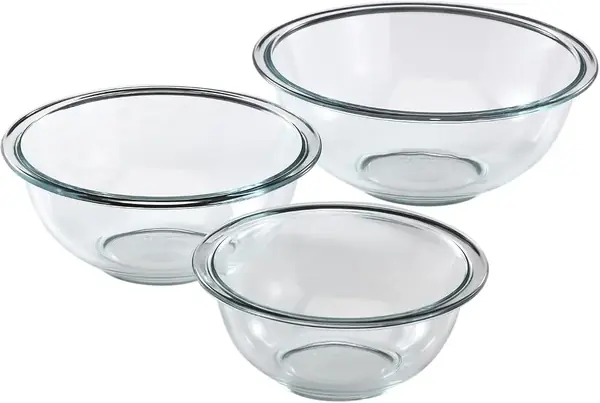
Clear Pyrex Essentials glass mixing bowls in three sizes with round rims

Everyday mixing

Bake Score 97/100
Capacity
1, 1.5, and 2.5 quarts
Material
Tempered glass
Set Includes
Three glass bowls
Heat And Cold Use
Preheated oven, microwave, dishwasher & freezer safe
View on Amazon

Three bowls, three sizes, and no filler: the 1-quart, 1.5-quart, and 2.5-quart Pyrex Essentials set covers the mixing jobs that come up most often. The smallest is right for a single batch of muffins or a couple of eggs, the middle handles cake batter and pancake mix, and the 2.5-quart is the one that stays out for bread dough, big salads, or a double batch of cookies.

That practical range is why this is our default recommendation. In our testing, the clear glass let us watch color and texture as we mixed, and the tempered glass took a whisk and a spatula without complaint. The bowls are simple round shapes that are easy to scrape, and nothing about them asks for special handling beyond the usual care you give glass.

Pyrex lists these as safe for the preheated oven, microwave, freezer, and dishwasher, and that range is more useful than it sounds. We moved the same bowl from melting butter in the microwave to holding dough in the fridge without reaching for another container. The glass resists stains and odors, so cleanup is a quick hand wash or a dishwasher cycle.

We used the largest bowl for a double batch of cookie dough and still had room to fold without flour spilling over the rim. The smaller two are the ones we grab for vinaigrette, chopped vegetables, or a quick serving bowl. The 2.5-quart is the workhorse, and the smaller two keep prep moving without a stack of plastic bowls in the way.

Worth Noting

  • No lids for storage
Our Verdict

We recommend the Pyrex Essentials set as the best starting point for most kitchens: three useful sizes, dependable glass, and no extra pieces to store.

Check Latest Price
2

Pyrex 4-Piece Mixing Bowl Set with Lids Best Set with Lids

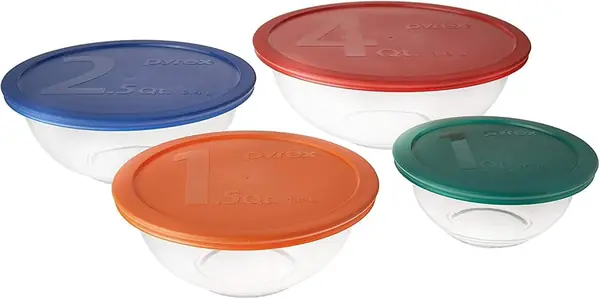
Clear Pyrex glass mixing bowls with four colored plastic lids in assorted sizes

Mixing and storage

Bake Score 96/100
Capacity
1, 1.5, 2.5, and 4 quarts
Care
Dishwasher-safe; lids top rack
Set Includes
4 bowls with 4 lids
Lid Colors
Green, orange, cadet blue, and red
View on Amazon

What separates this Pyrex set from the three-piece Essentials is a lid for every bowl, including the 4-quart. That makes it the set we recommend when mixing and storing are the same job: the 1-, 1.5-, 2.5-, and 4-quart bowls go from batter to fridge without a transfer to another container.

The lids are color-coded and labeled, which sounds like a small detail until you are matching four lids to four bowls. We appreciated that the 4-quart is genuinely large enough for a double batch of bread dough or a big salad, while the smaller bowls handle prep and leftovers. The glass is non-porous, tempered, and dishwasher-safe.

Nesting is the other reason this set earns cabinet space. The bowls stack inside one another, and the lids fit without turning the stack into a precarious tower. Four bowls still take more room than a simple trio, so this is the better choice for a household that stores as much as it mixes.

We used the 4-quart for a batch of bread dough and the 1.5-quart for overnight oats, and the lid made the second job easier than covering a bowl with a plate. The set takes the place of both a mixing set and a few storage containers. The 4-quart is the piece that earns the upgrade; the smaller bowls are the ones that keep the fridge organized.

Our Verdict

Choose this Pyrex set when you want a lid for every bowl and enough capacity for big batches; it is the storage-minded upgrade to our top pick.

Check Latest Price
3

Anchor Hocking 2-Quart Batter Bowl Best for Pouring Batter

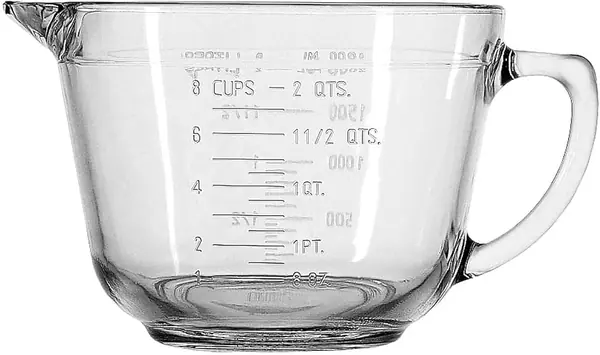
Clear Anchor Hocking glass batter bowl with handle, spout, and measurement lines

Pouring batter

Bake Score 95/100
Capacity
2 quarts
Weight
3.5 lb
Features
Embossed measurements and molded spout
Oven Limit
Up to 425°F
View on Amazon

A batter bowl earns its name at the pour. The Anchor Hocking 2-Quart has a molded spout and a handle, so pancake batter, cake batter, or a custard can go from bowl to pan without a ladle or a funnel.

That is why this is our pick for pouring, and why it stays out on weekend mornings. The embossed lines let us measure and mix in the same vessel, which cuts down on dishes, and the extra-thick glass feels substantial in the hand. It is rated for a preheated oven up to 425°F, plus the microwave, fridge, freezer, and dishwasher.

The trade-off is weight. At 3.5 pounds empty, this is not a bowl you carry across the kitchen with one hand once it is full. We set it on the counter and use the handle to steady the pour rather than to lift the whole batch.

For a single 2-quart bowl, the spout and handle are the whole argument. We keep it within arm's reach when the recipe is more about pouring than folding, and that is the clearest endorsement we can give it.

Our Verdict

We reach for this Anchor Hocking bowl when the batter has to be poured, not spooned; the spout and handle earn their keep.

Check Latest Price
4

Anchor Hocking 1.5-Quart Mixing Bowl Best for Small Kitchens

Clear Anchor Hocking tempered glass mixing bowl with round rim and deep sides

Small kitchens

Bake Score 92/100
Capacity
1.5 quarts
Care
Dishwasher safe
Material
Tempered glass
Dimensions
7.25"W x 3.65"H
View on Amazon

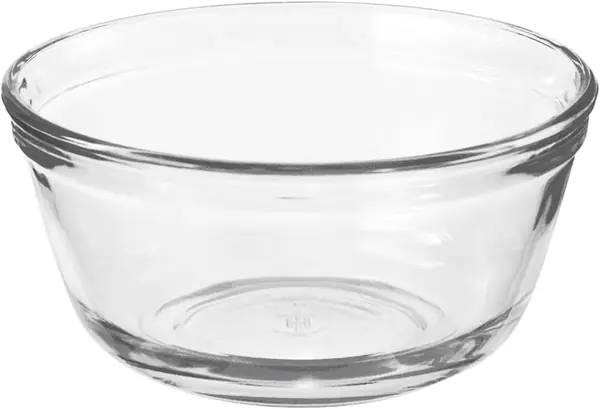
If your cabinet has room for one bowl, not a set, the Anchor Hocking 1.5-Quart is the size that fits the most jobs. At 7.25 inches wide and 3.65 inches tall, it tucks into a crowded shelf and still has enough room for a box of brownie mix or a small batch of dough.

We like that it is tempered glass and dishwasher-safe, and that the glass is non-reactive with ingredients. It works in the microwave and oven, and the clear sides make it easy to see when a small batch is combined. At 1.6 pounds, it is light enough to lift with one hand.

The simple round shape is easy to scrape with a spatula, and there is no handle or spout to clean around. We used it for a small batch of pancake batter and for reheating soup; it did both without crowding the counter.

The 1.5-quart is the bowl we reach for when the recipe is small and the sink is already full. It earns its place as the bowl that stays on the counter for cereal, soup, or a quick vinaigrette.

Worth Noting

  • Too small for double batches
Our Verdict

This is the right glass bowl for a small kitchen or a single recipe, provided you are not trying to mix a double batch.

Check Latest Price

How We Tested Glass Mixing Bowls

We started by pulling every glass mixing bowl and bowl set we could find from the brands that make their own tempered glass, then filtered for construction, a genuinely useful spread of sizes within a set, and whether the bowls nested without wedging themselves together. That left 12 bowls, which moved into a real kitchen for six months: weekend pie dough, weeknight marinades, butter melted in the microwave, salads tossed at the table and carried straight to the porch.

Each one got weighed empty on a kitchen scale, then filled and lifted one-handed with a hand mixer running to see how the weight carried. We measured working capacity separately by filling to a comfortable mixing line rather than the lip, because the number on the box nearly always measures to the rim, and we kept track of which sizes in a set we actually reached for — a few sets turned out to be two useful bowls and two that never left the cabinet.

For durability, we poured near-boiling water into bowls pulled straight from the fridge, knocked each one off the counter empty and full to see where it landed and whether the rim chipped, and nested and separated them a few dozen times looking for hairline cracks at the base. For cleaning, we smeared on cold butter and leftover tomato sauce, let them sit overnight, then washed some by hand and some in the dishwasher and checked for clouding and grease film. The bowls rated for oven and freezer use got used that way too, since a bowl that only mixes is doing half the job.

How to Choose Glass Mixing Bowls

Match capacity to your usual batches

Most home baking happens between 1 and 2.5 quarts. A 1-quart bowl handles muffin mix, a small salad, or a few eggs; 1.5 to 2 quarts covers cake batter and a single loaf; 2.5 quarts gives a double batch of cookies room to fold. Bread bakers should add a 4-quart bowl for folding room.

We prefer three useful sizes to five that overlap. The Pyrex Essentials set covers prep through most batters with 1-, 1.5-, and 2.5-quart bowls; the larger Pyrex set adds a 4-quart for big doughs and storage. Size up only when you know you need the capacity.

Decide whether you need lids

Lids turn a mixing bowl into a storage container, but they also add parts to match, wash, and store. If you routinely cover dough, marinate, or put leftovers in the fridge, a set with a lid for every bowl is worth the cabinet space. The Pyrex 4-Piece Set is the clear example here: the 1-, 1.5-, 2.5-, and 4-quart bowls each get a color-coded lid, so the set can replace a few storage containers.

The trap is assuming every lid fits every bowl in a set. Match the lid to the bowl's model number or size, and check whether the lids are top-rack dishwasher-safe. If you mostly mix and serve, a lidless set nests more simply and gives you one less thing to hunt for.

Weigh the bowl before you fill it

Glass is stable and non-reactive, but it is heavy. A 3.5-pound batter bowl is fine on the counter; once it is full of pancake batter, it is a two-hand lift. That is the trade-off behind the Anchor Hocking Batter Bowl: the handle and spout give you control at the pour, but the bowl is not the one to carry across the kitchen when full. We treat the handle as a pouring aid, not a carrying handle.

For dense dough, a wide, heavy bowl that stays put is more useful than a handle. For pancakes, waffles, and custard, a spout saves cleanup. Decide which motion you do more often, then choose the shape that supports it.

Check the oven and temperature limits

Not every glass mixing bowl is rated for the same heat. The Anchor Hocking Batter Bowl is listed for a preheated oven up to 425°F. Read the manufacturer's limit before you put a bowl in the oven, and keep it off the stovetop and out from under the broiler unless the maker explicitly says otherwise.

Sudden temperature changes are the other risk. A bowl that has been in the fridge or freezer should come closer to room temperature before it goes into a hot oven. Those habits matter more than the brand name on the glass.

Frequently Asked Questions

Final Verdict

The Pyrex Essentials 3-Piece Set is the one we recommend to most people: three sizes that cover prep, batters, and dough, with glass that moves from microwave to oven to dishwasher. If leftovers are part of your routine, the Pyrex 4-Piece Set is the better choice because every bowl gets a lid. For pancakes and waffles, add the Anchor Hocking Batter Bowl; its spout and handle make the pour cleaner, even if the bowl is heavy when full.